This Hathor: Cette divinité à tête de vache (parfois elle n'en possède que les oreilles) protège les femmes et les défunts, car elle est assimilée à la déesse de l'Occident; elle est aussi déesse de la musique.
Aux heures héroiques de l'histoire de l'égyptologie, pionniers, chercheurs et voyageurs reconnurent l'importance du site.
On y vénérait aux origines le dieu Khentamenti; mais en Xle dynastie, le roi Antef, pour des raisons que l'on suppose plus politiques que strictement religieuses, y imposa le culte d'Osiris, qui devint Osiris-Khentamentiou, Osiris Chef des Occidentaux
Occident: c'est le royaume des morts (les âmes des défunts vont là où le soleil se couche).
et Seigneur d'Abdjou. Dès cette même XIe dynastie, le nome
nome : Mot d'origine grecque désignant les provinces administratives (il y en eut de 38 à 42, selon les époques).
et sa capitale acquirent une importance considérable, bénéficiant du support croissant que les rois accordèrent au développement des mythes osiriaques
Osiris: Epoux d'Isis, il engendra, après avoir été tué par son frère Seth, un fils, Horus qui, devenu adulte, le vengea. Il est représenté avec sa couronne atef, le sceptre béqua et le fouet nekbekb.
: à en croire les exégètes, c'est à Abydos qu'aurait été déposée la tête même du dieu, assassiné et dépecé par son frère Seth. A l'occasion des grandes fêtes annuelles et bisannuelles, des foules de pèlerins venus de tous les nomes du royaume convergeaient aux abords du grand temple, et s'associaient à la célébration des mystères divins, à l'affrontement d'Osiris et de Seth, à la mise à mort du dieu par son propre frère, à son démembrement, à la douleur et à la colère d'Isis, à sa quête des restes épars de son époux, aux funérailles et à la résurrection du Justifié enfin, qui reprenait place à la tête de ses sujets et de ses domaines. Certains épisodes de cette passion se jouaient en plein air, avec la participation active, et sans doute tapageuse, des hordes de pèlerins. D'autres, plus secrets ou de portée plus hermétique, se déroulaient à l'intérieur même du temple, avec pour seuls acteurs les prêtres et les desservants.
Au terme de ce que l'on en est venu à appeler au fil des dynasties le Festival d'Osiris, et avant de reprendre le chemin de leurs provinces, les pèlerins prirent coutume de déposer aux pieds du dieu un témoignage de leur foi, humbles ex-voto de limon séché, statuettes, stèles, chapelles, ou s'ils étaient rois, temples à part entière.
En XIXe dynastie, Abydos était au faîte de sa gloire: le grand Séthi Ier y fit alors pèlerinage et dédia lui aussi à Osiris son présent, l'Auguste Château des Millions d'Années
Châteaux des millions d'années : Sur la rive occidentale de Thèbes, les pharaons des XVIIIe, XIXe et XXe dynasties se font construire de grands monuments culturels appelés improprement "temples funéraires". En réalité ils s'en servaient de leur vivant pour le culte du roi divinisé associé à Amon, la principale divinité thébaine; les anciens Egyptiens préféraient à juste titre le terme de "châteaux des millions d'années"
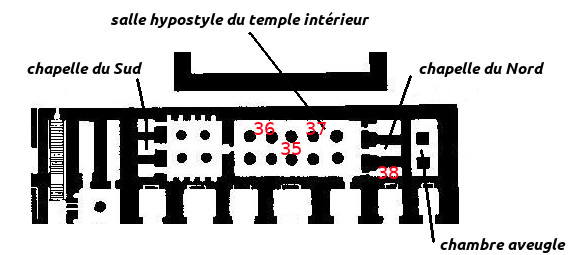
du Roi Menmaatre, l'un des lieux saints les plus parfaits, mais aussi l'un des plus déconcertants d'Egypte.
Pèlerinage à Abydos: les étapes sont numérotées de 1 à 8. Le parcours "initiatique" doit se faire, dans l'ordre croissant des étapes.
This
Au début de ce que l'on appelle l'époque prédynastique (3300-2920 av. J.-C.), la population s'est regroupée en deux centres : un au Nord, dans la région du Delta, l'autre au Sud, à Hiérakonpolis, où sont attestés des souverains tels que le roi Scorpion et Narmer. Celui-ci, le dernier roi de l'époque prédynastique, conquit la Basse-Egypte et unifia le pays, sans doute après plusieurs guerres. Son successeur Aha - que l'on peut probablement identifier avec le légendaire Ménès - fonda la 1ère dynastie (du mot d'origine grecque dunamis = force). Les deux premières dynasties sont aussi appelées thinites parce que, d'après l'historien grec Manéthon - auquel on doit un classement de tous les souverains égyptiens en trente lignées -, les rois de cette époque provenaient de la ville de This, dont on n'a jamais retrouvé la moindre trace, mais qui devait se situer dans la région d'Abydos.This
fut rebaptisée Abdjou, que les Grecs transcrivirent en Abydos. Quittant ThèbesThèbes
Thèbes: Avec la XVIIIe dynastie (env. 1550-1295 av. J.-C.), fondée par Ahmosis, la ville d'Ouaset, plus connue sous le nom grec de Thèbes, devint le coeur du pays. C'est à cette époque que le grand temple d'Amon de Karnak devint le plus grand centre religieux du pays et que furent creusées les nécropoles royales de la Vallée des Rois et de la Vallée des Reines.Thèbes
pour descendre le Nil, dépassant Dendérah
Dendérah
Dendérah était la capitale du VIe nome de Haute-Egypte, et sa nécropole abrite des tombeaux creusés entre l'époque prédynastique et la fin de l'Ancien Empire. Ce site doit sa notoriété au célèbre temple d'Hathor, qui remonte à l'époque gréco-romaine. Dendérah était dédiée à Hathor, une des plus anciennes divinités égyptiennes, représentée sous la forme d'une vache ou d'une femme avec des oreilles de vache.Dendérah
où régnait Hathor
Hathor
 Hathor: Cette divinité à tête de vache (parfois elle n'en possède que les oreilles) protège les femmes et les défunts, car elle est assimilée à la déesse de l'Occident; elle est aussi déesse de la musique.
Hathor
, le voyageur aborde bientôt Baliana, d'où il peut atteindre par voie de terre Arabat el-Madfouneh, le maigre hameau qui garde l'entrée au site de l'antique Abydos. A la limite du désert, il découvrira les vestiges de la ville sainte:
- un temple votif consacré à Osiris par Séthi Ier.
OsirisEpoux d'Isis, il engendra, après avoir été tué par son frère Seth, un fils, Horus qui, devenu adulte, le vengea. Il est représenté avec sa couronne atef, le sceptre béqua et le fouet nekbekb.OsirisSéthi IerMenmaatre Séthi Ier (1312 - 1298 av. J.-C.) compte parmi les grandes figures de l'histoire des souverains du Double-Pays. Fils de Ramsès Ier, fondateur de la XIXe dynastie, il fut le père de Ramsès II et le premier de toute cette lignée de pharaons absolutistes qui se succédèrentsur le trône jusqu'à l'extinction de la XXe dynastie, jusqu'à Ramsès XI qui, épuisé par un héritage trop lourd, mourut misérablement en 1085 av. J.-C.
De fait, Séthi n'était pas né pour le pouvoir: Horemheb, le dernier représentant de la XVIIIe dynastie, n'ayant pas d'enfants, l'aurait distingué parmi d'autres pour son intelligence et pour sa détermination; mais, craignant d'imposer à l'Egypte et aux partis en cause un candidat trop brillant qu'ils auraient sans doute contré, il eut la subtilité de désigner son père Ramsès, un général de carrière originaire de Tanis, alors vieilli et usé. Le haut clergé et la cour applaudirent à ce choix, sûrs qu'ils étaient de pouvoir mener à leur guise un roi sans ambition et sans ressort. A sa mort deux ans plus tard, et à l'avénement de son fils Séthi, ils comprirent enfin qu'Horemheb leur avait trouvé leur maître.
Sans songer vainement à regagner le prodigieux empire asiatique que s'était taillé deux siècles auparavant le pharaon Thoutmosis III, admettant donc implicitement que l'incurie de ses prédécesseurs immédiats, d'Amnophis IV Akhenaton en particulier, avait à jamais ruiné les ambitions de l'Egypte en Asie Mineure et laissé les Hittites maîtres du terrain, il limita son action à des campagnes d'assainissement, jusqu'aux portes des royaumes qui étaient restés fidèles à sa cause. Au passage, il défit implacablement les Bédouins de la Palestine méridionale en révolte, mâta une coalition des princes cananéens obscurément soutenus par les Hittites, et rétablit son autorité jusqu'à la hauteur de Tyr.
A l'intérieur même de son royaume, Séthi fut un administrateur sage et modéré, un souverain éclairé, qui sut faire oublier les errances des règnes précédents; l'Egypte ne se souvint bientôt plus qu'elle avait frôlé la guerre civile.
Soucieux de restaurer l'image royale dans toute sa gloire, Séthi fut aussi un grand bâtisseur: il savait que la pierre a la mémoire plus longue que les hommes. On lui doit donc quelques-unes des réalisations les plus éblouissantes de toute l'histoire d'Egypte, et en particulier la salle hypostyle du grand temple d'Amon de Karnak qui demeure aux siècles des siècles sans rivale. Nombre de sanctuaires de Moyenne et de Haute-Egypte sont marqués de son cartouche, preuve qu'il eut à coeur de les restaurer, de les agrandir, de les embellir. Songeant à son propre destin d'éternité enfin, il se fit creuser à la Vallée des Rois le plus vaste hypogée recensé, et élever au lieu dit Gournah, à la limite des terres arables et de la zone désertique, un temple funéraire qui fut sans doute, à son image, majestueux; hélas, éprouvé par le temps et par les hommes, pillé par tous ceux qui réemployèrent ses blocs à leurs propres fins, il se limite aujourd'hui à une salle hypostyle, à un vestibule et à un pronaos béant sur le désert d'Occident. A sa tombe et à son temple, Séthi ajouta, comme pour prendre pied dans le royaume d'Osiris, ses fondations abydéniennes.Séthi Ier - l'Osireion, conçu comme le tombeau même du dieu.
- un second temple, au cartouche
cartoucheBoucle de corde, avec un noeud à la base, à l'intérieur de laquelle était inscrit le nom du pharaon. Le cartouche, symbole du pouvoir universel du dieu soleil - donc du pharaon - est réservé aux deux noms les plus importants parmi les cinq que portait le souverain.cartouchede Ramsès II.
- plus loin les fondations de monuments remontant aux Ancien, Moyen et Nouvel Empires, sanctuaires et tombeaux.
Aux heures héroiques de l'histoire de l'égyptologie, pionniers, chercheurs et voyageurs reconnurent l'importance du site.
Abydos
Abydos fut, au cap du IIIe millénaire av. J.-C., le fief des souverains des deux premières dynasties; la ville portait alors le nom de This. Plus tard, et probablement dès les premières heures de l'Ancien Empire, alors que Djéser faisait de Memphis sa capitale, This fut rebaptisée Abdjou, que les Grecs transcrivirent en Abydos.On y vénérait aux origines le dieu Khentamenti; mais en Xle dynastie, le roi Antef, pour des raisons que l'on suppose plus politiques que strictement religieuses, y imposa le culte d'Osiris, qui devint Osiris-Khentamentiou, Osiris Chef des Occidentaux
Occident: c'est le royaume des morts (les âmes des défunts vont là où le soleil se couche).
et Seigneur d'Abdjou. Dès cette même XIe dynastie, le nome
nome : Mot d'origine grecque désignant les provinces administratives (il y en eut de 38 à 42, selon les époques).
et sa capitale acquirent une importance considérable, bénéficiant du support croissant que les rois accordèrent au développement des mythes osiriaques
 Osiris: Epoux d'Isis, il engendra, après avoir été tué par son frère Seth, un fils, Horus qui, devenu adulte, le vengea. Il est représenté avec sa couronne atef, le sceptre béqua et le fouet nekbekb.
: à en croire les exégètes, c'est à Abydos qu'aurait été déposée la tête même du dieu, assassiné et dépecé par son frère Seth. A l'occasion des grandes fêtes annuelles et bisannuelles, des foules de pèlerins venus de tous les nomes du royaume convergeaient aux abords du grand temple, et s'associaient à la célébration des mystères divins, à l'affrontement d'Osiris et de Seth, à la mise à mort du dieu par son propre frère, à son démembrement, à la douleur et à la colère d'Isis, à sa quête des restes épars de son époux, aux funérailles et à la résurrection du Justifié enfin, qui reprenait place à la tête de ses sujets et de ses domaines. Certains épisodes de cette passion se jouaient en plein air, avec la participation active, et sans doute tapageuse, des hordes de pèlerins. D'autres, plus secrets ou de portée plus hermétique, se déroulaient à l'intérieur même du temple, avec pour seuls acteurs les prêtres et les desservants.
Au terme de ce que l'on en est venu à appeler au fil des dynasties le Festival d'Osiris, et avant de reprendre le chemin de leurs provinces, les pèlerins prirent coutume de déposer aux pieds du dieu un témoignage de leur foi, humbles ex-voto de limon séché, statuettes, stèles, chapelles, ou s'ils étaient rois, temples à part entière.
En XIXe dynastie, Abydos était au faîte de sa gloire: le grand Séthi Ier y fit alors pèlerinage et dédia lui aussi à Osiris son présent, l'Auguste Château des Millions d'Années
Châteaux des millions d'années : Sur la rive occidentale de Thèbes, les pharaons des XVIIIe, XIXe et XXe dynasties se font construire de grands monuments culturels appelés improprement "temples funéraires". En réalité ils s'en servaient de leur vivant pour le culte du roi divinisé associé à Amon, la principale divinité thébaine; les anciens Egyptiens préféraient à juste titre le terme de "châteaux des millions d'années"
du Roi Menmaatre, l'un des lieux saints les plus parfaits, mais aussi l'un des plus déconcertants d'Egypte.
Abydos
Pionniers, chercheurs et voyageurs
Pendant près d'un siècle, les plus grands noms de l'Egyptologie s'y illustrèrent, et concoururent à en ressusciter la splendeur première.
- En plein XVIIIe siècle déjà, Claude-Etienne Savary
Claude-Etienne SavaryComme le raconte Jean Vercoutter dans son livre (p 36-38 Gallimard "A la recherche de l'Egypte oubliée" ) Parmi les voyageurs qui ont précédé de quelques années le débarquement de l'armée française à Alexandrie en 1798, deux doivent être évoqués en raison de l'influence que leurs récits vont exercer sur les savants qui accompagnèrent Bonaparte : Savary et Volney.
Savary
Savary, né à Vitré, voyage pour son plaisir. Il reste au Caire de 1776 à 1779 et, quoi qu'il ait dit, il ne dépasse pas les environs de cette ville. Ses Lettres écrites d'Egypte ont trait davantage à l'Egypte moderne qu'aux monuments antiques, qu'il décrit d'après les auteurs classiques ou en empruntant à Maillet ( Consul général de France en Egypte sous Louis XIV ) et Sicard (supérieur de la mission des Jésuites au Caire qui parcourt vraiment toute l'Egypte et en dresse la première carte).
Volney
Volney, né à Craon, en Mayenne, en 1757 s'appelle en réalité Chasseboeuf. Après de solides études classiques à Angers, Volney s'est installé à Paris, où il a fait sa médecine tout en publiant, à vingt ans à peine, un Mémoire sur la Chronologie d'Hérodote. Il part, sac au dos, fusil à l'épaule et autour des reins une ceinture de cuir contenant 6000 francs en or. C'est sans doute dans cet équipage qu'il débarque à Alexandrie en 1782. Son Voyage en Syrie et en Egypte ne contient aucune description de l'Egypte, bien qu'il y soit resté 7 mois. Et cependant il mérite d'être cité car il a été très lu par les savants de l'Expédition d'Egypte qui ont été frappés par ses remarques sur les antiquités.Claude-Etienne Savaryy avait fait escale: "En marchant pendant une heure vers L'Occident, on découvre les débris d'Abydus, où Ismandès bâtit un temple magnifique en l'honneur d'Osiris: c'étoit le seul de l'Egypte, où les chanteurs et les musiciens eussent défense d'entrer. Cette ville, réduite en un simple village sous l'empire d'Auguste, ne présente de nos jours que des monceaux de ruines sans habitants; mais à l'Occident de ces ruines on retrouve encore le monument célèbre d'Ismandès. On entre d'abord sous un portique élevé d'environ soixante pieds, et soutenu par deux rangs de grosses colonnes. La solidité inébranlable de l'édifice, les grandes masses qui le composent, les hiéroglyphes dont il est chargé, font reconnoître l'ouvrage des Anciens Egyptiens." - Les savants de l'Expédition d'Egypte y effectuèrent, mais de façon sommaire, les premiers relevés des vestiges les plus accessibles. Edme Jomard en rend compte au Tome IV du Recueil des Observations et des Recherches de la Description de l'Egypte :"L'intérieur de l'édifice est dans un état parfait de conservation. Les sculptures, et les couleurs dont elles étaient revêtues, sont presque intactes, et l'on admire le vif éclat du bleu et des autres nuances qui composent les peintures, comme si elles étaient fraîchement exécutées. (...) La décoration, remarquable par la richesse des couleurs, est d'une grande simplicité sous le rapport des formes architecturales. On trouve peu de variété dans les colonnes, dans les chapiteaux et les corniches. Partout ailleurs il y a, entre ces différents membres d'architecture, une grande diversité de proportions, de caractère et de grandeur absolue, qui les fait contraster et balancer ensemble, dans les différentes salles des édifices, avec plus ou moins d'harmonie, sans cependant que les dispositions symétriques soient jamais violées. Ici, la symétrie règne seule, et il semble que l'architecte ait voulu à dessein être sobre d'ornements pour faire mieux ressortir les sculptures, les reliefs ou les peintures à fresque, dont les murs et les plafonds sont couverts".
- Quelque trente ans plus tard, Champollion passa devant Baliana, mais ne s'y arrêta pas, tout comme, à la même époque ou presque le vaudois Charles Gleyre, dessinateur et chroniqueur précieux, dont les crayons et les aquarelles sont conservés au Musée cantonal des Beaux-Arts de Lausanne. La proximité de Thèbes semble leur avoir fait à tous deux brûler les étapes !
- Les premières fouilles scientifiques furent dirigées par Mariette,
MarietteComme le raconte Jean Vercoutter dans son livre (p 102-106 Gallimard "A la recherche de l'Egypte oubliée")
"En 1842, le français Auguste Mariette est professeur au collège de Boulogne,lorsqu'on le charge de classer les papiers et les notes de son cousin Nestor l'Hôte, le dessinateur de Champollion, qui vient de mourir. En regardant ces admirables dessins, il sent soudain une attirance irrésistible pour l'Egypte. Il faillit renoncer à l'étude des hiéroglyphes qu'il a entrepris seul, à l'aide de la Grammaire et du Dictionnaire de Champollion. Il persévère et entre en correspondance avec Charles Lenormant et Emmanuel de Rougé, successeurs de Champollion dans la chaire d'égyptologie du Collège de France.
Mariette, alors marié et père de famille, décide d'abandonner la sécurité de son emploi à Boulogne pour se lancer dans l'aventure égyptienne. Ses protecteurs parisiens lui obtiennent un poste des plus modestes au musée du Louvre : il fait des étiquettes et touche 166,66 francs par mois!
En 1850, on lui confie une mission pour aller en Egypte acheter des manuscrits coptes. Le moment est mal choisi: peu auparavant, deux Anglais ont visité les monastères coptes du Ouadi Natroun, ils ont enivré les moines à l'alcool et se sont fait donner - sans les payer - un nombre considérable de manuscrits. Le patriarche copte, indigné, n'est donc nullement disposé à laisser un étranger pénétrer de nouveau dans les couvents. Lorsque Mariette arrive, il se voit refuser toute autorisation d'entrer dans les couvents.
Désoeuvré, Mariette décide d'abandonner la mission dont il est chargé et d'employer les fonds qui lui ont été confiés à tout autre chose que l'achat de manuscrits coptes.S'installant à Saqqarah, il aperçoit le 27 octobre 1850, un sphinx à demi ensablé....C'est ainsi que commence la fouille du Serapeum de Memphis, la nécropole souterraine des taureaux Apis. La fouille dure plus de deux ans. Dégageant, sphinx après sphinx, la route qui mène au temple, Mariette n'arrive aux abords du Sérapeum proprement ditque le 11 février 1851, et avec des crédits presque épuisés. Il n'a pas encore soufflé mot de sa découverte. Il se résigne donc à l'annoncer officiellement en France pour obtenir un peu d'argent. A la demande de l'Institut, le Parlement français vote le 26 août 1851, dans l'enthousiasme, un crédit extraordinaire de 30.000 francs pour permettre de poursuivre les fouilles. Dans son ardeur, Mariette a oublié qu'il est en Egypte et que les trouvailles n'appartiennent pas à la France!
La réaction ne se fait pas attendre: ordre lui est donné d'arrêter immédiatement la fouille et de remettre aux agents égyptiens tous les objets découverts jusqu'alors.
De longues discussions s'engagent alors entre l'Egypte et la France. Le 12 février 1852, enfin, le consul général de France obtient la levée de l'interdit: un firman en bonne et due forme autorise la France à reprendre les fouilles ...
Avec l'aide de Ferdinand de Lesseps, alors, occupé à creuser le canal de Suez, Mariette revient en Egypte en octobre 1857. Il est chargé de préparer le voyage en Egypte du prince Napoléon, cousin de Napoléon III, et de réunir pour lui une collection d'antiquités qui lui sera offerte par le nouveau khédive, Said Pacha.Chaleureusement accueilli par Said Pacha, qui lui donne de l'argent et met à sa disposition un bateau à vapeur, Mariette entreprend aussitôt des fouilles: à Gizeh, Saqqarah, Abydos, Thèbes, Eléphantine.Le 1er juin 1858, Mariette est nommé Maamour, directeur des travaux d'antiquités en Egypte. Le vice-roi Said Pacha lui donne tous les moyens et tous pouvoirs.Mariettedans les années 1860-1863. Grâce à l'appui financier du gouvernement français, elles furent publiées sous le titre de Fouilles exécutées en Egypte, en Nubie au Soudan, d'après les Ordres du Vice-Roi, avec pour sous-titre Première Série- Gébel Barkal, Abydos. Le texte en est de Mariette et de ses assistants, et les planches du graveur Devéria. Deux volumes additifs parurent respectivement en 1869 et 1880. Quinze ans plus tard, Amélineau remplaça Mariette sur le terrain, et consacra ses efforts sur la zone Ouest du site, au lieu dit Omm el-Qaab: c'est alors que la grande nécropole thinite fut mise au jour. - Les missions anglaises dirigées par Sir Flinders Petrie succédèrent aux Français dès les premières années du XXe siècle. Au Nord du temple votif de Séthi Ier, et à proximité des arasements d'un sanctuaire remontant, semble-t-il, à l'Ancien Empire, Petrie retrouva, au fond d'un puits, quelques statuettes inestimables, dont celle, en ivoire, d'un souverain inconnu de la période thinite portant la couronne de Haute-Egypte, et, plus précieuse encore, celle du roi Chéops, en ivoire également, haute de sept centimètres: dans l'état actuel de nos connaissances, il s'agit de la seule image recensée du plus grand bâtisseur de toute l'histoirede l'Egypte.
- A la suite de Petrie, Ayrton, Curelly et Weigall désensablèrent d'autres fondations isolées, parmi lesquelles les cénotaphes de Sésostris III et d'Ahmose. L'Osireion, lui, fut identifié et dégagé par Miss M. Murray, et fouillé de 1912 à 1914 par l'Egypt Exploration Society, alors dirigée par Naville. Pour remettre en valeur le temple votif de Séthi Ier et ses abords immédiats, les campagnes se succédèrent jusqu'en 1954.
Pionniers, chercheurs et voyageurs
Pèlerinage à Abydos: les étapes sont numérotées de 1 à 8. Le parcours "initiatique" doit se faire, dans l'ordre croissant des étapes.
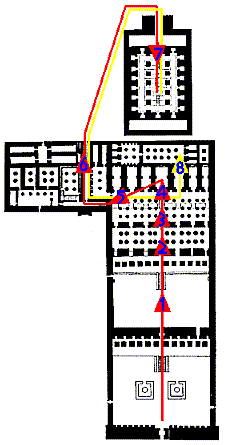
Pèlerinage à Abydos: les étapes sont numérotées de 1 à 8. Le parcours "initiatique" doit se faire, dans l'ordre croissant des étapes.
 Petite chapelle en pierre ou en bois qui se trouvait à l'intérieur du sanctuaire et où l'on conservait l'effigie du dieu.
 Entrée monumentale des temples, constitué par un portail entre deux énormes môles trapézoidaux.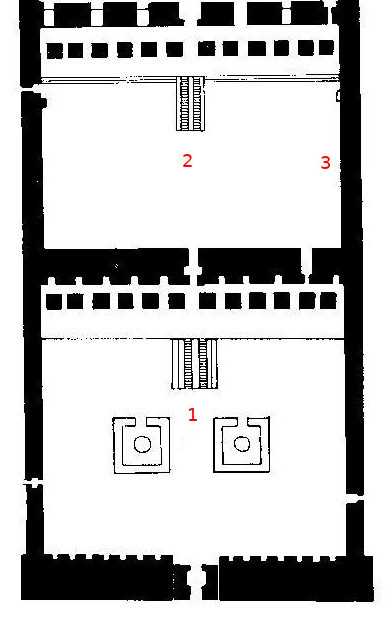
 Personification divine de l'ordre cosmique, rattachée secondairement aux concepts de vérité et de justice. Elle porte sur la tête une plume d'autruche,transcription de son nom.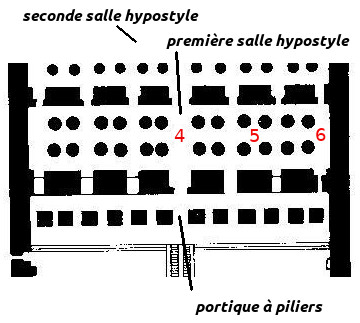
 Pilier, symbole de stabilité et de durée; il représente la colonne vertébrale d'Osiris. C'est aussi une amulette protectrice.
 Epouse d'Amon, vénérée à Thèbes. Primitivement représentée sousla forme d'un vautour, elle prit ensuite un aspect humain.
 Le Roi des dieux est représenté sous les traits d'un être humain (parfois ithyphallique), coiffé d'un mortier surmonté de deux plumes ou, parfois, avec une tête de bélier, l'animal qui lui est consacré. Avec la déesse Mout et le dieu Khonsou, il formait la triade thébaine. Il a été également identifié avec le dieu Rê et vénéré sous le nom d'Amon-Rê. Thèbes était le siège principal de son culte.
 Ptah: Dieu de Memphis, où il était considéré comme le créateur du monde et l'époux de la déesse lionne Sekhmet, il étaitreprésenté comme un homme momiforme avec, dans la main, le sceptre ouas. Il assimila ensuite un autre dieu funéraire de Memphis, Sokaris, et fut vénéré sous sa forme syncrétique, Ptah-Sokaris.

 Dieu du ciel et protecteur du pharaon qui lui est assimilé, Horus pouvait avoir la tête ou tout l'aspect d'un faucon. En tant que fils d'Osiris et d'Isis, il es souvent représenté comme un enfant (Harpocrate) le doigt à la bouche.