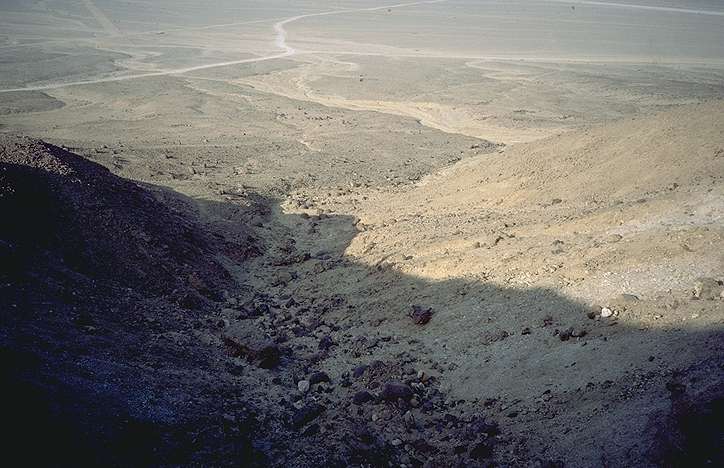
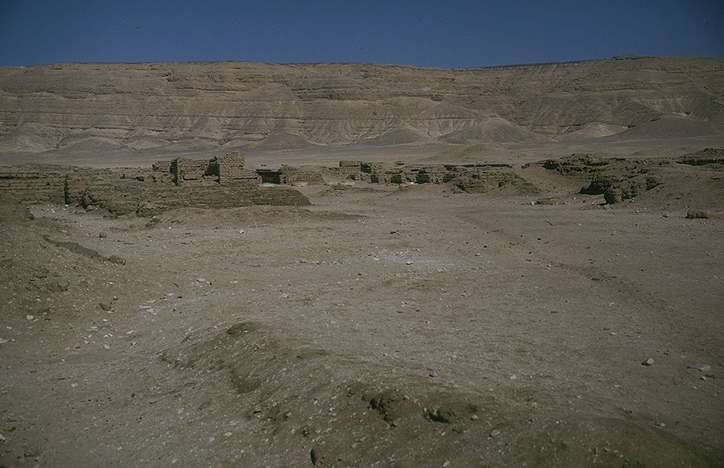
Là il y a bien longtemps, battait le coeur d'une capitale, grouillante de tout son peuple d'ouvriers, d'artisans, de fonctionnaires, de dignitaires et de princes; là s'érigèrent des temples, des palais, des centres administratifs, des magasins; là furent tracées des rues bordées de demeures aux façades blanchies: là surtout, un homme seul, l'un des plus déconcertants de tous ceux dont l'histoire a gardé la mémoire, tenta de vivre son rêve. De ce rêve, plus rien ne subsiste aujourd'hui, si ce ne sont, émergeant du sol, quelques pans de mur et des tronçons de colonnes arasées. Tell el-Amarna, rongée par l'oubli, s'est effacée sous le voile des sables.
L'oubli s'empara aussi de celui qui fut à l'origine de cette épopée désespérée, Aménophis IV Akhenaton. Frappé d'anathème, rayé de toutes les mémoires pendant près de trois mille ans, il fut condamné au néant. Lui qui ne rêvait que de justice universelle, de paix, de contemplation et de ferveur, fut rejeté par ceux mêmes pour lesquels, sa vie durant, il avait lutté. Ses proches, ses parents parfois, son peuple, s'acharnèrent sur sa mémoire, rasant sa capitale, mutilant ses effigies, martelant son nom jusqu'aux parois des tombes qu'il avait pourtant contribué à faire creuser. Car on ne lui pardonna jamais d'avoir osé défendre la dignité de l'homme, d'avoir affirmé son identité.
La haine de ses contemporains porta ses fruits: aucune des sources auxquelles nous avons coutume de nous référer, listes royales ou archives, ne mentionne Akhenaton ni la Table d'Abydos ni le Papyrus royal de Turin, ni même la Chronologie de Manéthon.
Or, en 1969, préfaçant l'une des grandes monographies consacrées au drame amarnien, Cyril Aldred pouvait écrire : « Le personnage de Cléopâtre mis à part, aucun souverain de l'ancienne Egypte n'a peut-être fait couler autant d'encre de la plume des historiens, archéologues, moralistes, romanciers et amateurs divers que le pharaon Akhenaton». La réhabilitation d'Akhenaton est le fait de tous ceux qui, par leurs travaux, par leur passion surtout, contribuèrent à conjurer la vieille malédiction : aujourd'hui, le roi a retrouvé sa place parmi les grands novateurs de la conscience universelle.
Les voyageurs du XIXe siècle, pour la plupart du moins, ne s'y arrêtèrent guère. Nestor l'Hôte se borna à dessiner quelques-unes des stèles-frontières 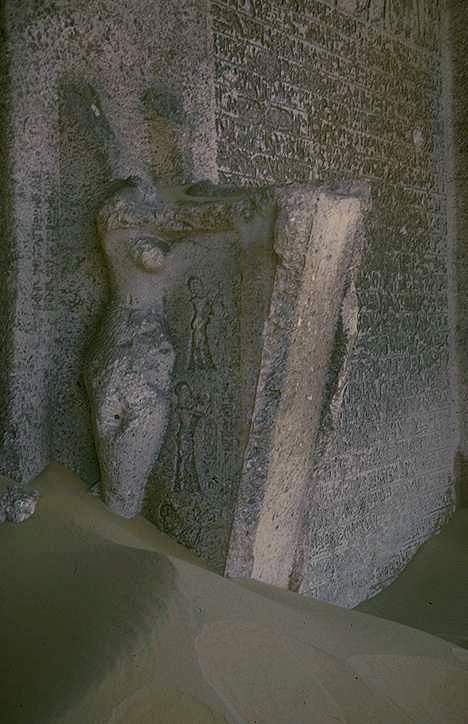 qu'il découvrit dans le désert avoisinant. Enfin, la grande expédition prussienne dirigée par Richard Lepsius fit étape sur le site en 1843. Dans les Denkmäler aus AEgyten und AEthiopen parus de 1849 à 1859, où furent rassemblés tous les relevés que les dessinateurs de l'équipe exécutèrent sur les monuments de la vallée du Nil, la troisième division (Band VI, Blätter XCI-CLXXII) consacre vingt-et-une planches aux vestiges d'Amarna. Le public savant de l'époque put alors découvrir, et avec quelle stupeur, l'étrange physionomie du roi proscrit. Rendus avec l'implacable sécheresse qui caractérise les travaux scientifiques, on y retrouve les sujets chers aux artistes amarniens: le roi se rendant au temple, salué par la foule massée le long des rues, le roi faisant offrande au Disque, la famille royale dans l'intimité des appartements privés, la remise des récompenses aux hauts fonctionnaires de la cour, et surtout ces représentations des temples et des palais de la cité en plan, ou plus exactement en plan et en élévation à la fois, synthétiques donc, et qui, de par la minutie de l'observation, permirent aux archéologues d'étayer les découvertes qu'ils firent sur le terrain.
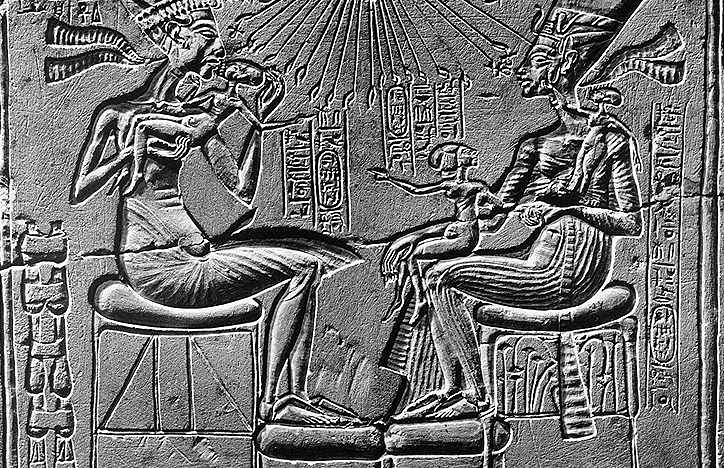
XVIIIe DYNASTIE - La famille royale sous la bénédiction d'Aton - Calcaire - haut. 0,332 - Berlin , Ägyptisches Museum - Cette stèle provient sans doute de l'un des autels domestiques d 'Akhenaton
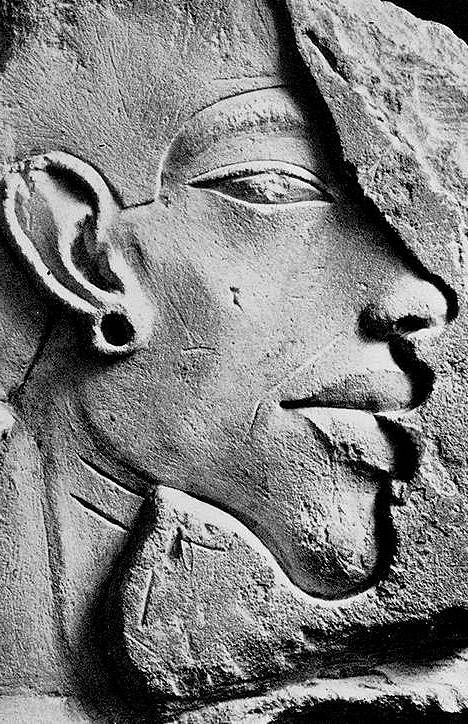
XVIIIe DYNASTIE - Etude de sculpteur pour le profil d'Akhenaton - Calcaire haut. 0,144 - Provenance indéterminée - Berlin Ägytisches Museum
Quinze ans plus tard, un petit ouvrage «traduit librement de l'anglais», mais publié sans nom d'auteur sous le titre de Les Antiquités égyptiennes, présente un canon revu de la succession des rois ; mettant en regard les listes de Manéthon et les «noms des rois (...) trouvés sur les monuments» l'auteur propose, à côté d'Aménophis-Memnon et d'Horus, trois cartouches nouveaux : Aak-en-Aten-Ra ou Amenhept II, frère d'Horus- Titi, sa soeur,femme de Aï - Amountouanch, frère d'Horus. C'est peut-être la première mention moderne du nom d'Aménophis IV Akhenaton, et de ceux de Toutankhamon et de Néfertiti. Bien qu'identifié, Aak-en-Aten, ou Khou-en-Aten, comme on l'appelait alors, continuait à intriguer les érudits. La morphologie singulière du roi, en particulier, donna lieu aux hypothèses les plus invraisemblables: Mariette, dont l'imagination devait bientôt trouver sa pleine mesure dans les méandres du livret d'Aïda, fit d'Akhenaton un esclave soudanais châtré par ses maîtres et hissé sur le trône à la suite d'un dramatique coup d'état ; Lefébure, lui, prétendit qu'Akhenaton était une femme déguisée en homme, qui aurait usurpé le pouvoir royal en succédant à son père Aménophis III, identifié à l'Horus de Manéthon.
Enfin, par un beau matin de juin 1887, une paysanne des environs de Tell-el-Amarna, grattant le sol à la recherche de sebakh, ce composé nitreux qui, dans les villages d'Egypte, sert à entretenir le feu, découvrit au pied d'un mur arasé des centaines et des centaines de tablettes d'argile couvertes de signes mystérieux. Elle en emporta quelques-unes au creux de son voile pour les montrer à ses voisins, puis au fonctionnaire local, détenteur de l'autorité, et donc du savoir. Mais celui-ci, plus préoccupé semble-t-il par le port altier de ses moustaches que par une obscure histoire de briquettes, fit éconduire la quémandeuse. Or notre paysanne tenait à gagner les quelques piastres que lui valait son obstination ; elle chargea donc ses deux ânes et son fils de toutes les tablettes qu'elle put rassembler, et se rendit à Luxor, espérant y rencontrer un mamour moins arrogant. A l'arrivée, hélas, il ne restait plus dans les ballots que quelques dizaines de pièces intactes, le reste ayant été réduit en poussière par les cahots du chemin. Elle en montra deux à un inspecteur qui, prenant enfin l'affaire au sérieux, les fit étudier: à la stupeur générale, il s'avéra qu'on avait mis la main sur les archives diplomatiques de la cour d'Aménophis IV. Lorsque la malheureuse dut avouer l'anéantissement des quatre cinquièmes de son bagage, la déception fut amère. Trois cent cinquante tablettes seulement furent sauvées du désastre. Mais le site était lancé!

Tablette no 23 du British Museum, envoyé par Toushratta - du Mitanni à Aménophis III pour lui annoncer que la déesse - Ishtar de Ninive avait été expédiée en Egypte.
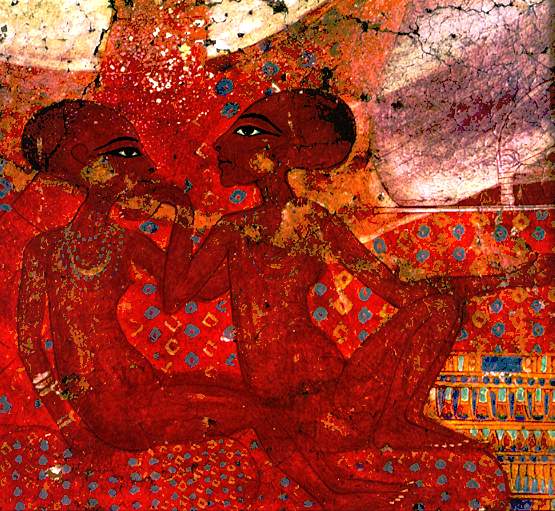
En 1891-1892, Sir Flinders Petrie y entreprit une première saison de fouilles: il dégagea une partie importante du palais royal, les centres administratifs et, plus au Sud, quelques maisons particulières. Il mit ainsi au jour, entre autres, un ensemble unique de peintures profanes qui décoraient les appartements royaux, parmi lesquelles les deux exquises petites princesses, transportées aujourd'hui à l'Ashmolean Museum d'Oxford.
De 1902 à 1923, avec de fréquentes interruptions dues aux conflits internationaux, le site fut occupé par plusieurs missions : l'Egypt Exploration Fund, la Deutsche Orient Gesellschaft, et enfin l'Egypt Exploration Society, sous la direction de J.D.S. Pendlebury, responsable de la publication des fouilles.
Si les travaux exemplaires dès savants qui, ds la fin du XIX siècle, se sont passionnés pour l'époque amarnienne ont permis d'éclairer d'un jour nouveau les aspects essentiels du drame, il n'en reste pas moins que nombre de questions demeurent sans réponse: Akhenaton et les siens savent préserver leur mystère.

XVIIIe DYNASTIE - Tête d'une statue colossale d'Aménophis III - Quartzite - haut. 1,177 - Provient de Luxor - Londres British Museum 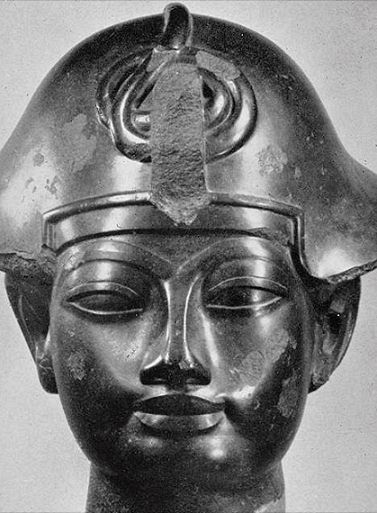
Tête en basalte noir représentant Amenophis III
Vers 1425 av. J.-C., Thoutmosis IV, grand-père d'Akhenaton, avait épousé une princesse mitanienne, qui prit le nom égyptien de Moutemouïa des son arrivée à la cour ; à quelques temps de là, en province, et pour être précis aux environs de l'actuelle Akhmîm, alors chef-lieu du neuvième nome de Haute-Egypte, un hobereau local, Youya, épousait Thouya, sa cousine. Installés à Thèbes quelques mois après leur mariage, Youya et Thouya y firent une enviable carrière de cour: Youya adjoignait à ses fonctions de prophète et d'intendant des Troupeaux de Min celles de lieutenant de la Charrerie et de préposé au Cheval du Roi : Thouya, elle, reçut le titre de supérieure du Harem d'Amon.
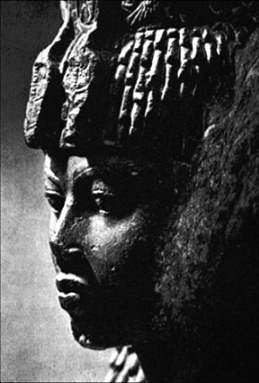
XVIIIe DYNASTIE - Tête d'une statuette de la reine Tiy - Schiste gris - haut. 0,072Provient de la région du Sinai - Le Caire Musée archéologique
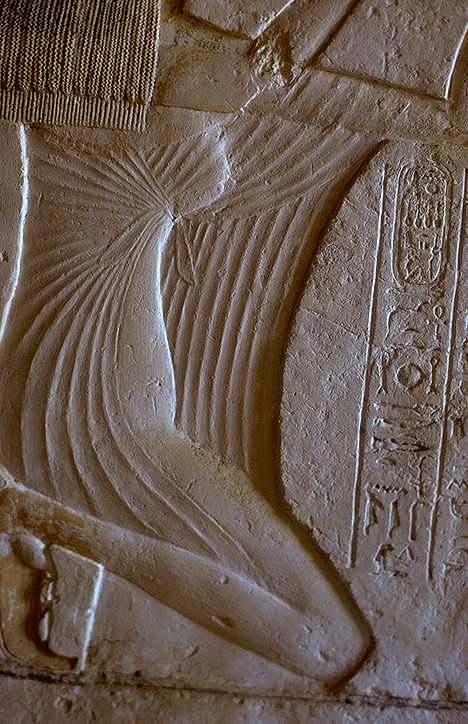
XVIIIe DYNASTIE - Tiy, épouse de Ay, en rohe d'apparat - Bas-relief du premier couloir - Tell el-Amarna, nécropole civile, tombe de Ay
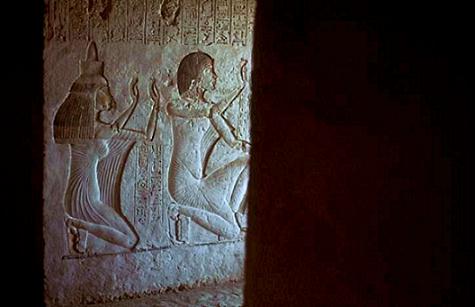
Ay et son épouse en adoration devant Aton - Bas-relief du premier couloir - Tell el-Amarna, nécropole civile, tombe de Ay
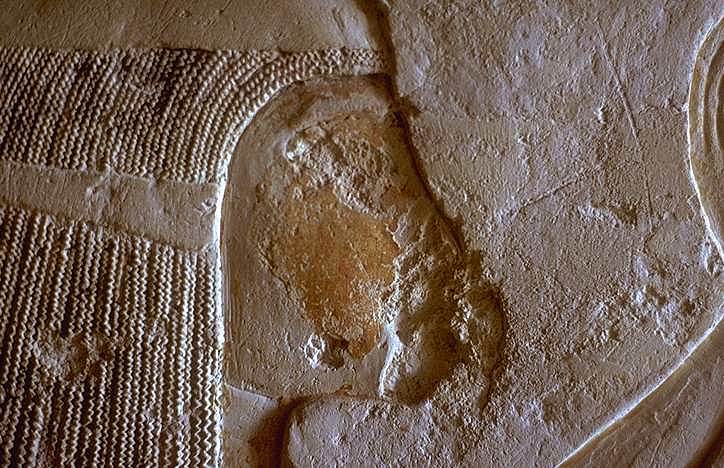
détail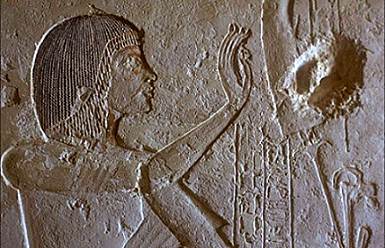
détail
En quelque trente-huit ans de règne effectif, Aménophis III et Tiy eurent de nombreux descendants: un héritier d'abord, Thoutmosis, qui mourut prématurément, puis, Aménophis, le futur Aménophis IV Akhenaton et Semenkhkare; des filles aussi, dont la princesse Sitamon; plus tard, Toutankhamon, qui devait succéder à son frère aîné, et Baketaton, la cadette, «chère au coeur de son père».
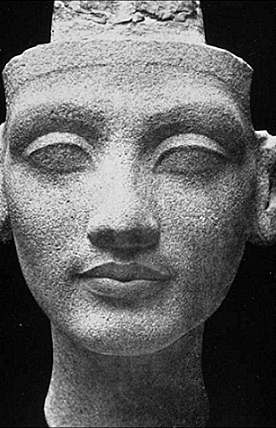
XVIIIe DYNASTIE - Buste inachevé de Néfertiti - Grès - haut 0,292 - Provient de Tell el-Amarna- Berlin - Ce buste, qui porte encore des repères d'artiste au pinceau, a - été dégagé lors des fouilles de l'atelier de Thoutmès à Armana.
Prince héritier, puis corégent, Aménophis épousa, sept mois après sa majorité, la légendaire Néfertiti. Et là encore, un mystère: qui était-elle? D'aucuns veulent l'identifier à Tadouhipa, fille de Toushratta, roi du Mitanni; son origine étrangère se trahirait dans le nom égyptien qu'elle choisit en s'installant en Egypte, Néfertiti, la Belle qui est venue, sous-entendu d'ailleurs. Mais cette hypothèse, si séduisante soit-elle, ne résiste pas à un examen sérieux, car les documents signalent l'arrivée de Tadouhipa à Malagatta en l'an 36 du règne d'Aménophis III, soit bien après le mariage attesté de Néfertiti et d'Aménophis. Les tenants de l'orthodoxie préfereraient en faire une descendante tardive d'Amènophis III et de Tiy. Une princesse donc; car on se souvient que seule une fille de sang royal était jugée digne de s'unir à l'héritier du trône ; mais nulle part il n'est fait mention de Néfertiti en tant que fille de roi. Peut-on imaginer alors qu'elle était née du roi et d'une épouse secondaire? Pas davantage, car si sa mère avait été de haut lignage, Néfertiti n'aurait pas manqué, conformément à l'usage, de citer son nom dans les protocoles, ce qu'elle ne fit jamais. Force nous est donc d'admettre que Néfertiti n'appartenait pas à la famille régnante. Certaines représentations montrent la jeune reine en compagnie de sa nourrice Ti, épouse du Père Divin Ay ; si Ay, l'un des plus hauts personnages de la cour, reçut, en plus des innombrables titres honorifiques et fonctions qu'il cumulait, l'épithète de Père Divin, c'est sans doute qu'il donna le jour à un enfant qui fut associé à la lignée royale. De fait, tout nous porte à croire qu'Ay fut le père de Néfertiti. Le fait que Ti ne soit jamais appelée Mère Divine, mais nourrice ne met pas l'hypothèse en danger, car il est vraisemblable qu'elle fut la seconde épouse d'Ay et qu'elle joua auprès de la jeune reine le rôle d'éducatrice, de mentor. La découverte récente d'une chapelle consacrée par Ay au dieu Min dans la région d'Akhmîm nous permet de faire un pas de plus: le Père Divin était sans doute apparenté à Youya, et de très près ; la similitude de leurs deux carrières, et plus encore leur attachement commun au neuvième nome de Haute-Egypte, nous incitent à penser que Ay fut fils de Youya et donc frère de la reine Tiy. Sans être de sang divin, Néfertiti serait du moins alliée à la famille régnante par son père, puisque nièce de Tiy ; son mariage avec l'héritier du trône serait donc en tous points conforme aux usages égyptiens.
Six filles naquirent de leur union: Méritaton, qui épousa un frère d'Aménophis IV, le prince Semenkhkare, Maketaton, morte au seuil de l'adolescence, Ankhesenpaaton, que l'on donna en mariage au prince Toutankhaton. et qui devint plus tard reine d'Egypte sous le nom d'Ankhesenamon. Néfernéferouaton-Tasheri, Néfernéferoure et Setepenre enfin, dont nous ignorons tout.
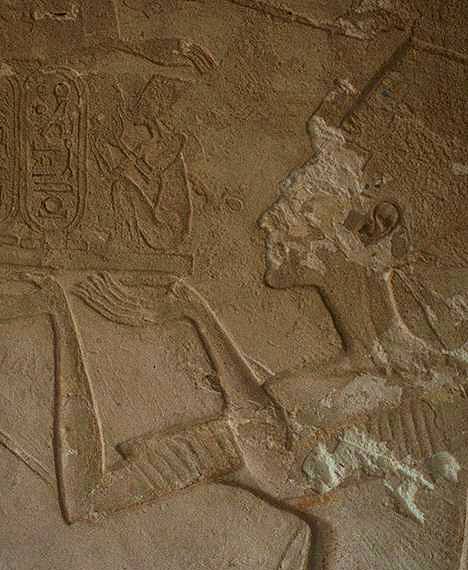
Néfertiti faisant offrande à Aton - Bas-relief de l'antichambre - Tell el-Amarna, nécropole civile, tombe de Mahou
Tout d'abord, Akhenaton n'inventa pas Aton. Le dieu est mentionné dans les Textes des Pyramides déjà, textes dont la rédaction remonte à l'Ancien Empire: Aton y est cité dans les Litanies parmi les avatars de Ra dont il est la manifestation sous la forme du Disque. De plus, on constate que le culte du Disque s'implanta à Thèbes bien avant l'avènement d'Akhenaton: Thoutmosis IV déjà paraît avoir marqué une ferveur particulière pour le vieux dogme héliopolitain ; sans s'avancer jusqu'à prétendre qu'il délaissa le culte officiel d'Amon, on doit noter pourtant qu'il fut le premier des pharaons du Nouvel Empire à se placer sous l'autorité de Ra, et donc à se réclamer d'un système théologique plus que millénaire déjà: en faisant graver entre les pattes du Sphinx de Guizeh la fameuse stèle du Songe, il affirmait devoir son trône à Ra-Harakhty, à Ra des deux Horizons : je te donnerai, dit le dieu, la royauté sur terre à la tête des vivants, tu porteras la Couronne Blanche et la Couronne Rouge. En pleine période d'orthodoxie encore, voilà donc Amon privé de sa prérogative essentielle de désigner lui-même celui qu'il estime être digne de le manifester sur terre, son fils le souverain. Après Thoutmosis IV, Aménophis III alla plus loin encore : on a retrouvé dans les fondations du dixième pylône deKarnak un bloc où le roi est représenté en compagnie du même Ra-Harakhty, qualifié de «Jubilant dans l'Horizon en son Nom de Shou qui est Aton».
Pourquoi ce retour à l'héliopolitanisme? Sans doute de la part des rois, pour tenter d'échapper au clergé d'Amon dont les ambitions se faisaient chaque jour plus insolentes et la mainmise plus lourde ; mais aussi et surtout par un besoin d'authenticité qui se manifesta dans les milieux érudits de la capitale dès la fin de la XVIIIe dynastie. Sousl'influence d'Amenhotep fils de Hapou, lui-même issu des collèges héliopolitains, les anciens écrits furent réétudiès, les vieux rituels remis à l'honneur; on sait ainsi que la célébration du premier jubilé d'Aménophis III donna lieu, des mois à l'avance, à un colossal travail de compilation pour que tout s'accomplît dans le ton juste. Il n'est pas vain de supposer que ces recherches patientes et laborieuses permirent aux théologiens de retrouver la source pure des premiers cultes solaires que le dogme amonien avait depuis longtemps occultée. La restauration de Ra-Harakhty et d'Aton, divinités primordiales, en fut l'inéluctable conséquence.
Dès lors, où réside l'hérésie, si Akhenaton n'a pas inventé Aton, et s'il s'est borné à faire siennes les idées de ses pères? En ceci qu'il prétendit à l'absolu, en se consacrant à la seule célébration d'Aton dont il s'érigea en prophète, adoptant l'épithète de our maou, de Grand Voyant que portaient par tradition les plus hauts pontifes d'Héliopolis. Maître des rites, il s'affirma en manifestation vivante d'Aton, s'identifiant au dieu jusqu'à se faire représenter au cintre des stèles civiles en véhicule unique de la piété populaire. Néfertiti et les filles royales furent par la suite associées au mythe : ces scènes familières qui regroupent le roi, la reine et les princesses dans l'intimité de leurs appartements n'ont rien d'anecdotique; par le biais de la figuration, elles rappellent qu'au-delà de son unité première, Aton est à la fois le père, la mère et l'enfant, soit principe créateur et créature.
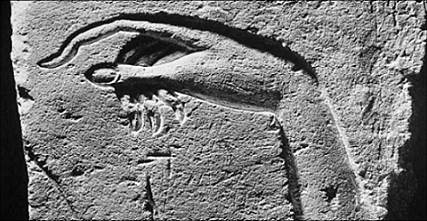
XVIIIe DYNASTIE- Main d'Akhenaton faisant offrande à Aton - Grès - haut. 0,235 - Provient d'Ashmounein - New York, Metropolitan Museum of Art
Né d'Aton, Akhenaton s'arrogea des prérogatives jusqu'alors réservées aux prophètes et aux grands-prêtres, et prétendit même, fait sans précédent dans l'histoire de l'Egypte, guider ses proches dans la voie de la révélation. Nombreux sont les courtisans de Tell el-Amarna qui, dans les stèles qu'ils firent graver à l'entrée de leurs tombeaux, s'enorgueillissent d'« avoir été instruits dans la doctrine par le roi lui-même» ou d'«avoir entendu jour après jour la doctrine de la bouche du roi lui-même».
Dépossédé de ses pouvoirs premiers, le clergé traditionnel entra en conflit ouvert avec le roi. Ce qui aurait pu n'être qu'une heureuse épuration des dogmes se métamorphosa en une farouche lutte de prestige entre partisans de la traditionhéliopolitaine et tenants de l'orthodoxie thébaine, puis entre Ra manifesté sous sa forme d'Aton et Amon et enfin entre le roi et les prêtres. C'est alors qu'éclata le drame, car poussé par les événements, Akhenaton dut adopter une politique plus intransigenate sans doute qu'il ne l'eût souhaité: en l'an IV de son règne, il changea son nom de Amenhotep, Satisfaction d'Amon en Akhenaton, Esprit agissant (c'est-à-dire incarnation) d'Aton.
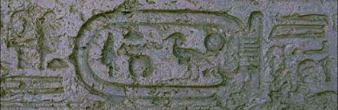
Aak -en-Aten
Moins de deux ans plus tard, il quittait Thèbes et fondait, « en un lieu qui n'appartenait à aucun dieu ni à aucune déesse, à aucun souverain ni à aucune souveraine, où personne n'avait de droit», une nouvelle capitale, un nouvel épicentre de son autorité Akhetaton, Horizon d'Aton.
L'installation de la cour à Tell el-Amarna coïncida avec des troubles d'une extrême gravité à Thèbes: les temples officiels de la vile sainte furent fermés, et leurs prêtres frappés d'interdit ; les représentations d'Amon furent profanées, son non et ses épithètes martelés. Mout son épouse, subit le même sort ; fanatiques jusqu'à l'outrance les partisans n'hésitèrent pas à violer les nécropoles pour y effacer jusqu'au fond des tombes toute mention du dieu honni ; d'autres se hissèrent au sommet des obélisques et y maltraitèrent au ciseau les symboles solaires. On a même trouvé trace ce d'un scribe qui reprit tous les documents d'archive dont il avait la garde pour en rayer rageusement tous les mots présentant quelque analogie avec les vocables d'Amon et de Mout: le mot mout, mère, ne fut même pas épargné! Akhenaton dut même se résoudre à laisser souiller les cartouches de son propre père Aménophis.
Et dire que l'atonisme se voulait une doctrine d'amour!

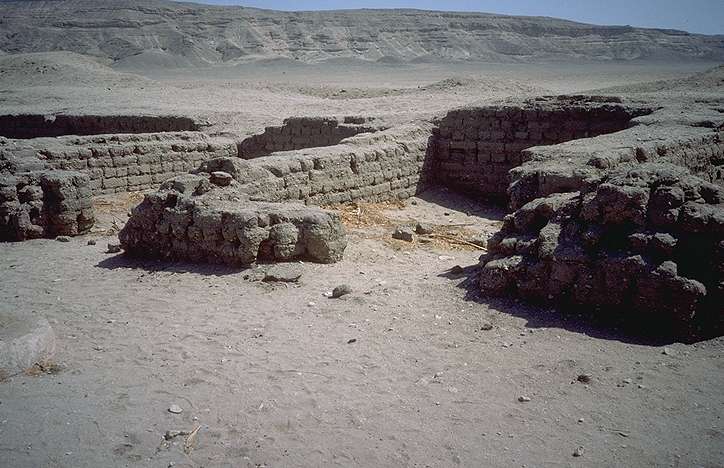
XVIIIe DYNASTIE - Arasements de l'une des cours à colonnes du palais du Nord, dit de Néfertiti - Tell el-Amarna, cité d'Akhenaton
Bien que sauvagement martelées au début de ce siècle seules les stèles-frontières que le roi fit ériger aux limites de son domaine exorcisent le silence : le royaume d'Akhenaton occupait un territoire de «six ater trois quarts de khe et quatre coudées de côté», soit environ treize mille mètres il y est dit que «le roi était monté sur le grand char d'Etat plaqué d'électrum et avait, au jour propice, marqué les limites du lieu qu'il avait appelé l'Horizon d'Aton alors, comme hommes, femmes et toutes choses étaient dans la joie, il avait érigé un autel et fait un sacrifice sans précédent à Aton. Alors, les proches du roi, les hauts fonctionnaires les chefs d'armée avaient eté amenés à sa face, s'étaient prosternés devant lui, cependant qu'il affirmait que c'était Aton lui-même qui lui avait designé ce lieu, (...) ce à quoi la cour répondit qu'Aton ne dévoilerait ses desseins qu'à lui seul et que bientôt toutes les nations de la terre viendraient ici apporter à Aton donneur de vie le tribut qu'elles lui devaient. Alors Pharaon avait levé la main vers le Disque au zénith, et avait juré qu'il bâtirait là Akhetaton pour Aton son père, en ce lieu précis et nulle part ailleurs , qu'il ne prêterait oreille à personne, pas même à la reine, si on tentait de le persuader de bâtir Akhetaton ailleurs. Puis il avait énuméré les monuments grands de beauté qu'il allait ériger, la liaison d'Aton, l'Etablissement d'Aton, le Pavillon pour la Reine, la Maison de Réjouissance pour Aton dans l'Ile «A ton-distingué-dans-ses-Jubilés», ainsi que tous autres édifices et ouvrages nécessaires à la célébration d'Aton, la Demeure du Roi et la Demeure de la Reine».
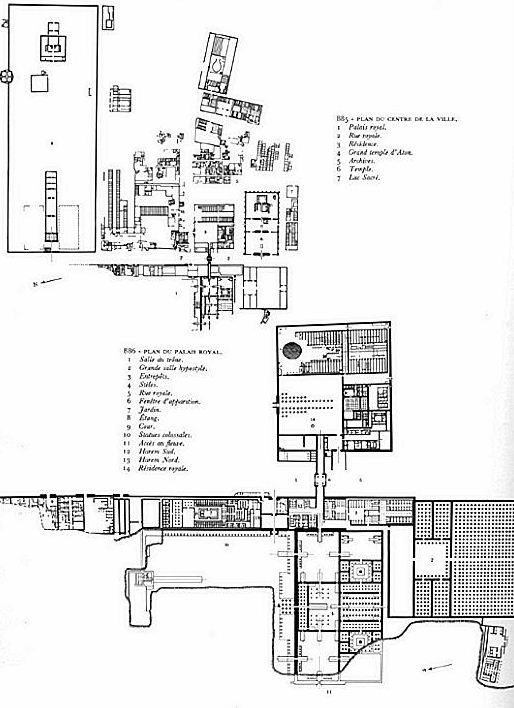
On a identifié les fondations de la plupart des édifices cités dans le texte royal. en particulier le grand et le petit temple d'Aton, le vaste palais auquel s'adossait le complexe des bâtiments administratifs la maison du roi, ou petit palais, la résidence de la reine, et surtout, dégagée sur plus de huit cents mètres, la rue royale qui traversait en ligne droite le coeur de la cité. Au-delà s'étendaient les quartiers de plaisance, résidences des hauts fonctionnaires, et plus loin vers le Nord, les banlieues, mosaïque complexe de maisonnettes pressées les unes contre les autres.
- North Palace, called the Palace of Nefertiti
- Great Temple of the Aten
- Royal Palace
- Central Quarter
- South Suburb
- North Tombs
- South Tombs
Les palais et les édifices cultuels avaient été conçus à la mesure des ambitions du roi: on a établi que la seule salle decouronnement du palais royal ne comptait pas moins de cinq cent quarante-quatre piliers de soutènement! Le gand temple d'Aton, lui, à en croire Pendlebury. «avait eté construit à l'intérieur d'un vaste mur d'enceinte limitant un rectangle de huit cents mètres de longueur sur trois cents mètres de largeur; il comportait deux sanctuaires, séparés l'un de l'autre par un espace de trois cents mètres environ. Ces deux sanctuaires, d'importance inégale, avaient été bâtis sur le même plan. Le temple intérieur, de beaucoup le plus grand, était divisé en deux parties essentielles, appelées «la Maison de Jubilation» et «la Rencontre d'Aton. La première, précédée d'un pylône, était une grand cour bordée de colonnades latérales qui aboutissaient hacune à un autel : la seconde se présentait sous la forme d'une succession de cours, séparées les unes des autres par des pylônes, et reliées par une chaussée qui s'élevait progressivement jusqu'au sanctuaire, elle était flanquée de tables d'offrandes et de kiosques servant sans doute de magasins. L'autel principal, entouré de tables d'offrandes, se trouvait dans la dernière cour, limitée à l'Est par un mur, et dans laquelle on remarquait une ceinture de chambres à ciel ouvert renfermant chacune un ou plusieurs petits autels. Le temple du fond ne comportait que deux cours précédées d'un pylône. A l'arrière de la seconde cour se dressait une pierre en forme de stèle reposant sur une base d'albâtre à laquelle on accédait par une rampe et qui, sans doute, jouait le rôle du rocher benben sur lequel s'était posé, à l'origine du monde, le premiersoleil»
Comme partout et toujours en Egypte, les maisons civiles étaient composées de matèriaux légers, briques, pisé et bois; la pierre, réservée aux demeures des dieux et des morts, n'y entrait guère, si ce n'est pour les seuils des portes et les bases des colonnes. Les missions allemandes ont dégagé les arasements de plusieurs des résidences d'Akhetaton: de plan carré ou rectangulaire hormis la loge du portier faisant saillie à l'angle Nord du bâtiment, elles étaient divisées en trois sections principales: les pièces de réception, ouvrant sur un vaste hall dont le plafond était soutenu par des colonnes de bois polychromé; les salles de séjour, également groupées autour d'un salon qui comportait presque toujours une large banquette de brique faisant office de divan; et enfin, à l'arrière de la demeure, les appartements privés, comptant un nombre variable de pièces, petits salons, salles de repos, cabinets de toilette, penderies, réservés au maître et à la maîtresse de maison. Les communs et un jardin de plaisance agrémenté d'un plan d'eau et de pavillons ou de kiosques complétaient la résidence. Les fondations retrouvées ne permettent guère d'évoquer l'harmonie sereine des demeures amarniennes, enduites de crépi d'un blanc éclatant sur lequel se détachait la polychromie subtile des frises de peintures décoratives, bouquets de lotus, fourrés de papyrus, d'où s'échappaient en vols serrés canards et oies sauvages. Les sables ont étouffé depuis longtemps la douceur de vivre en accord avec l'Unique.
Pour ressusciter tous ceux qui vécurent ici, prenant soin de la maison royale, dirigeant les centres administratifs, veillant à l'accomplissement du rituel au fond de santuaires, ou exploitant les vastes domaines qui s'étendaient à l'horizon, il faut gagner les premiers contreforts de la chaîne arabique, où furent creusés les hypogées des fidèles du roi : Merire, grand-prêtre du Disque, Ahmose, flabellifère à la droite du Roi et compagnon aimé, Ramessou, intendant du Palais, Houya, supérieur du Harem royal et intendant de la Maison de Tiy, Pentou, scribe royal et premier auprès du Roi, Parennefer, ami unique de Sa Majesté, Mahou, chef de la Police, Toutou, Panehesi, May Ipy, d'autres encore.
Ces tombes nous sont parvenues dans un état désastreux. Aucune, pas même celle du Père Divin Ay, de toutes la plus somptueuse, ne fut achevée, ni à plus forte raison occupée, puisque la cour tout entière regagna Thèbes dans les quelques mois qui suivirent la disparition du roi on ne retrouve ici que des piliers à peine dégrossis, des parois nues, des reliefs ébauchés, de rares notations de polychromie, mais aussi, çà et là, quelques-unes de ces admirables esquisses tracées à même la pierre par la main sans défaillance d'un scribe des contours. Et lorsque se déchaîna contre l'hérétique la fureur des partisans thébains, on envoya jusqu'au plus profond des caveaux des équipes de carriers qui, à grands coups de maillets, martelèrent, mutilèrent, profanèrent les images d'Aton, les représentations royales ou civiles, et jusqu'aux hymnes qui les accompagnaient, pour effacer à jamais de toutes les mémoires le souvenir du roi schismatique.
Si la disposition des tombes amarniennes reste conforme à la tradition et comporte, tout comme les hypogées thébains par exemple, un vestibule d'entrée, une grande salle à piliers de plan carré ou rectangulaire et une chapelle axiale abritant la statue du défunt, complétés par un puits menant à la chambre du sarcophage, l'iconographie des reliefs ou des peintures, par contre, est délibérément autre: on y chercherait en vain les références attendues aux mythes funéraires traditionnels: le rituel de l'ouverture de la bouche, la mise au tombeau, le pèlerinage à Abydos, en sont bannis, de même que toute allusion au Livre des Morts ou à quelque autre recueil annexe ; les grandes divinités du royaume d'Occident, Osiris, Isis, Nephthys, Anubis, Hathor ou Oupouat, ainsi que la longue théorie des génies parèdres n'y figurent pas davantage. Par contre, en accord avec la doctrine royale, Aton, Père et Mère de la Vie et de la Mort, est omniprésent, toujours accompagné du roi et de la reine, ses manifestations vivantes. Les artistes amarniens privilégièrent ainsi cinq sujets majeurs, que l'on retrouve systématiquement dans toutes les tombes de la nécropole:
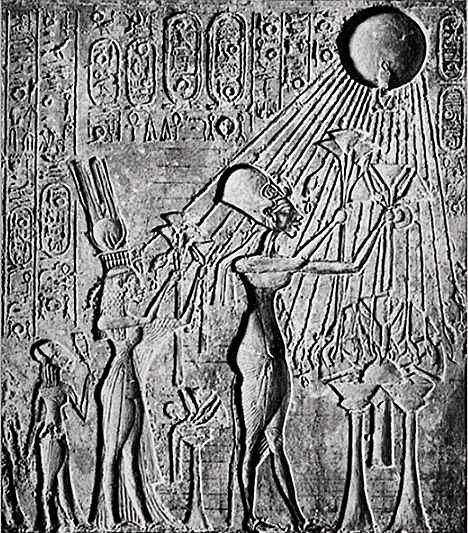
- La famille royale en adoration devant Aton: Akhenaton, Néfertiti et leurs filles consacrent des offrandes et offrent des libations au Disque dont les rayons, terminés par des mains, portent à leurs narines le signe ankh, symbolisant le souffle de vie, et par là l'inspiration divine.

La famille royale en adoration devant Aton - Calcaire - haut. 1,373 - Provient de Tell el-Amarna - Le Caire, Musée arhéologique - Ce relief a été détaché de la tombe du roi lors des fouilles de 1891-1892
- La famille royale dans l'intimité: le roi et la reine sont assis face à face sur de simples tabourets de repos, accompagnés de leurs filles, Méritaton, Maketaton et Ankhesenpaaton.
- La visite au temple: le roi et la reine, montés sur leur grand char d'apparat lancé au galop, suivis par les équipages de la cour et précédés par une garde de coureurs à pied, s'avancent jusqu'au pylône du sanctuaire où les attend le collège des prêtres; plus loin, on retrouve le roi au pied de l'autel, célébrant le Disque.
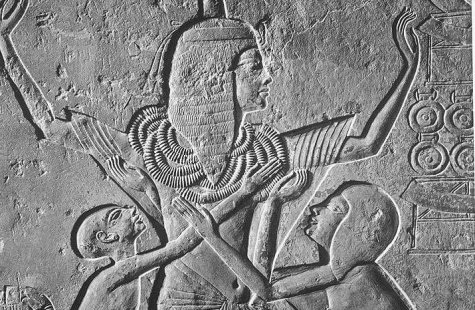
- La donation de l'or de récompense ou investiture: penchés à la fenêtre d'apparition du palais royal. le roi et la reine remettent aux hauts fonctionnaires qui se sont distingués le signe de l'or, sous forme de lourds colliers honorifiques; la cour et parfois les ambassadeurs étrangers rendent hommage au couple royal, cependant que les proches et les serviteurs du bénéficiaire dansent de joie.
XVIIIe DYNASTIE - Remise au général Horemheb des colliers de récompense - Calcaire - haut 0,772 - Provient de Sakkara - Leyde, Rijksmuseum van Oudheden - Ce relief a été dégagé dans la tombe memphite de Horemheb, alors général sous le règne d'Akhenaton
- La réception des tributs : le roi et la reine, en grand habit de cérémonie, assis sur un trône richement orné, dressé sous un dais, reçoivent les délégations étrangères de Nubie, du pays de Kouch, des provinces du Croissant Fertile, des terres lointaines d'Asie et de l'Egée, qui amoncellent à leurs pieds les produits rares de leurs contrées, pièces d'orfèvrerie, défenses d'éléphants, peaux, essences précieuses, fruits inconnus et fleurs savamment montées en bouquets.

Il arrive que l'artiste substitue aux sujets officiels la représentation de tel événement qui marqua la carrière du défunt: la visite de la reine Tiy à Amarna et l'inauguration du nouveau temple d'Aton chez Houya, l'inspection des magasins du temple chez Merire; les détails d'un procès retentissant chez Mahou, par exemple.
Mais c'est dans les marges des grands tableaux surtout que l'art amarnien trouve l'expression de son génie spécifique, dans la foule des petits personnages qui, indifférents semble-t-il à l'action principale, exaltent en scènes pittoresques le bonheurde vivre sous la loi d'Aton: ici, sans se laisser distraire par le cortège royal qui défile, une jeune femme cueille quelques fleurs au bord de la route ; là, aux portes mêmes du palais, un vaurien s'enfuit d'une basse-cour où il a dérobé des oeufs, au grand dam du fermier trop tard alerté; là encore, un serviteur chasse à grands coups de gueule un chiot espiègle qui agaçait sa maîtresse. C'est dans cette célébration sereine de l'harmonie universelle, à laquelle chacun participe, si petit soit-il, si humble soit-il, que l'atonisme remporta sa vraie victoire. En dépit des humiliations, des revers, des échecs, Akhenaton sut ouvrir à son peuple les portes de l'espoir en lui enseignant que la ferveur, la foi, ou plus simplement le bonheur consenti de chaque instant, conduisent l'homme à retrouver au terme de son chemin l'ineffable lumière du Disque, l'ineffable mansuétude de Dieu. On a retrouvé dans les décombres de la tombe royale inoccupée des fragments épars du coffre qui aurait dû abriter les viscères du roi ; les quatre déesses tutélaires, gardiennes traditionnelles des vases canopes, y sont remplacées par quatre faucons aux ailes déployées, comme pour montrer qu'après sa mort, porté par les oiseaux divins, Akhenaton savait qu'il rejoindrait pour jamais le sein d'Aton son père.
Ce chant d'amour et de ferveur, le plus vibrant que nous ait légué la littérature de l'ancienne Egypte, passe pour avoir été rédigé par Akhenaton lui-même, vers 1360 av. J.-C. Plusieurs versions avec variantes en ont été retrouvées dans les sépultures saccagées des dignitaires de Tell el-Amarna. Nous proposons ici les passages essentiels de l'exemplaire le plus complet provenant de la tombe de Ay.
« Tu apparais resplendissant à l'horizon du ciel,
Disque vivant qui as inauguré la vie !
Sitôt tu es levé à l'horizon oriental,
Que tu emplis chaque contrée de ta perfection.
Tu es beau, grand, brillant, élevé au-dessus de tout l'univers.
Tes rayons entourent les pays jusqu'à l'extrémité de tout ce que tu as créé.
C'est parce que tu es toi que tu les as conquis jusqu'à leurs extrémités,
Et tu les lies pour ton fils que tu aimes.
Si éloigné sois-tu, tes rayons touchent la terre.
Tu es devant nos yeux mais ta marche demeure inconnue.
Lorsque tu te couches à l'horizon occidental,
L'univers est plongé dans les ténèbres et comme mort.
Les hommes dorment dans leurs demeures, la tête enveloppée,
Et aucun d'eux ne peut voir son frère.
Volerait-on tous leurs biens qu'ils ont à leur chevet,
Qu'ils ne s'en apercevraient pas !
Tous les lions sont sortis de leurs antres,
Et tous les reptiles mordent.
Ce sont les ténèbres d'un four et le monde gît dans le silence,
C'est que leur créateur repose dans son horizon.
Mais à l'aube, dès que tu es levé à l'horizon,
Tu chasses les ténèbres et tu dardes tes rayons.
Alors le Double-Pays est en fête,
L'humanité est éveillée et debout sur ses pieds;
C'est toi qui les as fait lever !
Sitôt leur corps purifié, ils prennent leurs vêtements
Et leurs bras sont en adoration à ton lever.
L'univers entier se livre à son travail.
(...)
Tu a mis chaque homme à sa place et tu as pourvu à son nécessaire.
Chacun possède de quoi manger et le temps de sa vie est compté.
Les langues sont variées dans leurs expressions;
Leurs caractères comme leurs couleurs sont distincts,
Puisque tu as distingué les étrangers.
Tu crées le Nil dans le monde inférieur
Et tu le fais venir à ta volonté pour faire vivre les Egyptiens,
Comme tu les as créés pour toi,
Toi, leur Seigneur à tous, qui prends tant de peine avec eux !
Seigneur de l'univers entier, qui te lèves pour lui,
Disque du jour au prodigieux pouvoir !
Tout pays étranger, si loin soit-il, tu le fais vivre aussi:
Tu as placé un Nil dans le ciel qui descend pour eux;
Il forme les courants d'eau sur les montagnes comme la mer très verte,
Pour arroser leurs champs et leurs territoires.
Qu'ils sont efficients tes desseins, Seigneur de l'éternité !
Un Nil dans le ciel, c'est le don que tu as fait aux étrangers
Et à toute bête des montagnes qui marche sur ses pattes,
Tout comme le Nil qui vient du monde inférieur pour le Pays-Aimé.
(...)
Dès ton lever, tu fais croître (toute chose pour) le roi
Et la hâte s'empare de toute jambe
Depuis que tu as organisé l'univers,
Et que tu les as fait surgir
Pour ton fils, sorti de ta personne,
le roi de Haute et Basse-Egypte, vivant de vérité,
le Seigneur du Double-Pays, Néferkhéperoure-Ouaenre,
Fils de Ra, vivant de vérité, Seigneur des Couronnes, Akhenaton,
Que la durée de sa vie soit grande !
Et sa grande épouse qu'il aime,
La dame du Double-Pays, Néfernéferouaton-Néfertiti,
Puisse-t-elle vivre et rajeunir à jamais, éternellement !»
- Wikipedia
- Fonds Photographique → Ägyptisches Museum Akhenaton