;)
Le Martyr de Saint Matthieu (détail), Eglise de Saint Louis des Français-Rome
Jacques-Edouard Berger éprouvait pour Caravage une admiration sans égale. Professeur d'histoire de l'art à l'école des Beaux-Arts de Lausanne, il utilisa ses oeuvres pour nous mettre sur le chemin de l'initiation. Un voyage d'étude à Rome nous fit découvrir, live, Caravage que nous avions étudié avec passion en classe. Ensuite, plusieurs cours-conférences donnèrent à chaque fois un éclairage nouveau sur son oeuvre. En rentrant d'un voyage en Inde du Sud, une escale surprise à Rome nous offrit l'opportunité de passer quelques heures en l'église Saint-Louis-des-Français, haut lieu de l'épopée caravagesque. Le temps d'un tartuffo au Trescalini à Piazza Navona, Caravage magnifia Shiva.
Cette approche des oeuvres de Caravage modifia ma manière de vivre, de voir, de penser. Mes zones d'ombre et de lumière se dévoilèrent, donnant à ma vie une dynamique pas toujours facile à vivre mais qui, à chaque instant, se révéla non seulement passionnante mais surtout essentielle. Ce programme Caravage sur le Web, est ma manière de dire merci à Jacques-Edouard. Textes et images sont tirés de cinq de ses conférences. Le peintre est un médium, révélant grâce à la conscience de sa vastitude, de son magma d'humain, ses forces, ses faiblesses, ses ombres et lumières. Se placer devant une oeuvre du Caravage est une expérience, un moment de vie qui laisse des traces.
Caravage, selon Jacques-Edouard Berger, possédait un registre très vaste, une gamme de sentiments, de possibilités, de connaissance de lui-même, de l'autre, des lois qui nous régissent, du bien et du mal, si étendu qu'au travers d'une technique inouïe, il nous fait découvrir un langage, un message nouveau. Voir un Caravage permet à nos propre territoires, comme devant un miroir, d'entrer en résonances, et d'ouvrir des portes donnant accès à ses visions et à son monde.
Révéler, prendre conscience de nos zones d'ombre, de lumière, entrer dans son rythme, notre rythme, laissant le temps vivre le sien, voyager dans ses noirs animés, se laisser guider par un rai de lumière, respirer cette lumière, recevoir la vision du Christ au travers de la sienne. Grâce à sa connaissance profonde, vaste, viscérale de l'humain, de ses bonheurs, ses horreurs, ses lâchetés, ses tendresses, ses douceurs, au travers de la vie, de la mort, les sens à vif, dans un cri terrible, Caravage nous emmène par-delà le magma humain sur un chemin où la rédemption est possible. Il réussit à nous transposer dans un état de réceptivité tel que son message nous traverse telle la lumière dans les yeux de saint Matthieu. Comme le sculpteur Unkei l'avait été pour la pensée bouddhiste japonaise, Caravage est un passeur important de la peinture occidentale, un passeur important du message christique. Ses oeuvres appellent notre présence, le rappel à soi afin de nous ouvrir à l'aventure mystique.
Line Chatelain
;)
Madone du Magnificat, Botticelli
Marsile Ficin, humaniste, philosophe, théoricien et ami de Botticelli prônait la méthode platonicienne d'accession à la Beauté suprême. Cette méthode voulait que l'on s'élève au-dessus des beautés individuelles. Dans la Madone du Magnificat, par exemple, Botticelli n'avait pas besoin, pour représenter un de ses anges, de reproduire un seul visage. Pour mieux rivaliser avec la Nature, il parvenait à recomposer, à partir de plusieurs enfants ou adolescents, un ange peut-être impersonnel mais néanmoins vivant, plus vivant que ces petits vauriens aux mains sales, aux gestes trop brusques, irrespectueux de leur propre grâce qu'étaient ses modèles. Dans ses anges, faits de souvenirs et de beautés superposées, il ne restait que la blancheur, la méditation et le silence. Les cinq anges pourraient être cinq rêves du même adolescent idéal.
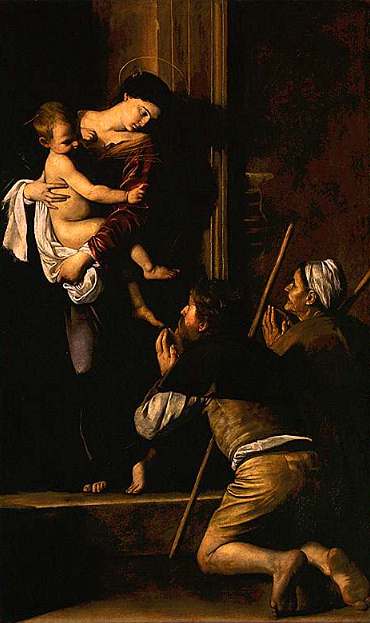
Caravage n'est pas un homme d'utopie, de rêve. Il est incapable d'avoir la vision du visage d'une sainte comme un Botticelli ou un Raphaël. Une madone, peinte par Caravage, la Madone des Pèlerins par exemple, devait vivre, avoir sa réalité de chair, d'os, de peines, de souffrances, de lumière. Ses modèles, au lieu de les inventer ou de les chercher parmi la noblesse romaine que l'on flattait en faisant jouer à telle jeune fille le rôle de Lucrèce ou celui de sainte Anne, il allait les chercher dans les bouges, les auberges, dans la rue. Cette manière de faire entraîna des scandales terribles.
Saint Matthieu et l'Ange, le premier, celui de 1600, un des tableaux les plus novateurs de Caravage, fut retiré le jour de l'inauguration de la chapelle.
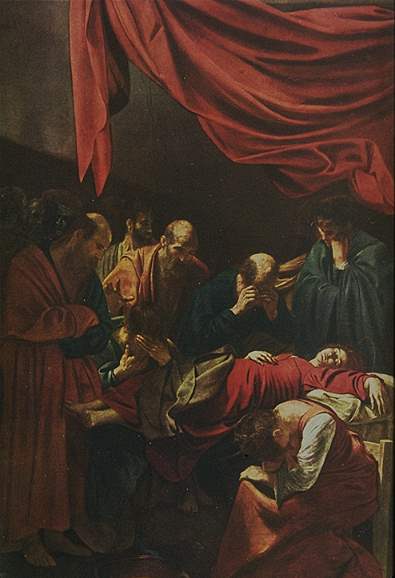
L'homme qui avait posé pour saint Matthieu était un des ivrognes les plus connus du quartier. Au premier plan, ses pieds aux ongles noirs, mal soignés scandalisèrent. On retira immédiatement le tableau. Caravage commença une seconde version. La Mort de la Vierge sera refusée. Une indiscrétion fera que l'on saura que le cadavre de la Vierge était celui d'une jeune fille noyée, retirée du Tibre. Très impressionné, il l'avait choisie pour représenter la Vierge.
;)
Madone des Pélerins
Le Martyr de Saint Matthieu (détail), Eglise de Saint Louis des Français-Rome
Caravage est l'inventeur du clair-obscur, en tant qu'agent principal du drame que l'artiste pose sur la toile. D'autres peintres italiens ont tenté, avant lui, de représenter la nuit.
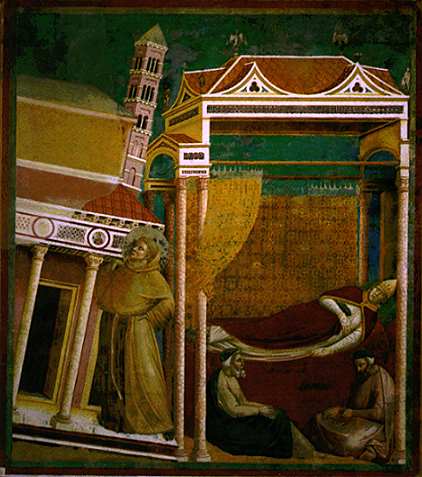
- Giotto à Assise
La première représentation en date est signée par Giotto. Dans le cycle de l'histoire de saint François d'Assise, une peinture de la nuit frappe le visiteur de la basilique: Le Rêve d'Innocent III
. Le pape rêve et voit apparaître saint François soutenant l'Eglise fléchissante. Comment Giotto représente-t-il la nuit? Il nous montre le pape étendu sur le lit de sa chambre à coucher, laquelle est ouverte telle une scène de théâtre. La scène est traitée dans une lumière diurne. Il y a une convention de la part de l'artiste post-médiéval: seule la représentation du pape endormi nous dit qu'il fait nuit. - Piero della Francesca à Arezzo
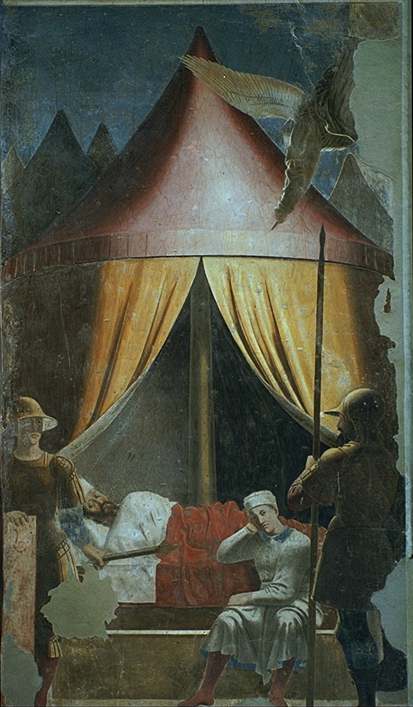
Quelque temps plus tard, arrive la grande Renaissance et avec elle, la recherche de la vraisemblance. Piero della Francesca à Arezzo, dans les fresques admirables sur le thème de la «Légende de la Croix», en tente une représentation Songe de Constantin
. Le sujet est le même. Le peintre s'est contenté pour représenter, symboliser la nuit, de traiter la scène en camaïeu de gris. Monochromie qui évoque une lumière autre que la lumière diurne de Giotto. Nous ne sommes pas du tout dans l'effet lumière-ténèbre qui devrait baigner cette scène. Elle reste conventionnelle. - Le Tintoret à Venise
Les représentations de la nuit se multiplient dans ce courant étonnant qui suit le grand siècle de la Renaissance, le maniérisme. Les thèmes abordés par cette école sont toujours savants, recherchés, érudits. Par là même, les décors, les atmosphères, les moments singuliers sont du choix des artistes. Le Tintoret peint L'Adoration des Roi Mages scan de nuit. Scène ouverte. Nous voyons la Sainte Famille, les rois mages et les assistants habituels d'une adoration, baignés et révélés par une lumière déjà tranchée qui provient d'une toute petite veilleuse accrochée à quelques mètres au-dessus de la scène. Une recherche d'une approche de la réalité, des données de la nature, de la lumière, mais sans qu'elle puisse s'abstraire des conventions médiévales. - Jacopo Zucchi
Les historiens d'art sont d'accord sur ce fait: c'est à Jacopo Zucchi que l'on doit la première représentation de la nuit. Dans Le Songe de Psyché, on voit une tentative, très timide encore, de trancher ombre et lumière sur les corps de Psyché et de l'Amour, de manière à représenter la nuit de façon cohérente. - Michelangelo Merisi dit Caravage Saint-Jean-Baptiste
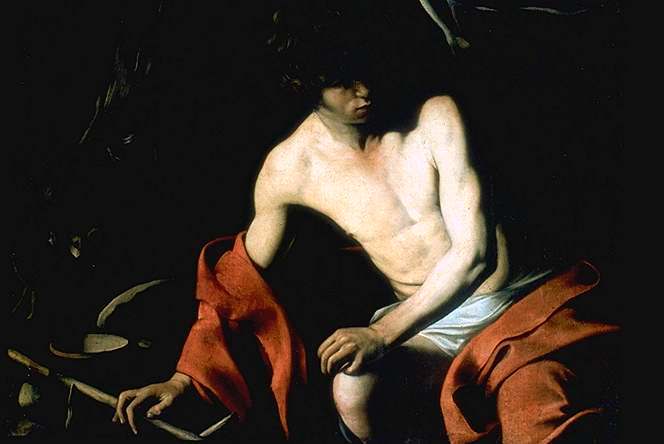
, Bâle Kunstmuseum.
Dans les représentations traditionnelles, Jean-Baptiste est représenté comme un adolescent, accompagné d'un agneau, préfiguration de la Passion du Christ. Nous sommes loin des représentations de la peinture florentine ou romaine de la Grande Renaissance où Baptiste devenait un éphèbe à la manière grecque. Là, nous avons un jeune homme de type italien du 17 ème siècle, à la chair blafarde, traité sans aucune complaisance, sans rien de cet idéalisme que les générations précédentes avaient imposé aux arts plastiques, notamment au langage pictural. Baptiste se présente de façon réaliste, mot clef du destin de Caravage.
Ce qui frappe le plus dans cette toile, c'est la répartition de la lumière. L'arrière-scène est plongée dans une obscurité totale. A aucun moment le décor n'est apparent. Ni objets familier, ni paysage, ni grotte ne le posent dans un lieu précis. On a l'impression qu'une toile de fond a été tendue derrière lui. Cette toile de fond est la nuit. Dans cette nuit marron foncé, presque noire, se détachent violemment, agressés par la lumière, l'épaule, la jambe, le profil de l'adolescent ainsi que le corps de l'agneau.Le terme technique pour cette peinture à effets de lumière, est le «clair-obscur».Caravage est l'inventeur du «clair-obscur» utilisé en tant qu'agent principal du drame que l'artiste pose sur la toile.
Caravage, le prince de la Nuit
Il est le peintre de l'obscurité et de la lumière mais jamais mécaniquement. L'effet qu'il recherche n'est pas un effet nouveau pour l'effet nouveau. Il invente un langage nouveau. Cette recherche n'est pas une recherche naturaliste. C'est une recherche mystique. Il est dégoûté des épiphanies, des images de saintes que le maniérisme avait multipliées par centaines, dégoûté des ascensions de la Vierge entourée d'anges et de nuées roses.
Caravage est un mystique, un croyant d'une foi profonde et viscérale. Il donne à la volonté divine une autre mission, un autre instrument. L'instrument de la volonté de Dieu est la lumière. Il n'y a pas de lumière sans ombre, ni d'ombre sans lumière. Il extirpe l'homme de l'ombre pour l'amener à la lumière qui trace son message dans la nuit. Il ne peut pas être un peintre réaliste même si la réalité, les modèles, ressemblent à l'homme de la rue. Sa recherche est une recherche surnaturelle, spirituelle. Ce qui donne vie à ces êtres anonymes, c'est le doigt de Dieu représenté par le rai de lumière qui frappe l'être élu.
Le jeu de l'ombre et de la lumière devient l'agent dynamique essentiel de la composition, en ce qu'il en orchestre l'action. Le corps humain perd donc ici le rôle fondamental que lui avait confié la grande Renaissance. Caravage utilise la lumière comme un signifiant. Elle dessine la réalité, la souligne et l'exalte, servant essentiellement à lier le dialogue des personnages, le dialogue des regards. Elle définit le rapport entre les personnages. Il recherche une lumière qui, née de nulle part, est une révélation d'origine divine. La peinture de cet homme-là n'est plus une peinture de genre, une peinture de clair-obscur mais une des peintures des plus mystiques qui soient. Cette lumière d'origine divine dessine la réalité et aide à la compréhension de cette même réalité. Il est impossible de la situer logiquement, de manière réaliste. La critique le lui a reproché en disant: «Il ne sait pas observer le réel». Pour Caravage, elle ne peut avoir cette fonction car elle crée le miracle. Elle est le doigt de Dieu.
- 1584:
- à 13 ans, il est placé dans l'atelier de Perterzano à Milan; il y restera 4 ans.
- dégagé de son maître, il travaille vraisemblablement à Milan et en Lombardie.
- 1592:
- à 21 ans, il arrive à Rome
- travaille chez le Cavalier d'Arpin
- vit dans un dénuement extrême
- rencontre Valentin, revendeur de tableaux dont la boutique se trouve près de Saint-Louis des Français
- est présenté au cardinal del Monte - 1593:
- Jeune garçon mordu par un lézard
- s'installe chez le prélat, avec gîte, couvert et appointements
- la Diseuse de bonne aventure
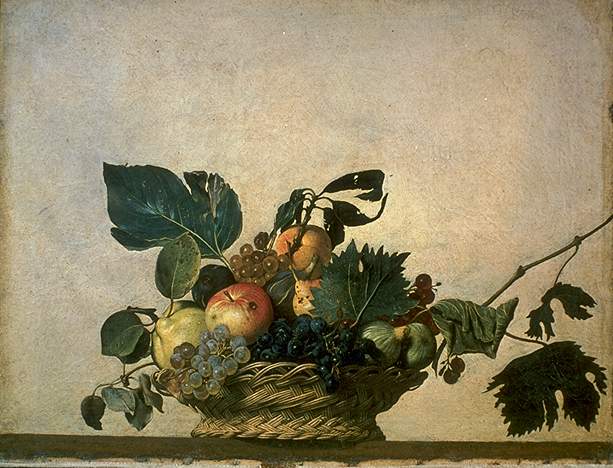
- Corbeille de fruits
- dernières oeuvres profanes.
Dès 1597, Caravage ne peint que des sujets religieux. - 1598:
- reçoit la commande de 3 tableaux pour la chapelle Contarelli, à Rome, église Saint-Louis-des-Français, illustrant la vie de Saint Matthieu
- 7 février 1600: plainte pour coups et blessures de Flavio Canonico, sergent du Château Saint-Ange
- 19 nov. 1600: plainte pour coups et blessures sur le peintre G.Spampa da Montepulciano
- 12 octobre 1604: dénoncé pour avoir jeté des pierres à la garde de nuit, via del Babuino.
- 1604:
la Mise au Tombeau - 12 mai 1605:
- arrêté pour port d'armes abusif. - 10 juillet 1605: - incarcéré à Tor di Nonna pour une obscure histoire de femmes.
- 1605: - au court d'une rixe «à quatre contre quatre», il tue Ranuccio Tommasoni da Terni.
- fuit Rome pour Palestrina, chez le Prince M. Colonna, beau-frère du marquis da Caravaggio.
- peint la Mort de la Vierge - 1607:
-peint Les sept oeuvres de Miséricorde - 1608:
- de Naples, se rend à Malte,« où il a de bons clients» : les chevaliers de l'Ordre de Malte.
- peint la Décollation de saint Jean-Baptiste
- 6 octobre: alerté par les rumeurs de Rome, les chevaliers font une enquête sur
Caravage: cité à comparaître devant l'Ordre, il est chassé de Malte le 1er décembre.- on le retrouve en Sicile, à Syracuse, Messine et Palerme. - 1609:
- le clergé de l'église des Crociferi à Messine enregistre la remise de la Résurrection de Lazare. scan lié lazare
- on le retrouve à Naples, où il est gravement blessé au sortir de l'auberge de Cerriglio.
- à Rome, ses protecteurs marchandent sa grâce auprès du pape. - juillet 1610:
- apprenant que sa grâce est proche, il s'embarque et arrive à Porto Ercole, passe la frontière des États Pontificaux, il y est arrêté puis relâché.
- témoignage de Baglione, chroniqueur de l'époque: Relâché, il ne retrouva plus la felouque. Furieux et désespéré, il parcourut la plage sous la morsure du soleil, tentant de retrouver sur la mer le bateau qui emportait ses maigres affaires. Arrivé à midi, il fut pris d'un accès de fièvre et se coucha. Sans aucune aide humaine, en près de trois jours, il mourut comme il avait vécu, misérablement. C'était le 18 juillet. A Rome, la veille, sa grâce était accordée!
- génial presque dans ses moindres oeuvres
- débauché, buveur, batailleur
- suborneur de femmes
- assassin
- exilé, errant, solitaire
- génial passeur du message christique
- révolutionnaire en tout
- figure romantique avant l'heure
- Karl vos Mandel, Giulio Mancini, Giovanni Baglione, ses exégètes, en ont fait la figure noire de l'asocial, du tourmenté, de l'isolé.
- Bellori: «Son tempérament l'entraîna vers la manière sombre, en accord avec son tempérament turbulent, provocant.»
- Poussin: «Il a détruit l'art de la peinture.»
- Cardinal del Monte: «Il avait autant de peine à faire un tableau de fleurs qu'une figure, étant donné qu'il n'y avait pas pour lui de distinction préconçue entre le beau et le laid, le noble et l'ignoble.»
- Il fallut attendre l'exposition de Milan, en 1951, pour voir enfin, de par la confrontation des oeuvres, se révéler la complexité du visage de l'artiste.
- on se rendait surtout compte qu'il était intensément un enfant de son siècle.
- il est né l'année de la Saint-Barthélémy,
- il est mort l'année de l'assassina d'Henri IV
I - Le miracle Caravage
La vie de Caravage, au 17ème siècle, est certainement une des plus aventureuses qu'ait vécu un grand créateur.Son chemin se dessine entre ombres et lumières. Son caractère passionné l'entraîne de la provocation au meurtre. Sa tête est mise à prix. Il doit fuir, se cacher. Mais il n'y en a pas trace dans sa peinture. Elle est certainement l'une des plus profondément ferventes que nous puissions voir dans toute la peinture baroque. C'est le vrai miracle Caravage. Miracle du sacré, à la dimension de ce qu'il a fait.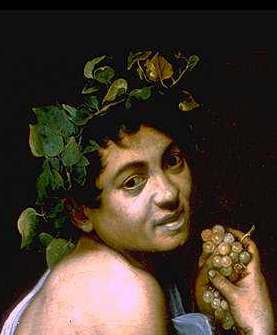
II- L'atelier de Peterzano
Le 29 septembre 1571, naît à Caravaggio, petit village du nord de l'Italie, Michelangelo Merisi, dit Caravage. Très fréquemment on portait le nom patronymique du lieu d'où l'on était originaire. Son père était l'architecte et le majordome du Marquis de Caravaggio. Avec ce double statut, il faisait partie de la maison. Le marquis, mécène dans la tradition de la Renaissance, avait des artistes près de lui. Raphaël était également majordome du pape ainsi que son antiquaire, son archéologue, en plus d'être son peintre ordinaire.Trop souvent, les historiens d'art du 19ème ont voulu que Caravage soit né dans le ruisseau. C'est faux. Il est issu d'une excellente famille d'artistes, dont la sécurité sociale était assurée par un excellent marquis qui, à la fin du 16ème, se prend pour un mécène du 15ème.
Comme tout le monde à cette époque, il commence l'étude de la peinture extrêmement tôt. Les peintres de la Renaissance et du baroque sont quasiment nés dans un atelier de peinture. On broyait des couleurs dès la plus tendre enfance. Arrivés à la maturité, ces peintres connaissaient leur métier parfaitement, comme respirer, marcher ou chanter. A 13 ans, sa famille décide de le consacrer aux arts. Il entre dans un des bons ateliers de Milan, celui du peintre Peterzano.
Pourquoi un bon atelier? Peterzano est un mauvais peintre mais on apprend beaucoup mieux son métier chez un mauvais peintre que chez un bon. Un bon peintre va vous inculquer sa vision des choses. Un mauvais peintre en est incapable. Ainsi, l'élève, pour sortir de sa chrysalide, se débattra avec ses propres moyens et accédera à sa propre vision. Un mauvais élève deviendra un mauvais peintre mais s'il est un génie, il en sortira sans avoir été abîmé, ni influencé, mais en possédant une éducation technique, un métier parfait. C'est ce que reçoit Caravage
III-
Une vie de misère
En 1592, il arrive à Rome. Il est évident que, sorti de l'atelier de son maître, il aurait dû d'abord recevoir des commandes locales toujours plus importantes, pour qu'une lettre de recommandation d'un personnage important le fasse, un jour, sortir de sa ville et ainsi, arriver à Rome en pleine maturité. Caravage s'installe tout de suite à Rome. Il a 21 ans. Âge des premiers tableaux. Évidemment, c'est un échec . Il y a bien assez de peintres, d'ornemanistes, de décorateurs. Qu'a-t-on à faire de ce jeune homme qui en plus, est insupportable? Il ne croit pas en la peinture que l'on fait, il le dit. Il ne croit pas en les chefs-d'oeuvre que l'on reconnaît, il le dit. Il prétend qu'il peut faire mieux, mais personne ne le connaît. Une vie de misère s'ouvre à lui dans la belle tradition de la bohème du 19ème siècle. L'épisode de sa période romaine commence par être romantique. Avec la recommandation de son vénéré maître Peterzano, il entre au service du Cavalier d'Arpin. Ce maître est plus mauvais encore que Peterzano mais il possède deux qualités qui font son succès: en grands habits, manchettes de dentelles et épée au côté, il peint à une vitesse incroyable. Une sainte Cécile est achevée en deux heures. Les cardinaux se déplacent pour voir ça, comme à la foire. Il exploite Caravage, lui fait faire tout ce qui l'ennuie, les guirlandes de fleurs, les mascarons, les cariatides. Naturellement, il ne le paie pas. Caravage vit dans un dénuement total. On raconte qu'il faisait le portrait des aubergistes pour subsister. Voler pour manger, squatter pour dormir mais la chance lui sourit. Le jeune Caravage rencontre un soir, Piazza Navona, le quartier des artistes, un personnage singulier, mi-français, mi-italien. On l'appelle le Valentin. Ce Valentin a une idée de génie: des gens veulent acheter des tableaux, ces gens ont des titres assez ronflants et des habits assez brillants pour ne pas les risquer dans la poussière d'un atelier d'artiste. Dans un appartement chic, aéré et coquet, il présente, expose la jeune peinture et y invite les mécènes. Le Valentin invente la galerie d'art.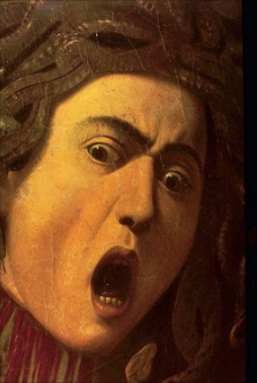
Parmi ses premières victimes - inutile de dire qu'il payait à peine les tableaux qu'il prenait et qu'il revendait fort cher - il y a le jeune Caravage à qui Valentin demande des sujets charmants, légers, gentils, pas trop risqués qui se vendaient, à l'époque, très bien.
IV- Un mécène éclairé
C'est ainsi que Caravage, par Valentin interposé, se fera une belle clientèle. Parmi ses clients, il y aura le Cardinal Del Monte, homme très aventureux. On dit de lui qu'il était le plus ennuyeux des prélats mais le plus averti des amateurs d'art. Il fait sortir Caravage de l'écurie de Valentin et lui offre dans sa maison un gîte, un couvert et des appointements. Alors que tout devrait aller bien, alors que Caravage devrait être heureux et reconnaissant envers son cardinal de mécène, las, il se tient mal. C'est un caractère passionné. 1600 est l'année des premiers scandales. Lorsque l'on est historien d'art, on dit qu'il était passionné et qu'il travaillait tard le soir. La vérité est que Caravage s'enivrait, était poursuivi pour de sombres histoires de moeurs, courtisait les femmes des autres, se battait pour elles et finissait régulièrement au poste de police.V-
Un tempérament excessif et violent
La vie de Caravage sera un exil permanent. Il devra fuir Rome. Le cardinal Del Monte et le cardinal Scipion Borghèse ne suffiront pas à sa protection.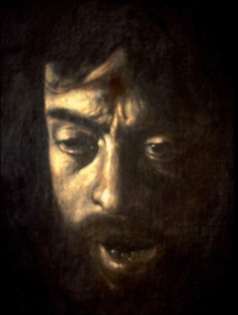
Il y aura mort d'homme. Bellori nous raconte: Le Caravage, quoique occupé par sa peinture, n'avait point abandonné ses occupations troubles; après avoir peint plusieurs heures dans la journée, il rôdait de par la ville, épée au flanc, et s'exerçait au métier des armes, montrant ainsi qu'il se souciait de tout autre chose que de son art. Lors d'une rixe avec un jeune homme de ses amis qui jouait avec lui à la paume, après un échange de coups de raquettes, il saisit son arme et tua le jeune homme; lui-même fut blessé dans l'aventure. De très nombreux documents témoignent que Caravage tua Ranuccio Tomassoni da Terni, sur le Champ de Mars, le 6 mars 1606. Il s'enfuit de Rome, sans argent, et poursuivi, trouva refuge à Zagarolo, sous la protection du duc don Marzio Colonna, pour lequel il peignit un Christ à Emmaüs et une demi-figure de la Madeleine. Ces oeuvres sont aujourd'hui perdues. Il prit ensuite le chemin de Naples, ville où il trouva aussitôt à s'employer, car sa manière et son nom étaient déjà connus. Mais les choses empirèrent. Il tua à nouveau. Pas seulement une fois. Trois. Caravage est un assassin. Il est difficile de protéger un tel homme. Sa vie sera une fuite permanente.
VI- Un destructeur de l'art de la peinture
Sa vie délinquante ouvre la porte à toutes les justifications des critiques de l'époque. Les détracteurs sont nombreux. Les sources sont infinies. Nous avons trace de quantités de voix indignées, offusquées, de ceux qui ont détesté cette peinture-là. Un de ses pires détracteurs est Nicolas Poussin. Poussin régnait à Rome sur un cénacle épris de classicisme, un cénacle épris de cet admirable sens des proportions et du calme en art dont il était lui-même le grand prêtre.Poussin se trouvant devant une toile du Caravage, La Mort de la Vierge
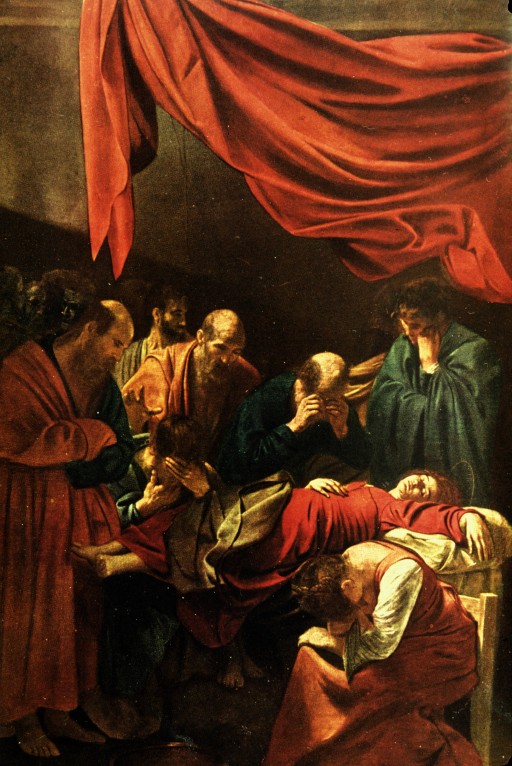
Une approche de vérité qui a horrifié ses contemporains.
La mort de la Vierge a provoqué un scandale. On savait que son auteur avait tué, on savait que son âme était noire et par conséquent sa peinture devait être noire. C'est à propos de cette toile que l'on a beaucoup parlé du vérisme de Caravage. La Vierge est morte. Son corps en porte les marques. Le ventre, le torse, le visage bleuissent, gonflent. Les chevilles sont marquées par le raidissement cadavérique, une approche de vérité qui a horrifié ses contemporains.Toute en verticales qui tombent du plafond, cette oeuvre est indescriptible de douleur
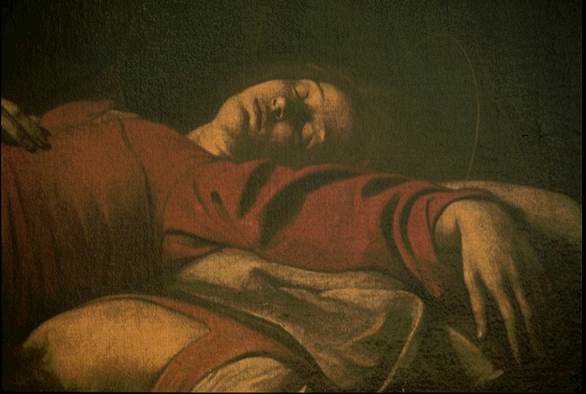
, se mit à hurler, à vociférer: «Je ne regarde pas, c'est dégoûtant. Cet homme-là est venu sur terre pour détruire l'art de la peinture. Une peinture aussi vulgaire ne pouvait être faite que par un homme vulgaire. La laideur de ses peintures l'emmènera en enfer.» Ces phrases colleront à la peau de Caravage pendant très longtemps. Deux siècles durant, Caravage est oublié. Il fallut attendre l'exposition de Milan, en 1951, pour voir enfin, de par la confrontation des oeuvres, se révéler la complexité du visage de l'artiste.
VII-
Des admirateurs enthousiastes
Le scandale Caravage fait retentir des hurlements de toutes sortes ainsi que des cris d'admiration, des enthousiasmes débridés. Baglione, chroniqueur des plus précieux de la Rome pré-baroque nous dit: « Une tête de sa main se payait plus cher qu'une grande composition de ses rivaux, tant était grande l'importance de la ferveur publique.» Baglione ne peut s'empêcher d'ajouter avec une certaine malice: «...ferveur publique qui ne juge pas avec les yeux mais regarde avec les oreilles.»
Une «clique pro-Caravage», soigneusement entretenue autour du cardinal Del Monte, l'admirait sincèrement. Les jeunes peintres allaient le voir. De détracteurs en admirateurs, Caravage tentait de poursuivre sa carrière. Car il n'était pas que peintre, il était aussi homme. L'homme passionné, emporté, romanesque portait malheureusement crédit aux propos ulcérés de ses détracteurs.
VIII- Des débuts prometteurs
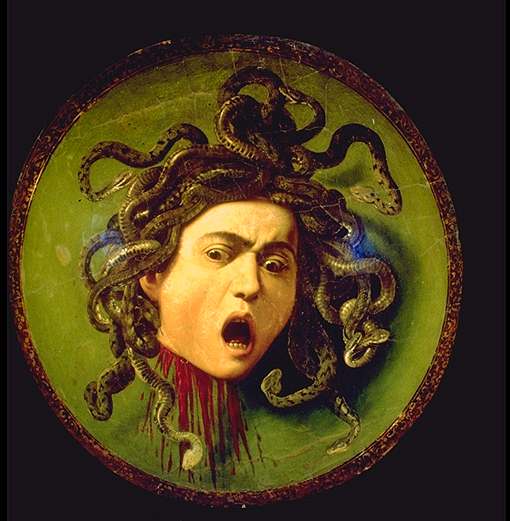
Caravage reçoit la commande d'un bouclier de parade pour une armure qui devait être offerte au Grand Duc de Toscane. Il peindra la Tête de Méduse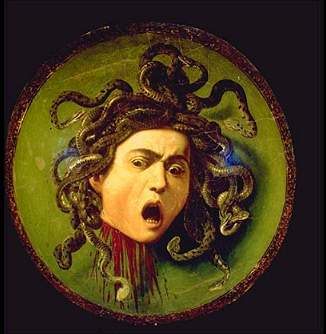
Tête de Méduse-Florence, galerie des Offices
Le premier autoportrait d'un Caravage adolescent. Une des premières oeuvres connues de Caravage semble avoir été une commande. Faite pour le grand duc de Toscane, un aristocrate Romain, le cardinal del Monte (selon Bellori). La période précédente, maniériste, aimait les spectacles. Le 17ème les aimera encore, preuve en sont les carrousels que Louis XVI organisera à Versailles. A Florence, de tels carrousels s'organisaient également. Des armures et des costumes extravagants étaient alors créés pour des ballets hippiques dans lesquels le bon public se repaissait de luxe et de grandeur. Pour le grand duc de Toscane, travesti en Persée, on commanda un bouclier orné d'une tête de Méduse. La chevelure était formée de serpents furieux. Baglione reconnaît, dans la tête de Méduse, le premier autoportrait
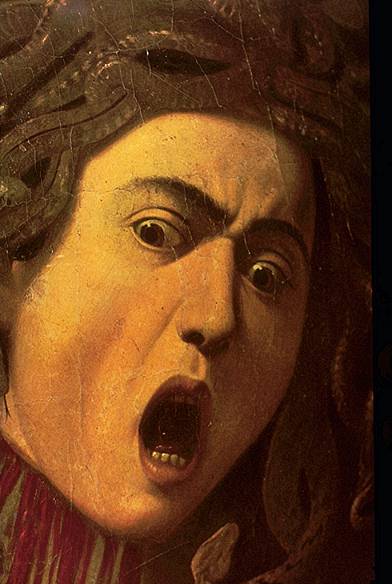
respirant violence et passion.
Des oeuvres profanes marquent ses débuts. A cette époque, le public était lassé des grandes scènes mythologiques et des allégories du piétisme qui avaient marqué la fin de la période maniériste. Les amateurs d'art voulaient une peinture reposante. Les artistes ont inventé pour cette clientèle blasée une forme de pré-rousseauisme, un retour aux sentiments vrais et frais: la peinture de genre. Valentin vendait cela très bien.
Voilà ce que propose Caravage:
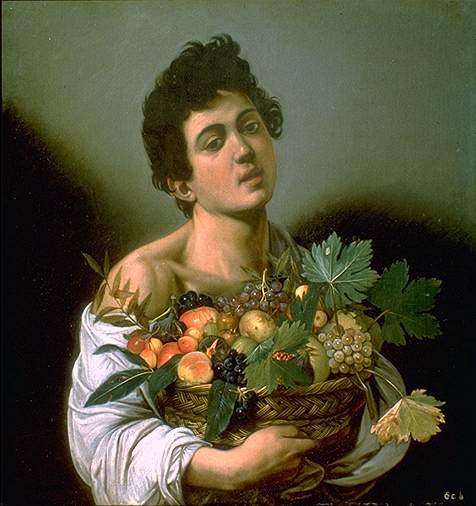
- Jeune garçon à la corbeille de fruits
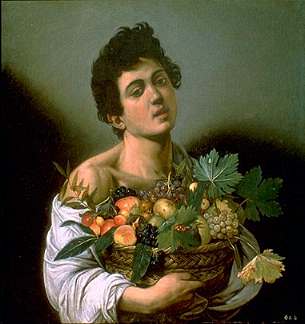
Jeune garçon à la corbeille de fruits Rome, galerie Borghèse
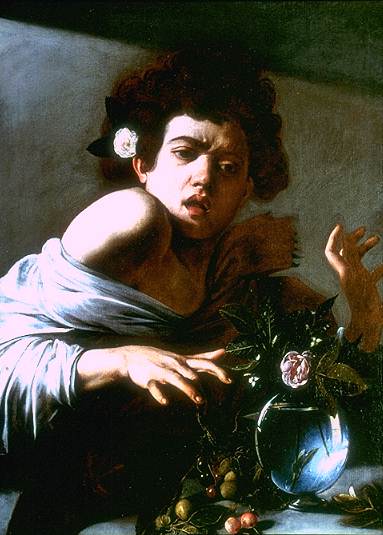
- Jeune garçon mordu par un lézard
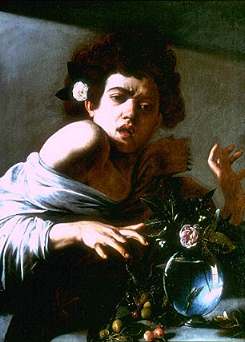
Jeune garçon mordu par un lézard - Londres, National Gallery
Le sujet est creux. Le rendu est dramatique à l'extrême. Beaucoup plus qu'une morsure, qu'une frayeur, c'est une angoisse universelle que vit ce jeune homme.
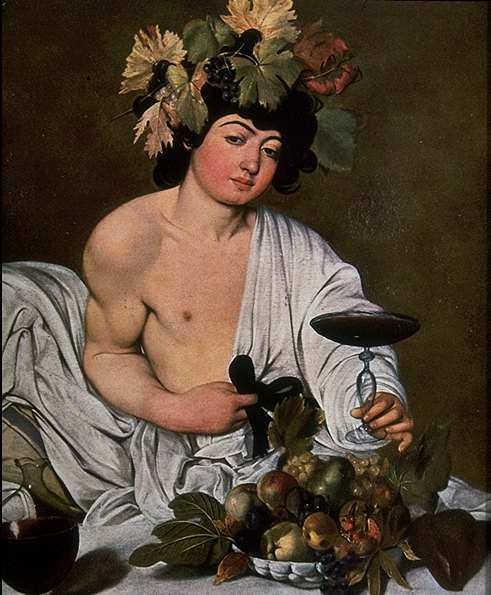
Ce sont jusqu'ici de petits tableaux, appelés tableautins. Le siècle en était friand pour meubler ses cimaises aux côtés des grandes compositions mythiques. A cette époque on mosaïquait ses murs de tableaux, cadres à cadres. Il fallait de petits tableaux pour meubler les vides. Caravage est dans le ton. Bacchus.
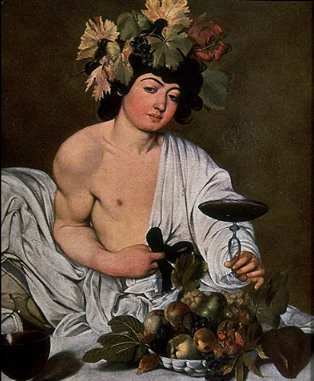
Bacchus , Florence, galerie des Offices
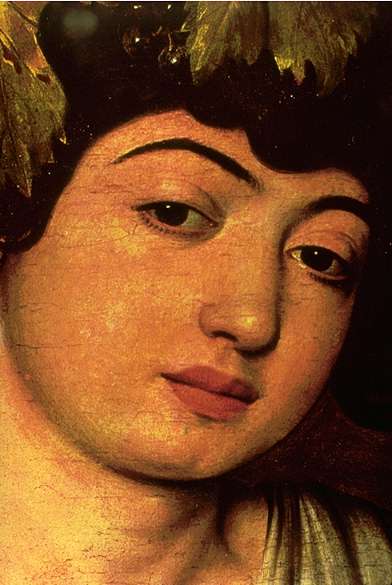
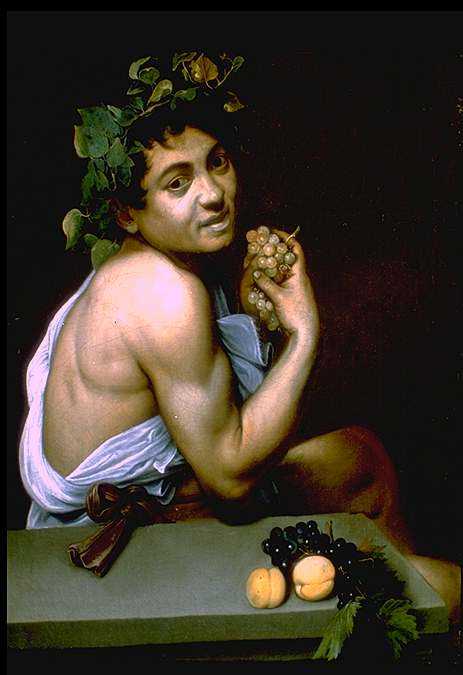
Je dirais que c'est le premier Caravage. Jusqu'alors, ses peintures s'inscrivaient dans une tradition relativement facile, avec un faire relativement sec. Caravage va chercher ses modèles dans le ruisseau, la lie de Rome. Lorsque le sujet est Bacchus, cela gêne un peu. Cela va gêner beaucoup lorsqu'il s'agira de Jésus. Il est important de constater que Caravage n'accepte pas ce bon ton à une époque et à un âge où il ne devrait pas se le permettre. Il devrait faire ce qu'on lui demande, être dans le ton et ensuite inventer quelque chose. Il s'y refuse. Ce refus entraînera une révolution à chaque tableau. Nous sommes bien loin d'une peinture de genre mais dans une peinture qui joue à une peinture de genre qui, à chaque fois, apporte un élément plus brutal, plus passionné. Il demandera à Valentin de le dispenser de ce genre de sujet. Caravage est en train de naître. Valentin s'en rend compte, lui en demande encore et encore. Dépité, il livre le Petit Bacchus malade
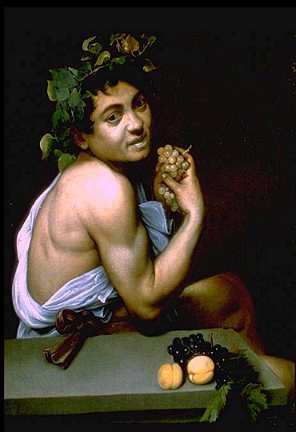
Petit Bacchus malade, Rome, galerie Borghèse, ca. 1593
IX- Des compositions plus vastes
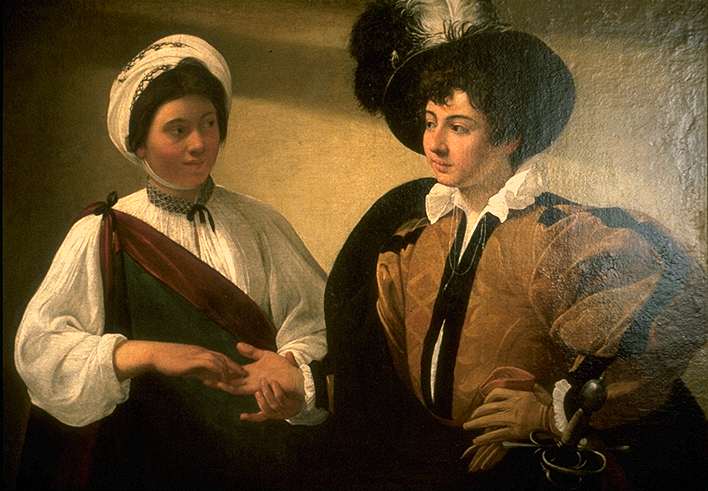
Les figures seules, qui marquent la période d'apprentissage de Michelangelo Merisi vont être remplacées par des compositions plus vastes. Peintures à deux, à trois figures mais toujours sur des sujets légers: La Diseuse de bonne aventure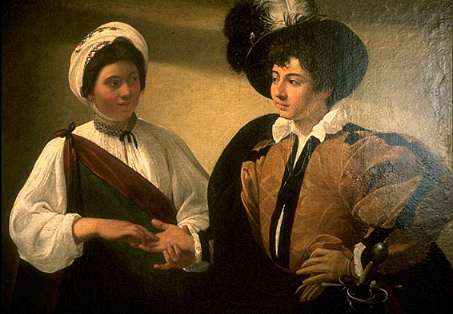
La Diseuse de bonne aventure, Paris, Musèe du Louvre
- le fait de couper les personnages à mi-figure, c'est tellement plus joli lorsque l'on voit tout.
- le fait de les isoler, c'est tellement plus joli avec un paysage dans lequel l'artiste peut montrer sa virtuosité.
- la simplicité, la vulgarité du décor, le mur de chaux.
- la provenance irréaliste de la lumière.
- des accents étranges partant en diagonales, viennent de nulle part, pour arriver nulle part.
- la position illogique de la fenêtre. La critique a dit: «Il ne sait pas observer le réel». Il est de fait que Caravage, pour la première fois ici, utilise la lumière comme un signifiant. La lumière dessine la réalité, la souligne et l'exalte. Ce rayon de lumière sert essentiellement à lier le dialogue des deux personnages, le dialogue des deux regards. Elle définit le rapport entre les deux personnages. C'est divinement peint.
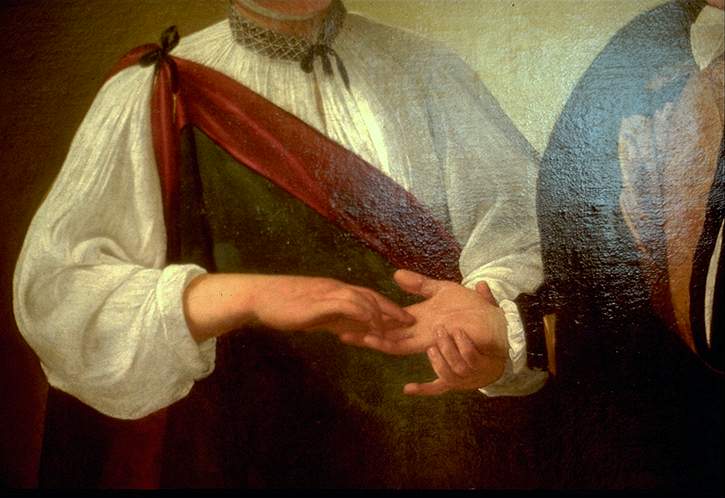
. Là, est en train de naître, timidement encore, ce que sera la véritable recherche de Caravage sa vie durant: la recherche d'une lumière qui, née de nulle part, est une révélation d'origine divine. La peinture de cet homme-là n'est plus une peinture de genre, ni une peinture de clair-obscur mais une des peintures les plus mystiques qui soient. Cette lumière, d'origine divine dessine la réalité et aide à la compréhension de cette même réalité. Corbeille de fruits
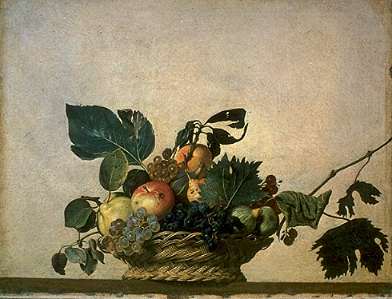
Corbeille de fruits, Milan, Pinacoteca Ambrosiana
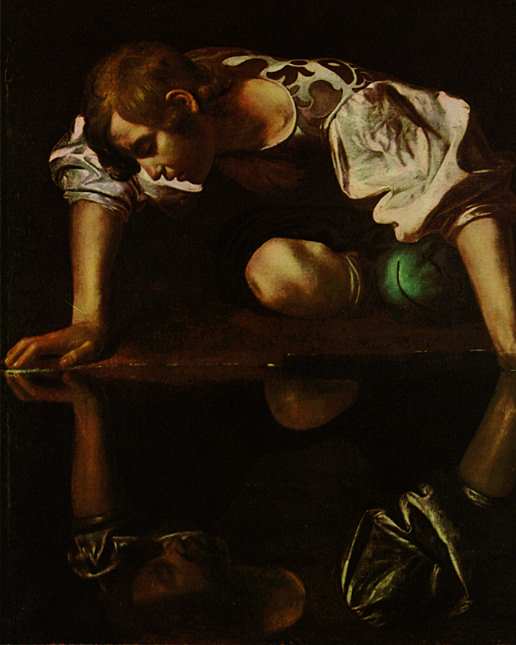
, Narcisse
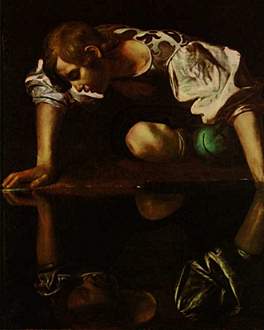
Narcisse, Rome, Galleria Nazionale d'Arte Antica, Palazzo Corsini
. On sent que depuis le premier tableau de genre à celui-ci, il y a une volonté de faire autre chose. Le sujet est autre, la préhension de la réalité est autre, mais il y a encore là toute les séductions de la peinture de genre.
Caravage, très vite, réussit à gommer cela. Ses tableaux seront de moins en moins plaisants au sens propre du terme. De moins en moins de coups de hardiesse, pour le coup de hardiesse. De plus en plus, ce seront des tableaux essentiels. Caravage n'est plus l'industrieux tâcheron exploité par un galeriste, il est le protégé d'un cardinal. Cela l'aménera à la peinture religieuse.
X- Une peinture à vocation religieuse et profondément mystique
Le Repos pendant la fuite en Egypte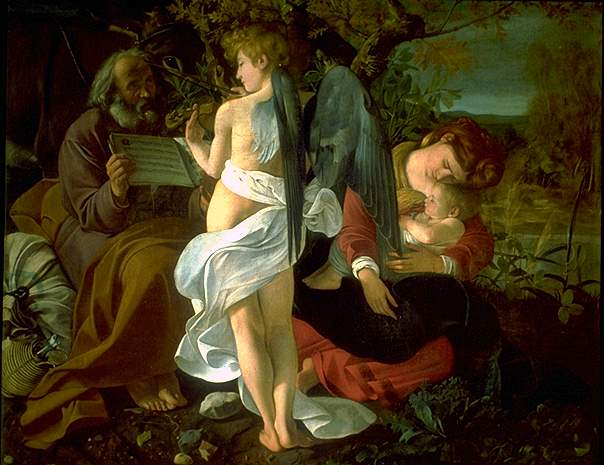
Repos pendant la fuite en Egypte - Rome, galerie Doria-Pamphili
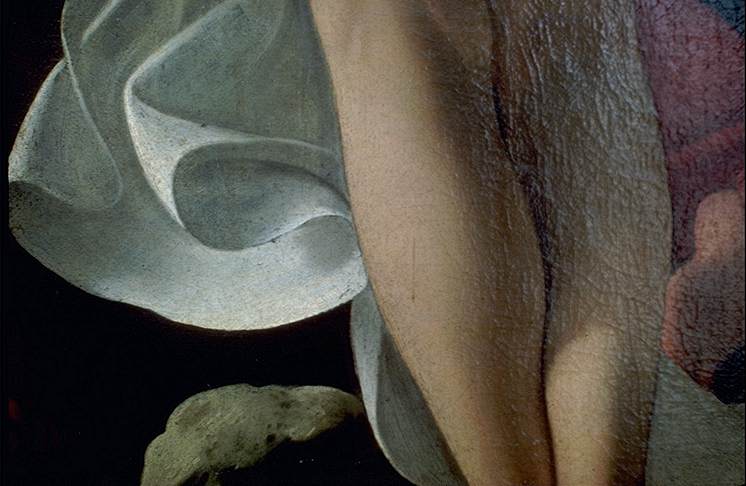
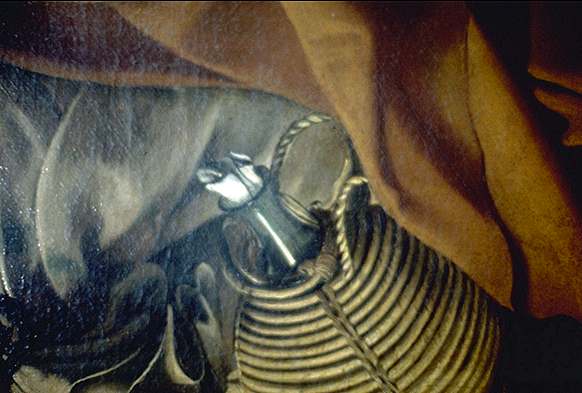
, Judith et Holopherne
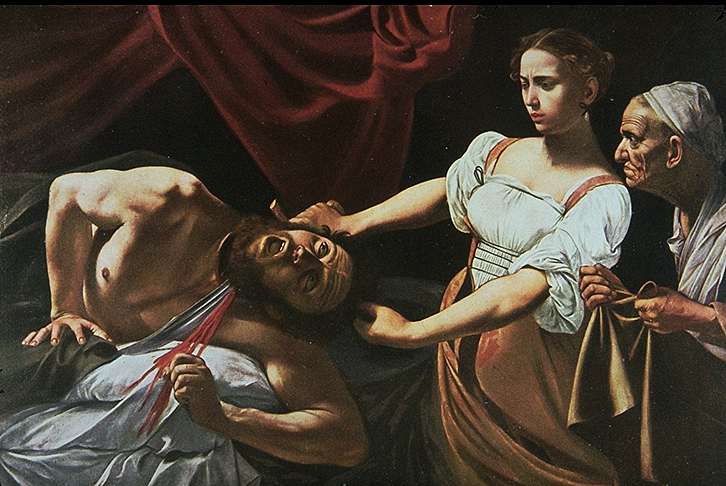
Judith et Holopherne, Rome, palais Barberini
Caravage laisse à Judith sa beauté mais en marque le second degré, l'horreur, dans le froncement des sourcils et dans cette concentration terrible du regard. Judith décolle la tête d'Holopherne sous le regard de la servante. Étonnante servante
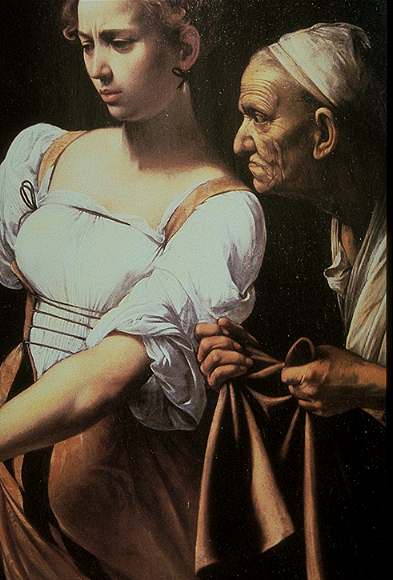
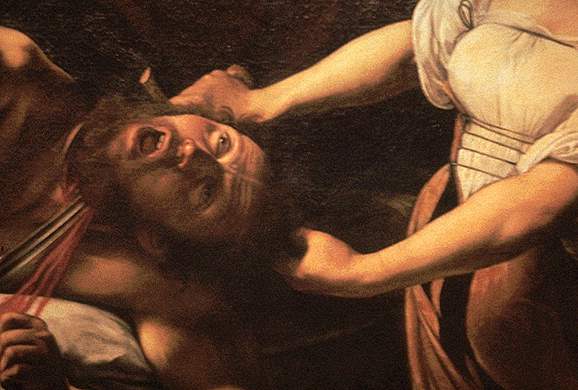
et l'horrible regard de la vieille, Judith est tellement impavide de beauté que le contraste devient saisissant, comme entre l'ange et Joseph dans le «Repos pendant la fuite en Egypte». Belle tête de Judith
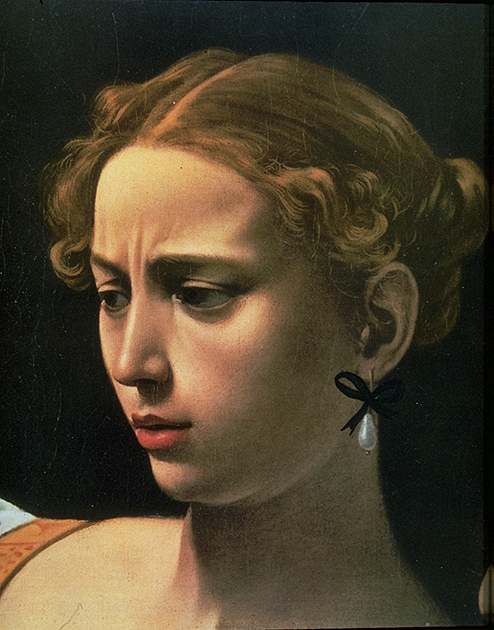
. Caravage se cherche. Il a essayé le bucolique avec le «Repos pendant la fuite en Egypte», l'expressionnisme avec «Judith et Holopherne», le voici avec Madeleine repentante
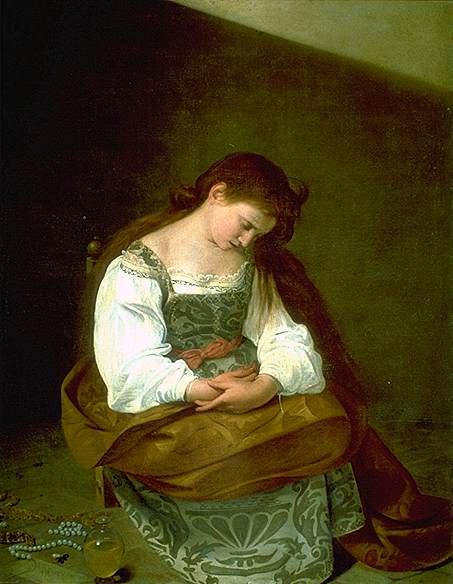
Madeleine repentante, Rome, galerie Doria-Pamphili
Sujet typique de la Contre-Réforme. La pécheresse, en vêtements mondains, abandonne la parure même de ses péchés: ses bijoux. Elle les a cassés et déposés à sa gauche, en formant une sublime nature morte, une «Vanité». Elle abandonne le vin de l'ivresse pour trouver dans la méditation une nouvelle ivresse, celle de l'approche de Dieu. Elle se referme sur elle-même, dans une formidable forme ovoïde, foetale, dans une méditation infiniment profonde, animée par l'étrange traitement de la lumière. Madeleine se prépare à une renaissance. Elle va accomplir une nouvelle naissance. Caravage est en train de naître.
Détail de ce tableau tellement admirable, la chaîne d'or, le rang de perles, une boucle d'oreille qui, très curieusement réapparaissent dans presque toutes ses oeuvres, telle une signature occulte. Baglione dit un peu méchamment que Caravage avait peint cette fiasque de vin afin de prouver à ses clients qu'il gardait son habileté de pinceau. Il y a une lumière interne dans ce vin qui en montre bien la force, qui montre mieux encore le sacrifice d'une Madeleine qui y renonce.
dans quelque chose de piétiste. C'est une méditation traitée de façon classique. Caravage découvre sa vocation, il peindra les grands mystères de notre foi, car il croit, au fond de lui-même, fondamentalement. Mais il se cherche. Sainte Catherine d'Alexandrie
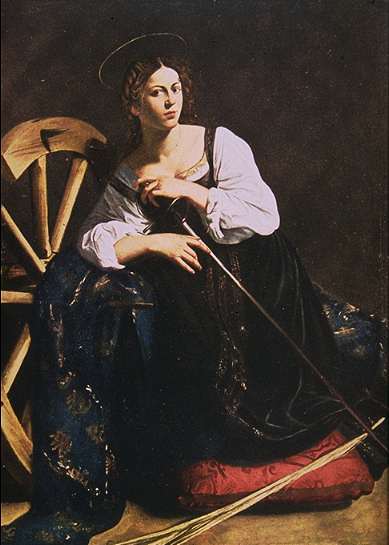
Sainte Catherine d'Alexandrie - Madrid, Collection Thyssen
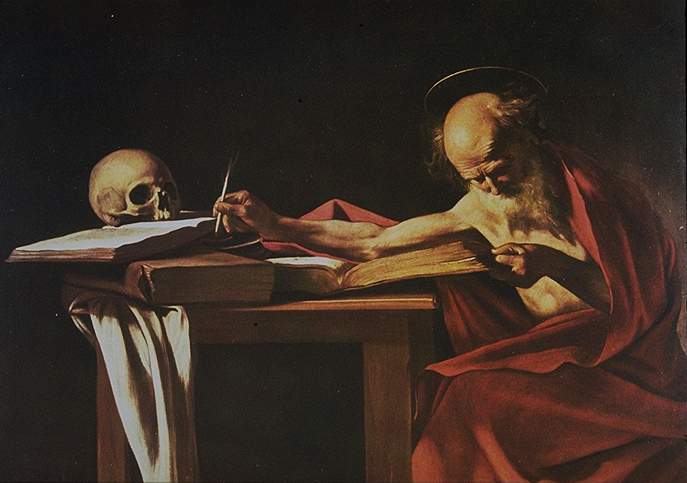
Saint Jérôme, Rome, galerie Borghèse
Au début du 17ème siècle, saint Jérôme est un sujet très prisé. Il s'agit de montrer le retour de la science aux lumières d'une nouvelle ferveur. Un sujet typiquement Contre-Réforme. Toutes les écoles, tous les peintres sont sollicités. Un saint, un crâne, emblèmes et symboles de la période baroque, célèbrent le Memento mori (Souviens-toi de ta mort). Le dialogue est intense. Un saint à gauche, un crâne à droite. Le visage
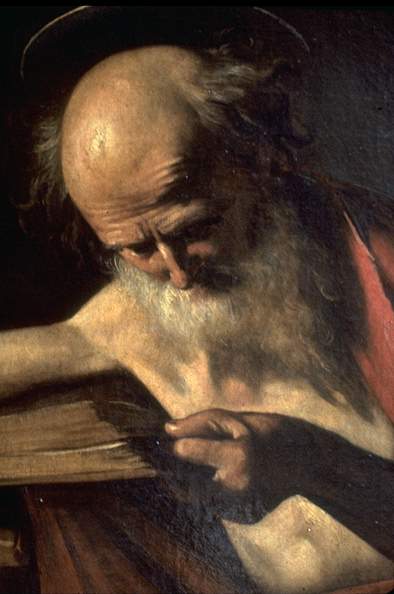
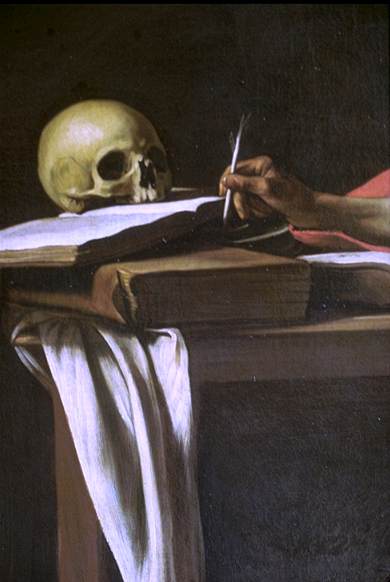
Remarquons comme l'un tend vers l'autre
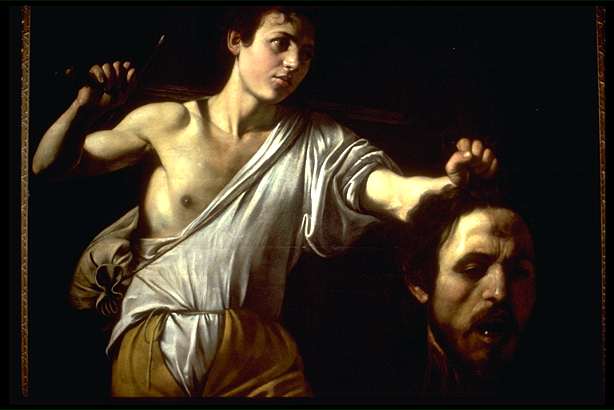
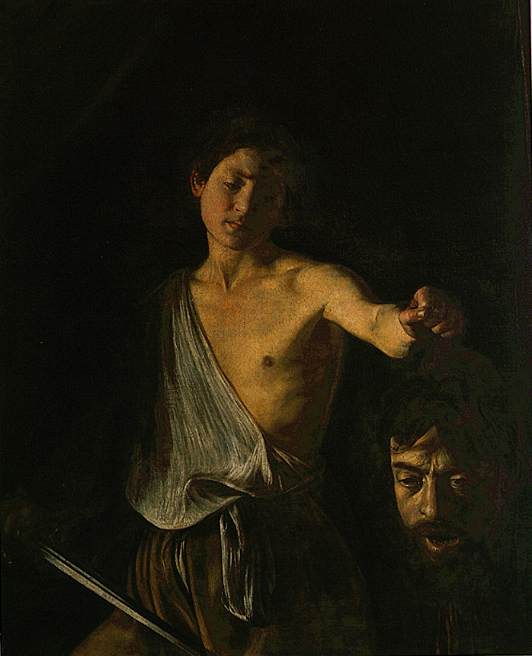
David avec la tête de Goliath , Vienne, Kunsthistorisches Museum
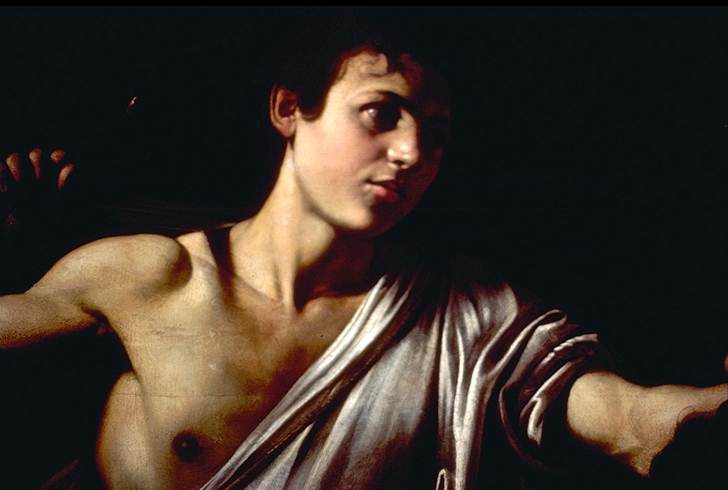
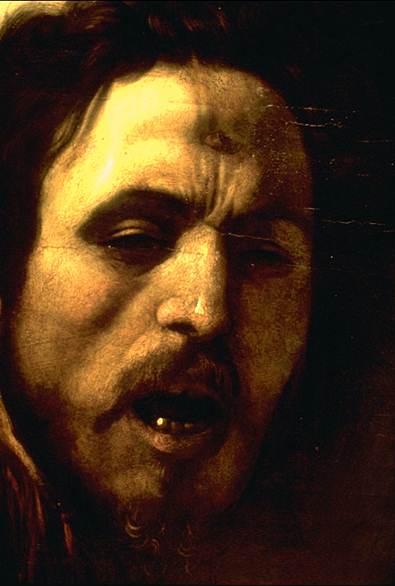
. La seconde version
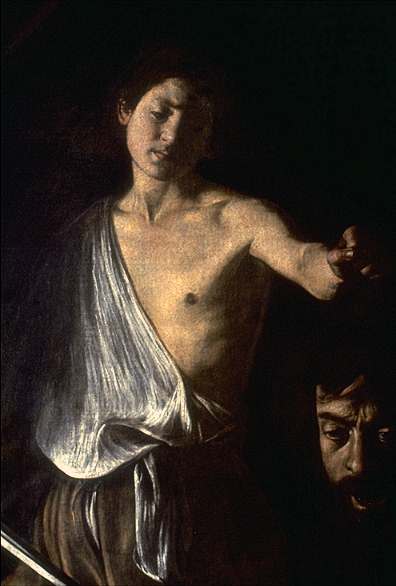
David et Goliath Rome, galerie Borghèse
Goliath
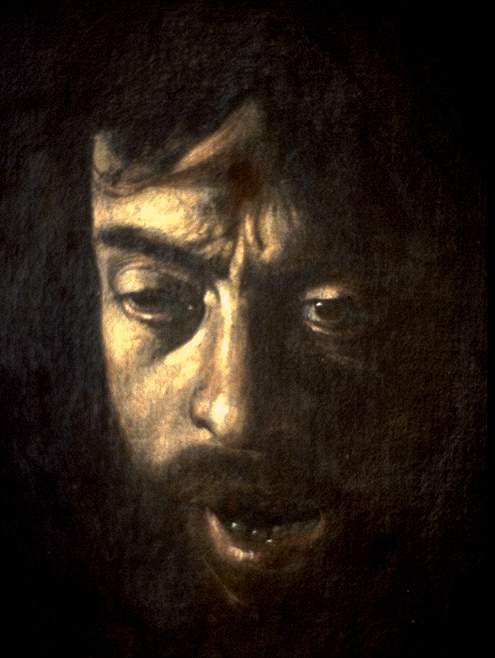
sera hallucinante. C'est en répétant ses sujets, en les traquant, les scrutant, les analysant que Caravage apprend à donner la pleine mesure de lui-même. Un des sujets préférés du peintre sera Saint Jean-Baptiste:Cinq Saint Jean-Baptiste
- Saint Jean-Baptiste, Rome, bibliothèque Capitoline. Un saint Jean-Baptiste
- Saint Jean-Baptiste, Rome, Palazzo Corsini. Un homme de la rue plus âgé, plus humain, celui-ci est un homme de la rue avec des traits fermés, communs. L'échancrure de son vêtement a laissé des traces de bronzage. Cela a beaucoup choqué à l'époque.
- Saint Jean-BaptisteRome, galerie Borghèse. Un portrait ambigü
- Saint Jean-BaptisteKansas City, W.Rockhill Nelson Gallery of Art. Une sculpture
- Saint Jean-Baptiste Bâle
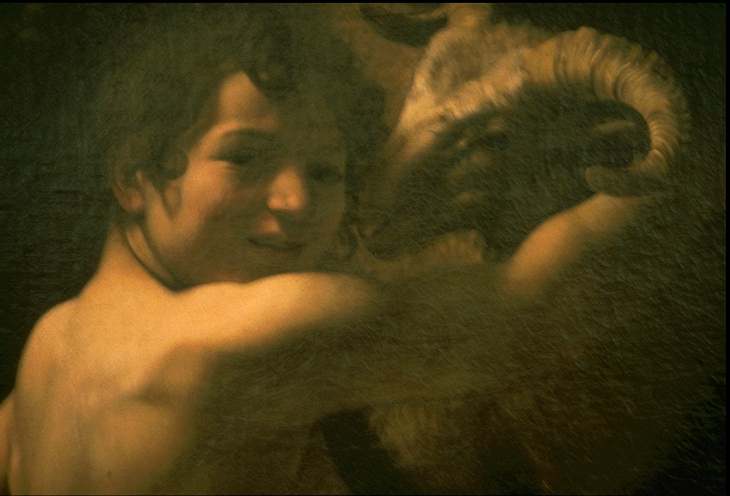
, il tentera de se dépasser. Madone des pèlerins

Madone des pélerins ou Madone de Lorette, Rome, église Sant'Agostino
La Vierge est chez elle. Jésus n'est plus le petit bébé de l'époque des rois mages. Il a grandi. Des pèlerins passent, veulent voir l'enfant qui est trop grand pour être dans les bras de sa mère. La Vierge veut dire qu'elle était comme cela le jour de la nativité. La pose est en contra posto, pose très commode avec un enfant trop lourd. Elle dit simplement : "Qui que tu sois, où que tu sois, comme que ce soit, frappe à ma porte, je te montrerai le Fils de Dieu". Une énorme ouverture d'amour, soulignée par la ferveur du couple de vieux pèlerins du premier plan, empreints de simplicité et d'ingénuité divine, tendus en avant par cet amour qui les touche à la vue de l'enfant. Les pélerins n'ont pas devant les yeux une vision bleutée comme souvent dans la peinture baroque. Ce mystère devient autre chose qu'un emblème, qu'une vision, il devient une réalité. Une oeuvre composée avec cette infinie simplicité et cette vérité essentielle qu'est le propre de la maturité du grand Caravage.
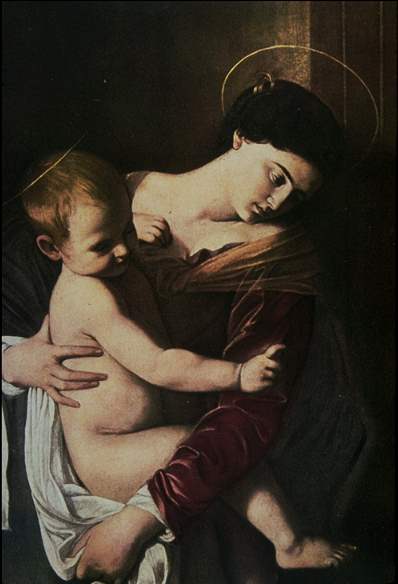
ou Madonne de Lorette. Cet homme, à qui l'on reproche de boire, de voler, de violer, de piller, d'assassiner, peint sans relâche. Crucifiement de saint Pierre
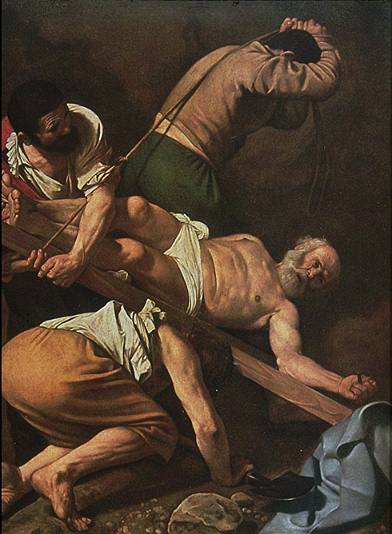
Crucifiement de saint Pierre - Rome, église Santa Maria del Popolo
, Conversion de saint Paul
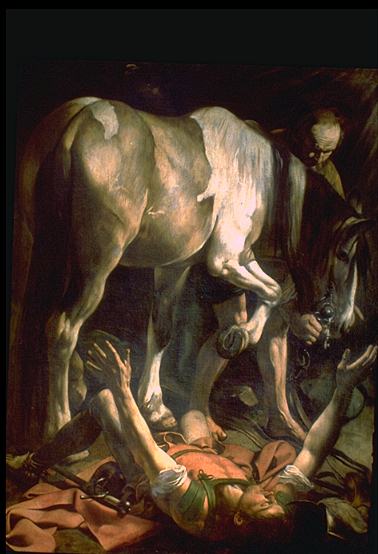
Conversion de saint Paul - Rome, église Santa Maria del Popolo
Caravage réussit à donner l'illusion du miracle. C'est une lumière miraculeuse que le personnage reçoit. D'où vient-elle? De l'illumination phosphorescente de la panse du cheval? La lumière divine se brise sur le cheval pour mieux illuminer le personnage au sol. Comme dans le tableau de la Madeleine, la composition se referme en une forme ovoïde, soulignée par les bras de saint Paul. dia 102 R On retrouve le symbole de l'oeuf et l'idée de re-naissance de la tradition chrétienne primitive.
.
XI-L'exil
Mise au tombeau,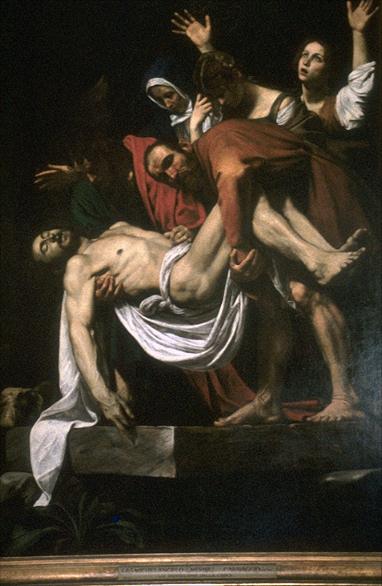
Mise au tombeau - Rome, Pinacothéque Vaticane
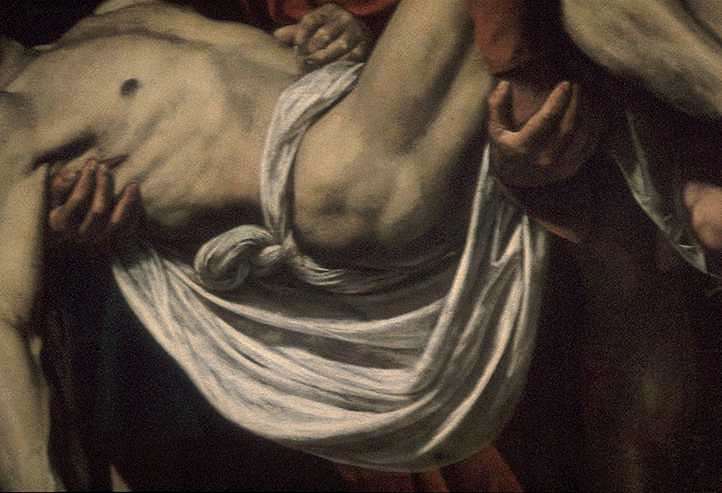
Caravage peint ce tableau les jours qui précèdent le meurtre qu'il va commettre. Lors d'une rixe à quatre contre quatre, pour une faute au jeu de la raquette, près de la demeure du cardinal del Monte, épaulé par Onorio Longo et par le capitaine Antonio Bolognese, Caravage est blessé mais tue Ranuccio Tommasoni de Terni. ( «Avvisi» di Roma, 31 mai 1606).
Il doit fuir Rome au moment où les commandes arrivent. Il se réfugié à Palestrina chez le prince Marzio Collona, beau-frère du marquis de Caravaggio. Le 6 octobre, il est à Naples. La période de l'exil commence. Tout est à recommencer. C'est à ce moment-là, privé de sa sécurité, de ses racines, de ses protections que Caravage va devenir un peintre bouleversant. Nous avons déjà vu des oeuvres bouleversantes, ce que nous allons découvrir dépasse tout.Selon Babioni, il aurait peint ce tableau très rapidement dans son exil à Palestrina pour se payer le passage pour Naples.
Madone du Rosaire
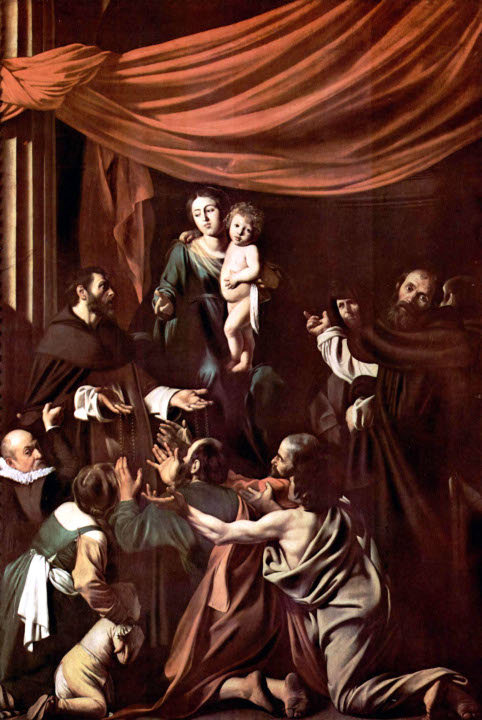
Madone du Rosaire, Vienne, Kunsthistorisches Museum
Caravage, qui aime les architectures gigantesques, s'est vu dicter l'ordre de représenter la Vierge offrant des rosaires à tous les représentants de l'Ordre du Rosaire de Naples. Une oeuvre très risquée et qui pourrait être ennuyeuse. Elle réussit à ne pas l'être, grâce à cette composition complètement infléchie par une diagonale sur la gauche. Diagonale révélée par les bras, les mains et les regards de tous les personnages, la Vierge n'étant plus qu'une comparse de l'oeuvre.
, Les sept oeuvres de Miséricorde
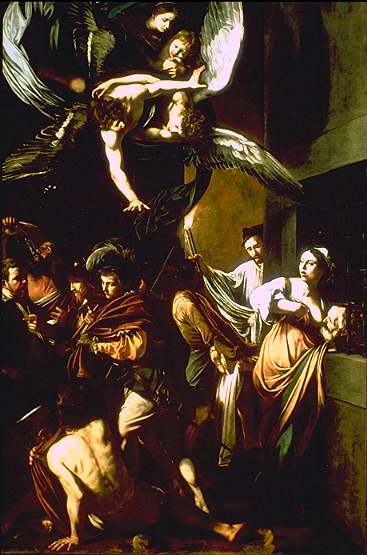
Les sept oeuvres de Miséricorde - Naples, église du Pio Monte della Misericordia
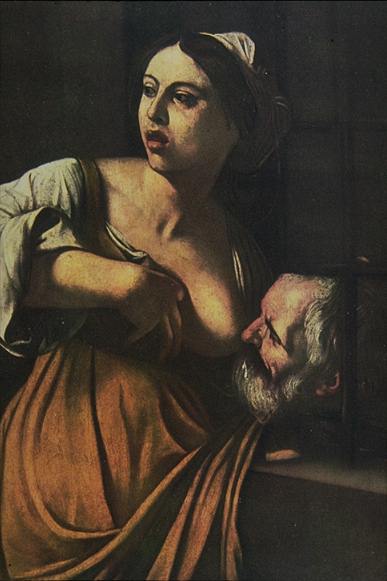
. Nous avons évoqué les étapes principales, Milan, Rome, Naples. Toujours pour les mêmes raisons, Caravage doit fuir Naples et s'embarque pour Malte où on le retrouve peignant pour le compte du grand maître de l'Ordre qui, dit-on, l'y aurait fait entrer. Portrait d'Alof de Wignacourt
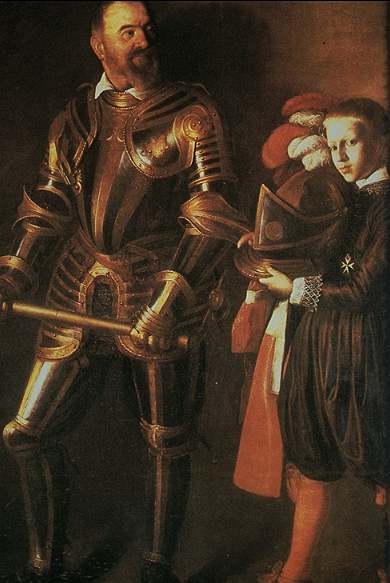
Musée du Louvre - Paris
, Caravage est au faîte de son art. La Décollation de Saint Jean-Baptiste
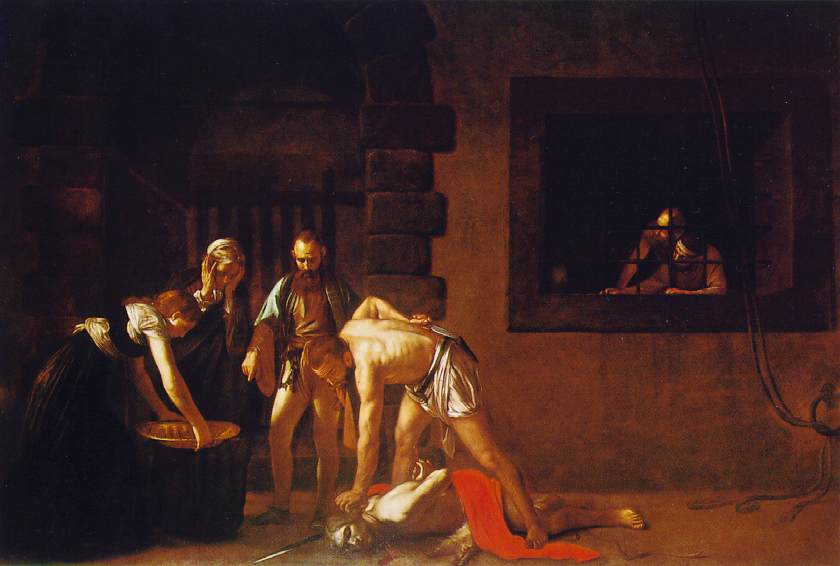
Décollation de Saint Jean-Baptiste, La Valette, Malte, cathédrale Saint-Jean
Un tableau de plus de 5 mètres de base, gigantesque, fait de vide et de silence. Jamais une décollation n'a été plus consciente que celle-ci. Rien. La nuit et les murs. La nuit et la pierre sur laquelle résonne l'écho de ce que Caravage nous montre. L'écho d'un plat que l'on porte, l'écho d'un cri qui est poussé, l'écho d'une angoisse qui s'installe. L'immensité de ce noir, de ces ténèbres est une menace plus fatale que la vengeance de Dieu. C'est l'horreur de l'assassinat dans cet anonymat de ténèbres colossales où le forfait se perpétue. Un rayon plus divin que jamais éclaire l'horreur de la décollation. On reconnaît à peine Salomé, à gauche, marquée de noir et de blanc, le bourreau, le saint avec simplement le rouge de son vêtement, le rouge de son sang. Et le cri qui nous poursuit. Une immense prison dans laquelle règne l'obscurité des murs aveugles à peine percés d'une fenêtre où deux prisonniers assistent à la scène et ce rayon qui miraculeusement illumine. Deux personnages penchés, le bourreau et Salomé, en fait deux bourreaux. L'intention de tuer pour l'une, et le geste qui tue pour l'autre. Leurs bras, traités de façon parallèle, expriment le dialogue entre ces deux êtres. Très curieusement, en habits du temps, un homme et une femme assistent, hébétés d'horreur. Saint Jean-Baptiste perd sa tête et le sang coule entre cette incroyable similitude chorégraphique des deux gestes.Détail
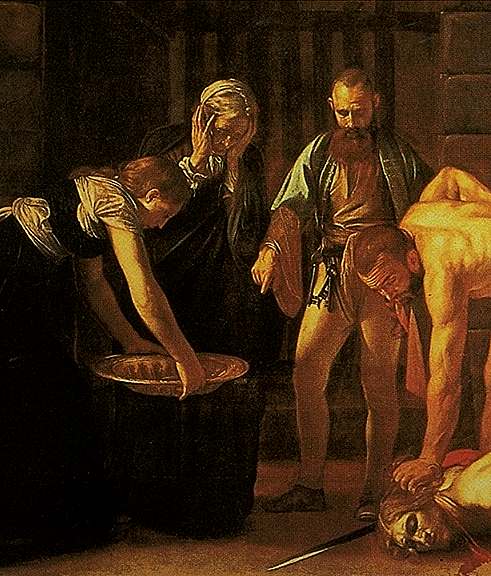
a été peinte alors qu'il vivait en paix sur l'île de Malte sous la protection des Chevaliers. C'est pour la cathédrale de la Valette qu'il peint ce tableau, une des versions les plus poignantes que l'on n'ait jamais peinte. Un thème usé, Salomé, Saint Jean-Baptiste, le dialogue de la femme et de la tête coupée a séduit les peintres, des premiers primitifs de l'époque romane jusqu'à Lucas Cranach, en période maniériste. Jamais ce sujet n'avait été traité de façon à la fois aussi souveraine et damnable. Baglione raconte qu'ayant outragé un chevalier, Caravage fut emprisonné, qu'il parvint à s'enfuir de Malte et à atteindre la Sicile où il s'établit à Palerme, effectuant des séjours à Messine et à Syracuse.
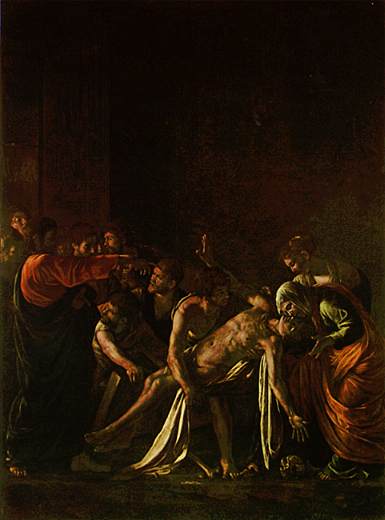
Résurrection de Lazare
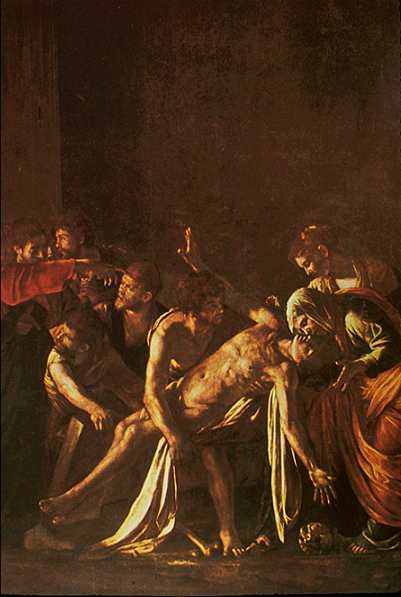
Résurrection de Lazare - 1609 - Messine, Musée Régional
Il n'a peint que la moitié inférieure du tableau. Nous pouvons sentir le poids dramatique que ce vide donne à la scène, l'oppression de ce vide sur cette résurrection, tel le doigt de Dieu. La ligne, le long du corps de Lazare, est soulignée et soutenue par la grande volute du personnage qui l'embrasse. Ces deux lignes préparent la révélation de la présence du Christ lui redonnant vie. La puissance et la dynamique de la verticalité du Christ, appuyée par la poutre solide du fond, les jambes dans la position de la marche, le bras à l'équerre, amènent Lazare d'une position horizontale à sa verticalité. La foule qui entoure la scène suit le mouvement de chute, puis de résurrection. Seul le Christ impose sa verticalité au travers de sa main qui donne la vie, et par là-même, exprime la volonté de Dieu.Ce tableau est beaucoup plus qu'admirablement composé. Il garde cette signification lourde que Caravage sait donner à ses compositions.
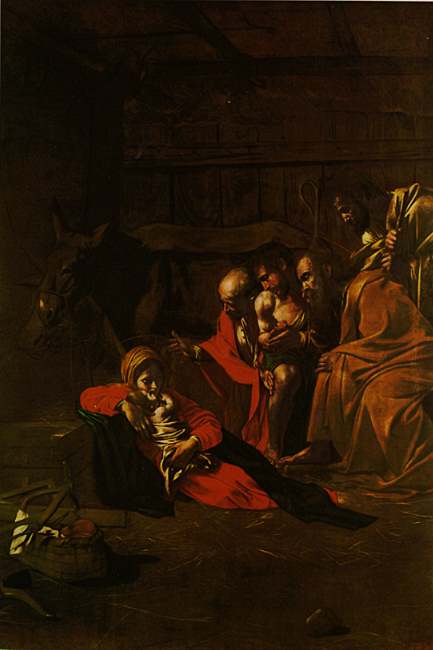
, Adoration des bergers,
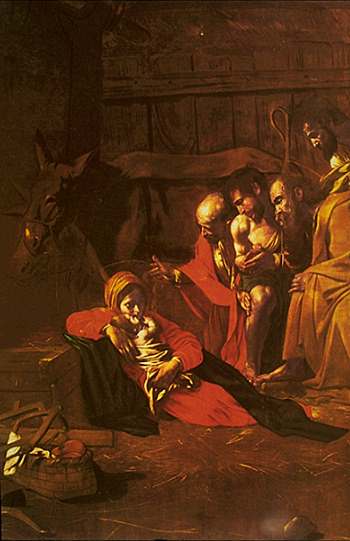
Adoration des bergers - Messine, Musée Régional
Caravage limite sa palette. Un camaïeu de bruns animé par un peu de bleu que l'on devine. Economie de moyens. Il invente le jeu de l'ombre et de la lumière. Jamais, chez lui, on ne verra la source lumineuse. La lumière vient du dehors, de très loin, de très haut. Cette lumière pourrait être le Doigt de Dieu ou la Volonté de Dieu.Cette lumière, dans la presque totale obscurité où sont plongées les oeuvres, anime et donne existence aux personnages importants. Ici, la Vierge et l'Enfant, la joue de la Vierge épuisée à laquelle semble s'apaiser l'Enfant, et cette main lasse qui tient le bébé. Chez Caravage, il y a ce privilège de la lumière qu'il réussit à capter comme aucun autre peintre ne l'avait jamais fait.
Caravage apprend que sa grâce est proche. De point en point, de palier en palier, nous avons découvert un Caravage de plus en plus empreint de ce mystère religieux qu'il peint et sait traduire avec toujours plus de ferveur.
Il a produit des oeuvres tellement ferventes, emplies d'un mysticisme des plus profonds et essentiels, il a témoigné d'un tel sens du sacré et surtout d'une telle compréhension du message christique, qu'en milieu romain il est pardonné. Tout heureux, il embarque pour Naples et omet de signaler sa présence, autrement dit, il est passager clandestin. On lui prend ses biens en gage de la traversée. Bêtement, il les défend en attaquant un marin. L'équipage lui tombe dessus. Il débarque blessé à Porto Ercole. Furieux et désespéré, il parcourt la plage sous la morsure du soleil, tentant de retrouver sur la mer le bateau qui emporte ses maigres affaires. Arrivé à midi, il est pris d'un accès de fièvre et se couche. Sans aucune aide humaine, en près de trois jours, il meurt comme il avait vécu, seul. C'était le 18 juillet.
Circonstances historiques
En 1598, un concours de circonstances fait décrocher à Caravage sa première commande importante. Matthieu Contarelli devient cardinal sous Grégoire XIII. Il reconstruit et embellit St-Louis-des-Français et fonde la chapelle Contarelli. Muziano et le Cavalier d'Arpin y travaillent. Entre-temps, Matthieu Contarelli meurt. Son exécuteur testamentaire, Virgilio Crescenzi, est chargé de mener à bien les travaux, mais avec trop de lenteur au goût du clergé de St-Louis-des-Français qui, en 1596, proteste auprès du pape. Celui-ci somme Crescenzi de hâter les travaux et, sur la recommandation du cardinal del Monte, fait à Caravage la commande de trois panneaux peints pour la chapelle. Inaugurée en 1601, l'oeuvre fait scandale. Un panneau est refusé. Ces trois peintures, ayant pour thème la vie de saint Matthieu, pourraient suffire à synthétiser l'oeuvre entière de Caravage. Le personnage est tout entier dans la chapelle Contarelli.Auparavant, il convient de souligner dans la «révolution» Caravage, deux caractères majeurs:
- Le jeu de l'ombre et de la lumière devient l'agent dynamique essentiel de la composition, en ce qu'il en orchestre l'action. Le corps humain perd donc ici le rôle fondamental que lui avait confié la grande Renaissance.
- Caravage s'inscrit contre le courant maniériste qui multipliait les formules exacerbées, sophistiquées, pour échapper aux canons trop rigoureux de la Renaissance. Il osera trancher ces liens que les peintres maniéristes n'avaient fait que multiplier en les renforçant.
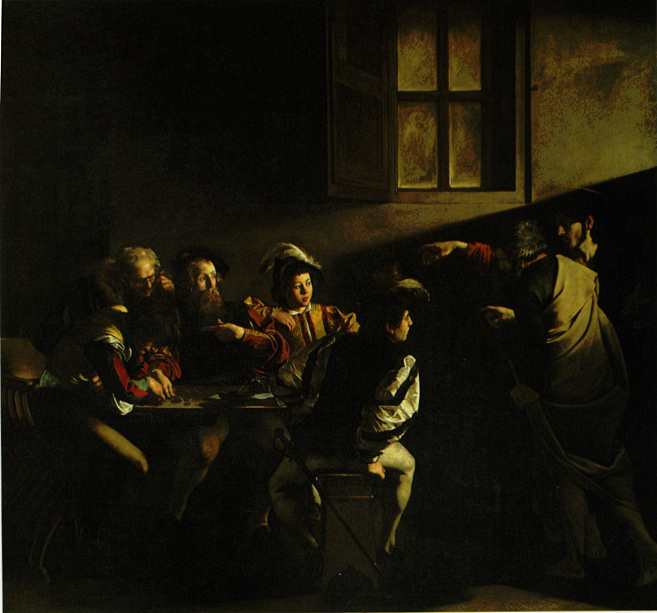
Vocation de saint Matthieu
Un jour, Matthieu, attendant le bateau, compte son gain. Nous nous trouvons dans une chambre d'auberge à l'atmosphère sulfureuse, avec comme seul décor, une table sur laquelle sont posées des pièces de monnaie qu'un jeune homme compte. A côté, un usurier vérifie. Deux jeunes gens richement vêtus se retournent distraitement lorsque deux personnages entrent. Un bras se tend vers Matthieu et l'on entend : «Tu es Matthieu, Matthieu tu me suivras.» Cette main est reprise par une autre main, celle de Matthieu. Deux mains. L'une pour désigner, l'autre pour répondre à la désignation. C'est tout. Le miracle de ce tableau, c'est qu'il est en train de se passer quelque chose. Le Christ vient d'entrer et désigne Matthieu. La lumière précède, suit et accompagne le bras du Christ. Ils se sont compris. Un miracle n'est pas évident. Caravage l'a voulu non évident. Le premier personnage entré, saint Pierre, cache le Christ, les deux jeunes gens cachent Matthieu et pourtant, c'est bien ce regard-là qui est désigné par cette main-là. Voilà le miracle du clair-obscur. Voilà le miracle Caravage. Personne n'a pu comprendre que le Christ entrait. Le Christ n'est pas entré avec des joueurs de tubas. Il est entré dans une réalité et dans un quotidien qui ont continué. Le visage de saint Matthieu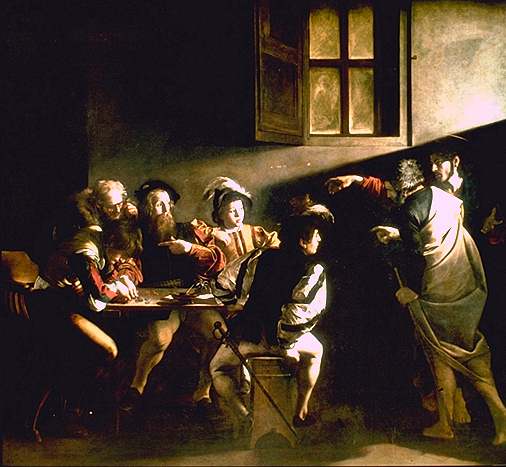
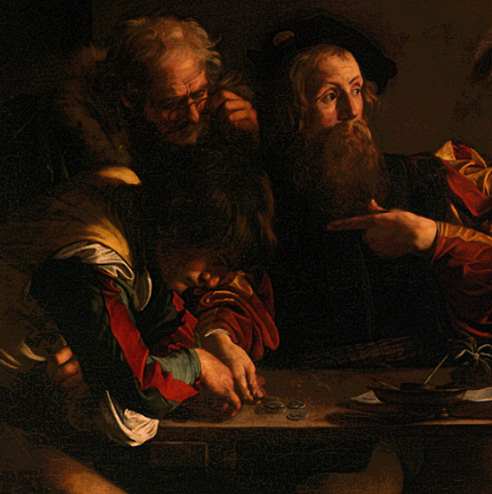
est transfiguré, beau, l'oeil lumineux, avec presque un sourire. Il se sent véritablement désigné. Le Christ
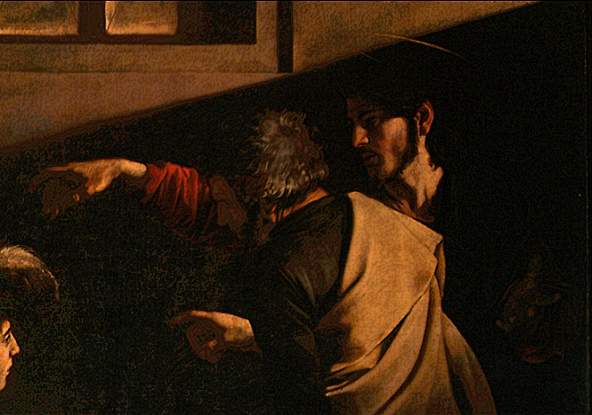
nous le cherchons dans la composition. Lorsque l'on isole son visage, on est frappé par la ferveur, la sacralité et en même temps l'humanité qui s'en dégage. Nous avons là l'une des têtes de Christ les plus frappantes d'évocation de ferveur et de grandeur que la peinture occidentale ait jamais connue. Il y a quelque chose de miraculeux dans la bonté, l'ouverture et la lumière de ce regard. Il est curieux de penser que l'homme dont on a dit qu'il était le plus débauché de son siècle a été celui qui a su peindre le mieux la vérité de l'humanité, de la générosité du Christ. Caravage se hisse au niveau des grands mystiques par cette faculté qu'il a de comprendre le Christ. Personne n'avait peint, si fidèlement aux Ecritures, la vocation de Matthieu. Bien entendu, des personnages semblent faire barrière à cette révélation. Ils ne font pas partie du mystère. Le jeune homme du premier
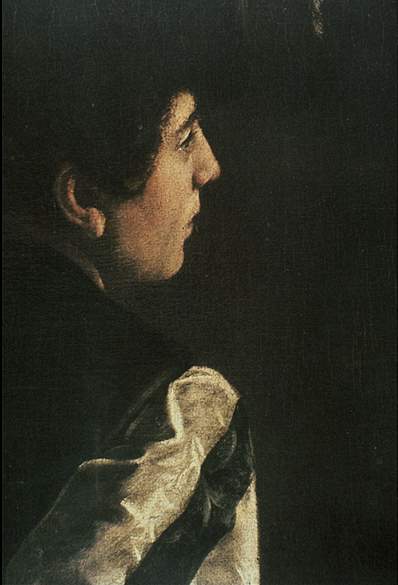
du premier plan
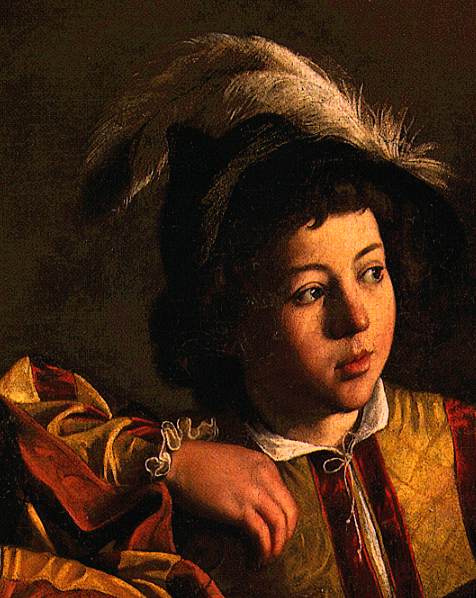
se retourne, il a entendu du bruit. Son compagnon regarde les nouveaux arrivants avec une vacuité de prunelle étonnante . Les regards des jeunes gens aux riches vêtements occultent les vrais regards de Matthieu et du Christ. Les yeux de Matthieu
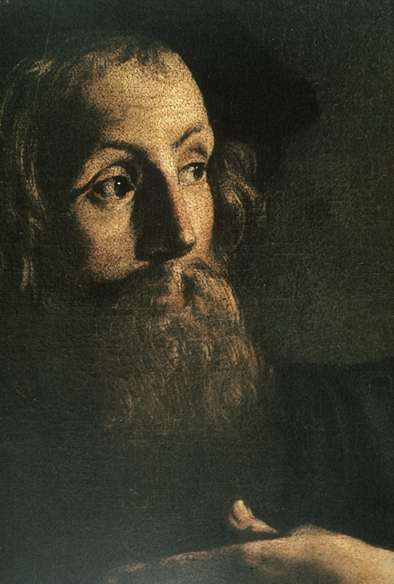
respirent la lumière des yeux du Christ
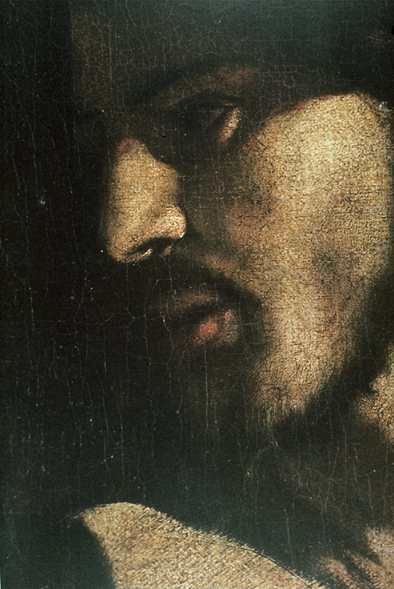
.
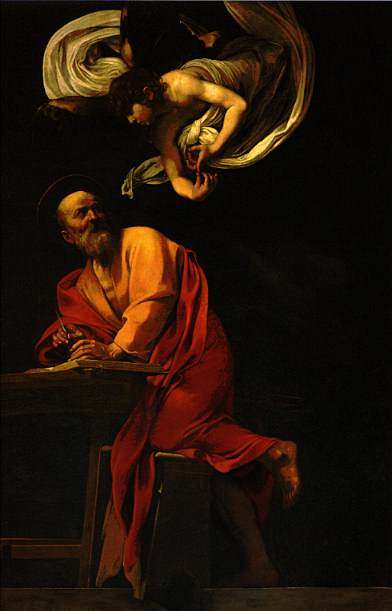
Saint Matthieu et l'ange
L'ange qui l'inspire est à la mesure de Matthieu. Il n'est pas un ange pour lettré, il est un ange pour batelier. Une frame pour la dia de l'entier au départ, puis deux pour les détails couplés. Qui n'a jamais peint un saint Matthieu aussi peu saint et un ange aussi peu ange? Matthieu était batelier. Il n'est pas un homme d'écriture, un homme de science, ni un lettré. En règle générale, lorsque l'on écrit un Evangile, on devient tout à coup docteur ès lettres, le doigt fin, le regard inspiré. Ici, pas du tout. Matthieu écrit péniblement. Caravage a tout mis en oeuvre pour que l'on sente l'épaisseur des articulations, la lourdeur des mains, le poids des épaules, la manière de se "tortiller" devant son bureau. Ces mains, rudes, calleuses savent à peine tenir une plume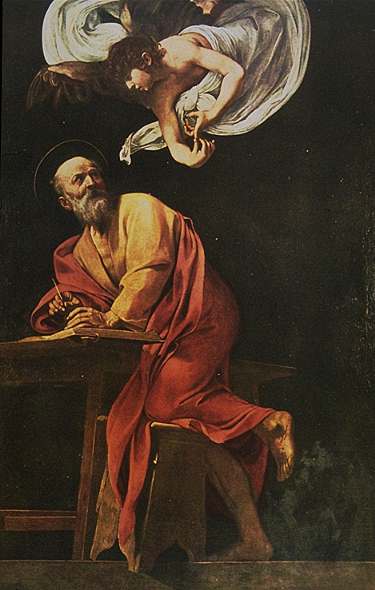
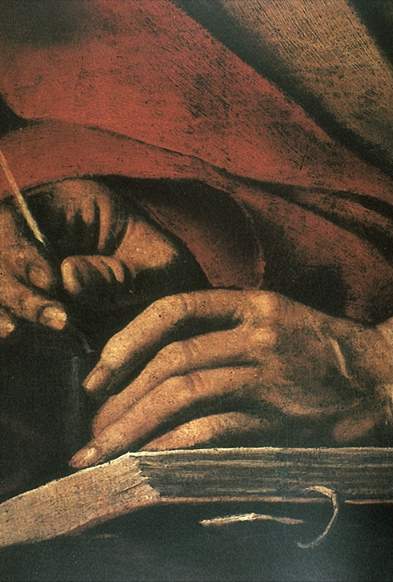
. L'ange qui l'inspire
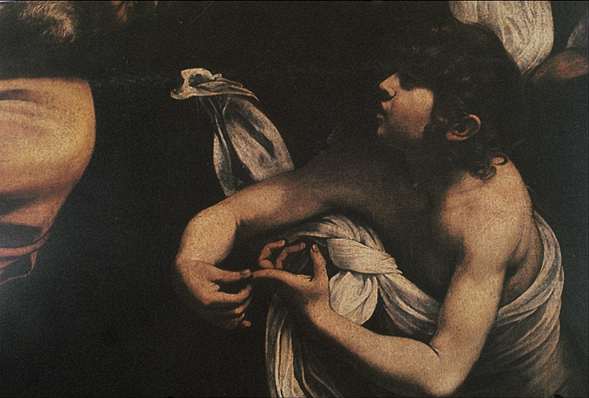
est à la mesure de Matthieu
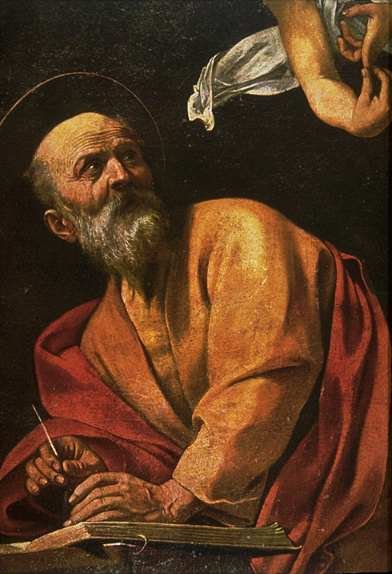
. Il n'est pas un ange pour lettré. Il est un ange pour batelier. Il a lui-même une tête de batelier. Malgré la maladresse de Matthieu, on voit son bon vouloir et l'aspect tourbillonnant de l'ange est d'autant plus miraculaire. Il apporte la révélation du Verbe à celui qui tente d'écrire. Ce dialogue respire une immense tendresse, une émotion et une ferveur intense. Le visage de Matthieu
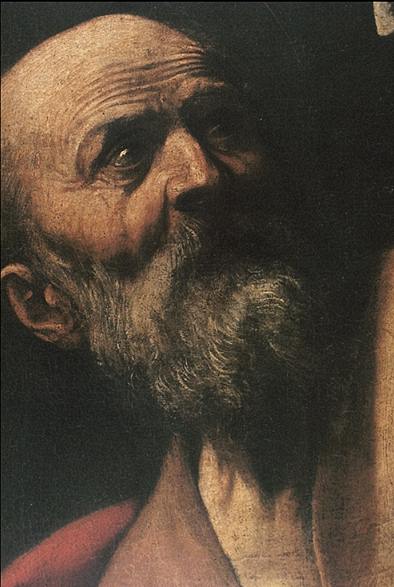
cerné par une peau rugueuse, une barbe sauvage, est rayonnant par le regard de reconnaissance qu'il lui adresse.
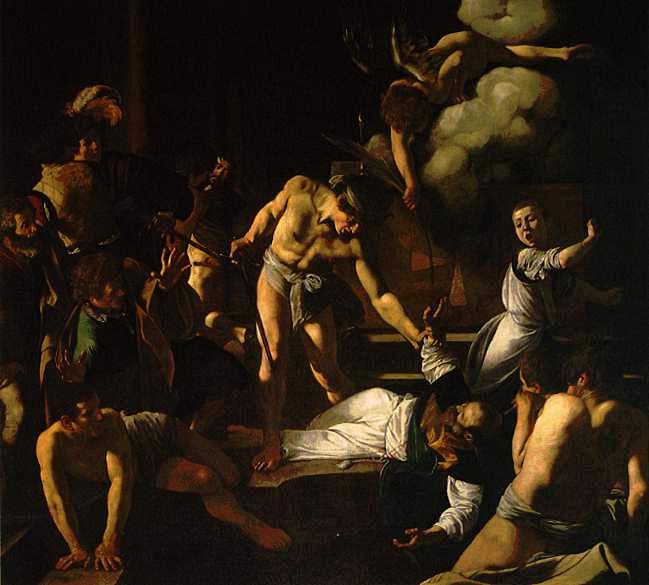
Martyre de Saint Matthieu
En haut, à gauche de la composition, un autoportrait de Caravage, protagoniste résigné plus qu'affolé, peut-être celui qui a compris et qui nous rappelle que nous assistons à une scène miraculaire.
Et puis, ce qui me paraît étrange, celui qui n'est pas concerné. Tout en haut, à gauche, un splendide jeune homme richement vêtu, contemple l'agonie du saint avec un détachement amusé.
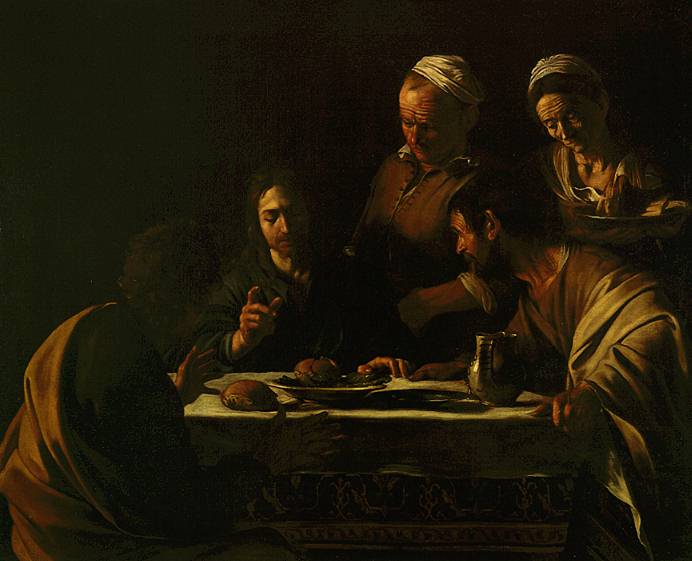
Cène à Emmaüs, London, National Gallery.
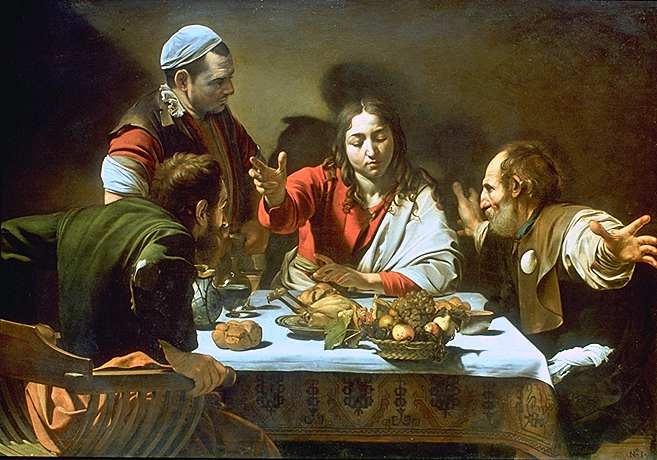
La lumière est utilisée d'une manière théâtrale. Sur la table, une belle nature morte dans laquelle Caravage s'amuse encore. Il aime montrer des poulets à la peau croquante, une miche, des miettes. Un goût pour la mise en scène de la table, un goût pour la mise en scène des couleurs. Le rouge de la robe du Christ correspond au rouge plus terne du vêtement de l'aubergiste. Ici la lumière est utilisée d'une manière théâtrale. L'ombre du Christ crée une auréole en négatif qui le met en exergue dans la composition.
Cène à Emmaüs, Milan, La Brera
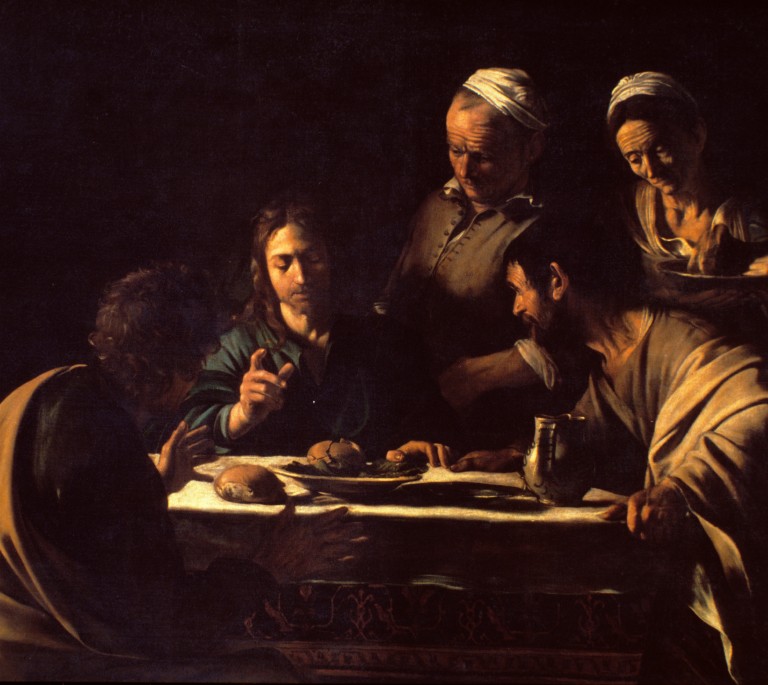
Plus aucune complaisance. En 1610, année de sa mort, Caravage reprend le même sujet. C'est le même Christ, la même table, la même nature morte, les mêmes comparses. Mais ce tableau est d'une autre trempe. La table, faite d'horizontales, est traitée comme une anamorphose. Plus aucune complaisance dans ce qui nous est montré sur la table et dans les expressions des personnages. Un camaïeu qui va du vert olive au sable en passant par toutes les modulations, dont le noir. Aucun effet. L'unique couleur est le bleu gris du vêtement du Christ. Une économie de moyen qui prépare le caravagisme. Il y a là tout ce que sera le jeune Vélasquez, Zurbaran, George de laTour, Le Nain ou Vermeer. Vermeer et Caravage ont tous deux l'art, la façon juste, d'opérer un camaïeu de gris par un bleu qui éclate. Vermeer aurait-il vu ce tableau?
David avec la tête de Goliath, Vienne, Kunsthistorisches Museum.
Un regard de sybille, de pythonisse
Sortant de la nuit, illuminé par un faisceau de lumière surnaturelle, David avance, le visage vidé par une vision divine. Un regard de sybille, de pythonisse. Tenant dans sa main la tête humaine, colossale de Goliath, David a l'air d'un mort en suspens. Goliath semble prêt à hurler sa colère et sa rage. Les deux visages appréhendés un peu de la même façon par la lumière forment un dialogue étourdissant. Retournement iconographique de la composition formidablement architecturée. David est frêle devant l'immensité de la tête de Goliath, marquant, dans toute l'horizontalité à laquelle Caravage a ramené les bras, les épaules et l'épée, une force contenue, déterminante. Le très beau visage de David, sculpté par cette lumière violente, ombreuse, est caractéristique de son clair-obscur extrêmement tranché. Le vêtement, le drapé, est presque absurdement ciselé, trop violent. L'opposition du noir et du blanc donne à David une forme de présence, une armure.
Caravage jugea-t-il ce tableau à effets? Détail de la tête de David

, de Goliath

.
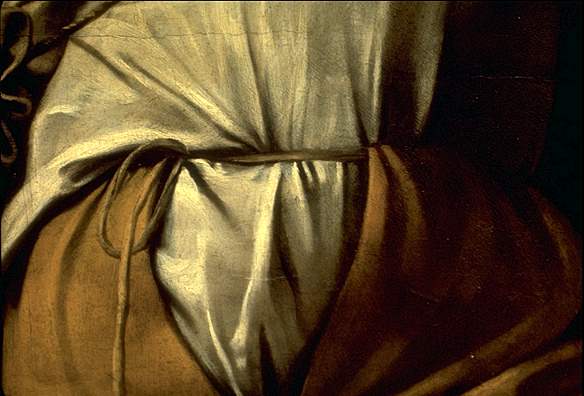
La ceinture
. Le passage du blanc à l'ocre du vêtement. L'habileté technique, sa rapidité de pinceau. Il y a des traits de pinceau qui, isolés, annoncent ce que seront un Vélasquez, un Franz Hals. Liberté, bonheur de la touche.
David et Goliath , Rome, galerie Borghèse.
Un dialogue tendu entre la juvénilité du vivant et la maturité du mort Les expressions de David et de la tête de Goliath deviennent plus problématiques, plus tendues. David a triomphé, mais triomphe-t-il vraiment? On sent en lui une douleur, une angoisse face à la mort, face au coup fatal qu'il vient de donner. Il ne triomphe plus du tout, comme dans la version de Vienne, et paraît presque perdu face à cette responsabilité de priver un être de vie. Une mélancolie tendue. Outrance du clair-obscur. Côté visionnaire dans le traitement du corps, délibérément déformé pour lui donner un aspect plus fragile encore. L'expression du visage reflète de la commisération, de la pitié. D'habitude, David triomphe. Là, il est sur le point de pleurer sur le geste qu'il vient d'accomplir. On remarque à quel point l'ensemble s'est épuré, simplifié.
Tout est devenu plus hiéroglyphique. David n'a plus aucune des séductions de l'oeuvre précédente. Une tristesse méditative, dans une absence de décor, une nuit immense, et un dialogue plus tendu entre la juvénilité du vivant et la maturité du mort. On voit comme cette oeuvre suit et perfectionne l'oeuvre précédente.
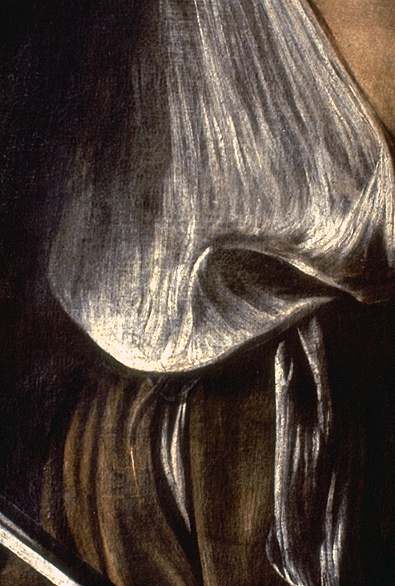
Le drapé

noir et blanc est un des plus beaux que Caravage ait jamais peint. Goliath
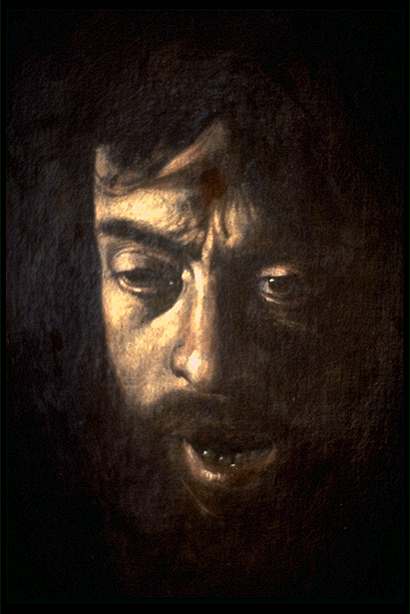
n'est plus simplement un masque effrayant mais exprime une résignation étonnante comme s'il voulait montrer, au-delà de la mort, qu'il avait accepté la sienne. Le détail est si prenant que les historiens d'art veulent y reconnaître un autoportrait

. Caravage s'est-il immortalisé sous les traits de Goliath, entre la douleur immense et le cri de révolte terrible de la Méduse furieuse? Une chose est certaine, ce visage, lorsqu'on l'a vu, lorsque l'on a pu capter son regard, on n'est pas prêt de l'oublier.
Saint Jean-Baptiste, Rome, bibliothèque Capitoline.
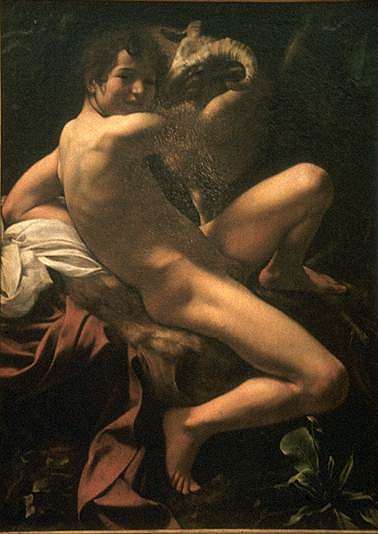
Un saint Jean-Baptiste ressemblant à un pâtre grec. Une peinture plus sensuelle que religieuse, mondaine et encore très maniériste. Un tableau surprenant à mettre dans une sacristie.
Saint Jean-Baptiste, Bâle, Kunstmuseum.
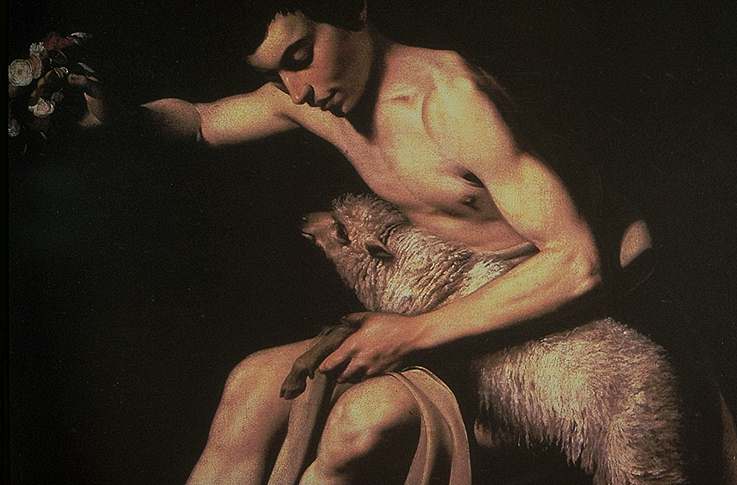
Dans les représentations traditionnelles, Jean-Baptiste est représenté comme un adolescent, accompagné d'un agneau, préfiguration de la Passion du Christ. Nous sommes loin des représentations de la peinture florentine ou romaine de la Grande Renaissance où Baptiste devenait un éphèbe à la manière grecque. Là, nous avons un jeune homme de type italien du 17 ème siècle, à la chair blafarde, traité sans aucune complaisance, sans rien de cet idéalisme que les générations précédentes avaient imposé aux arts plastiques, notamment au langage pictural. Baptiste se présente de façon réaliste, mot clef du destin de Caravage. Ce qui frappe le plus dans cette toile, c'est la répartition de la lumière. L'arrière-scène est plongée dans une obscurité totale. A aucun moment le décor n'est apparent. Ni objets familier, ni paysage, ni grotte ne le posent dans un lieu précis. On a l'impression qu'une toile de fond a été tendue derrière lui. Cette toile de fond est la nuit. Dans cette nuit marron foncé, presque noire, se détachent violemment, agressés par la lumière, l'épaule, la jambe, le profil de l'adolescent ainsi que le corps de l'agneau. Le terme technique pour cette peinture à effets de lumière, est le «clair-obscur». Caravage est l'inventeur du «clair-obscur» utilisé en tant qu'agent principal du drame que l'artiste pose sur la toile.
Saint Jean-Baptiste, Rome, Palazzo Corsini
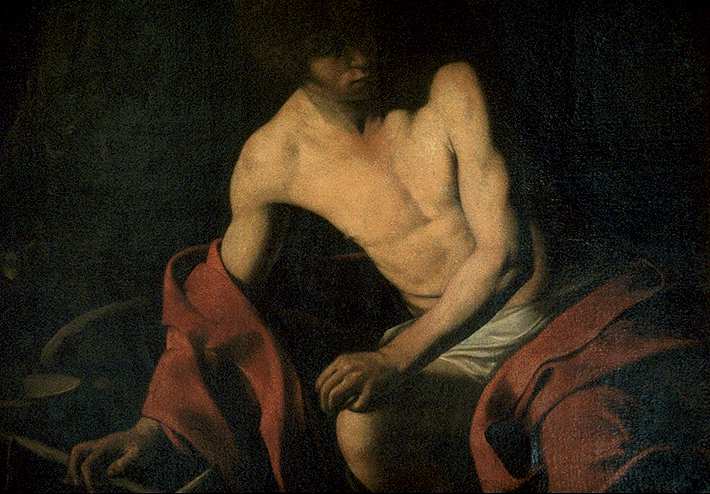
. Un homme de la rue Plus âgé, plus humain, celui-ci est un homme de la rue avec des traits fermés, communs. L'échancrure de son vêtement a laissé des traces de bronzage. Cela a beaucoup choqué à l'époque.
Saint Jean-Baptiste, Rome, galerie Borghèse.
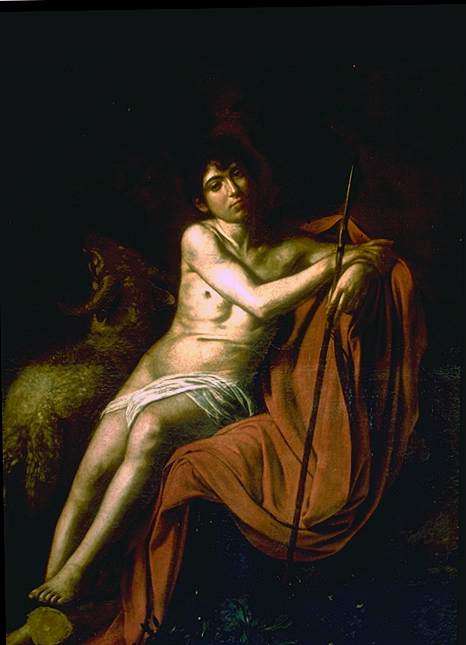
Un portrait ambigu La séduction du corps du premier a été abandonnée mais, cette fois, le visage est étonnant. Une expression de vide parce qu'il semble n'avoir jamais été plein. Une stupeur au sens étymologique du terme, mais en même temps creux, prêt à résonner. Ce portrait est très ambigu.
Saint Jean-Baptiste, Kansas City, W.Rockhill Nelson Gallery of Art
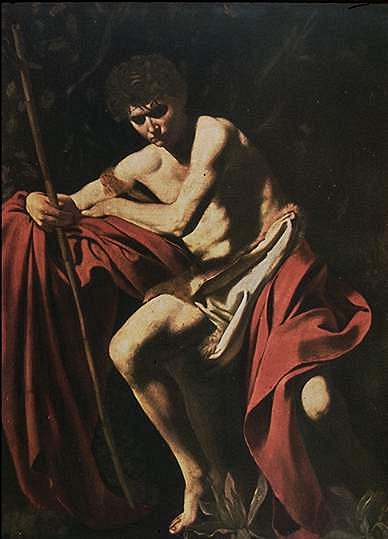
Une sculpture de l'ombre et de la lumière L'héroïsme est plus marqué. La prise de possession de l'espace plus déterminée, plus définie. L'ombre et la lumière jouent de façon telle que le visage accuse l'ambiguité du sentiment que reflète le saint. Le visage paraît paisible. Le jeu tranché du clair-obscur lui donne une grande violence. Une sculpture de l'ombre et de la lumière. On dit de ce tableau qu'il est le plus michelangelesque dans sa monumentalité. A l'opposé du génie épique de Michel-Ange, celui de Caravage, ici, est un génie de monumentalisme dans le silence le plus absolu. Oeuvre d'un total silence, d'une totale sérénité, en dépit du dramatisme de la lumière et du traitement de l'ombre.
Le terme apparaît pour la première fois dans un dictionnaire en 1690:
- Du portugais: barocco
- De l'espagnol berrueco: perle imparfaite.
- Au 18ème siècle: synonyme de bizarre
- Au 19ème siècle: Burckhardt lui donne son sens actuel; style de rigueur et d'austérité.
Le baroque est une période ambiguë : sévère et folle, diurne et nocturne, célébrant la vie, exaltant la mort. Memento mori (Souviens-toi de ta mort) en est la devise.
Précision de temps:
- Début:1585. Avènement de Sixte-Quint.
- Fin:1680. Mort du Bernin.
Lieu. Rome. Le Saint-Siège.Précisions de raison:
- Le sac de Rome en 1527 par Charles- Quint.
- La crise de l'Eglise.
- La Réforme.
- La Contre-Réforme.
- La coalition des ordres autour du pape.
- L'invention de l'ordre jésuite.
- «perinde ac cadaver»
- La personnalité des papes eux-mêmes.
- La Contre-Réforme ou Réforme catholique, née du besoin de l'Eglise de se régénérer, de s'épurer.
De 1545 à 1563, le Concile de Trente marque l'apogée de ces mouvements d'auto-réforme:
- redéfinition des doctrines et des dogmes.
- suppression des abus, des privilèges et des cumuls.
- établissement de l'autorité du Saint Siège.
- refonte de l'administration pontificale.
- création d'instruments adéquats, le Collège Romain, 1556.
Le baroque apparaît dès le XV ème siècle avec des figures de proue comme Savonarole, saint Vincent Ferrier, saint Bernardin de Sienne.
Il s'impose dès le 16ème avec la création d'ordres nouveaux; Les Capucins (1525), les Théatins, les Barnabites, les Ursulines et surtout, dès 1540, les Jésuites, approuvés par Paul III Farnèse et constitués par saint Ignace de Loyola.
Tout ceci fut l'oeuvre de grands défenseurs de la foi :
- saint Charles Borromée en Italie
- saint Thomas de Villeneuve en Espagne
- saint Barthélemy des Martyrs au Portugal
- saint François de Sales en France
mais aussi : saint Jean de la Croix, sainte Thérèse d'Avilla, saint François Xavier et le mouvement missionnaire soutenus par des papes inébranlables:
- Pie V 1556-1572 Antonio GhiglieriGrand inquisiteurRéformateur de la cour vaticane.Inventeur de l'index
- Grégoire XIII 1572-1585 Ugo Buoncompagni Réformateur du calendrierFondateur du Collège Romain.Contemporain de saint Bartélémy
- Sixte V 1585-1590 Félix PerettiRedouté par Grégoire XIII. Éloigné de la Curie
- Clément VIII Ippolito Aldobrandini 1592-1605
- Léon XI Alessandro da Médicis 1605
- Paul V Camille Borghèse 1605-1621.
- Urbain VIII. Matteo Barberini 1623 -1644
- Innocent X Pamphili 1644-1655Nonce à NaplesLégat en France et en Espagne.Cardinal dès 1629Pape de 1644 à 1655 Condamne le jansénisme en 1653
- Alexandre VII Chigi 1655-1667
Ce sont eux qui bâtirent la Rome nouvelle. Ce sont leurs blasons qui en ornent les monuments immortels.
Le clair-obscur à la conquête de l'Europe ou le caravagisme
En cette fin du 16ème siècle épuisé, épuisante, marquée par les écoles maniéristes et postmaniéristes, arrive la période de la Contre-Réforme et avec elle, les prémices de la période baroque, qui va dominer le 17ème siècle. A ce moment, Caravage fait son entrée sur la scène romaine. Il s'attirera très vite une immense notoriété par les inventions de son langage plastique. Il aura à ses côtés des émules. Innombrables sont les peintres qui seront tentés d'imiter son originalité, son style révolutionnaire. Parmi ses élèves, citons les Carrache, le Dominicain, Domenico Fetti, Luca Giordano, le Guerchin, Mattia Pretti. Avec plus ou moins de talent, ils tenteront d'approcher le miracle Caravage, sans jamais y parvenir.Le langage caravagesque franchit rapidement les frontière de l'Italie. En 1610, Caravage meurt à Porto Ercole. En 1598, il avait peint les trois compositions de la chapelle Contarelli à Saint-Louis-des-Français. Rome avait détesté (Poussin, plus tard, confirmera violemment les détracteurs). Rome avait adoré, les jeunes peintres en tête. Le caravagisme était né. Il ne fut pas seulement italien, romain et napolitain, il fut aussi européen: par leurs études, leurs stages à Rome, de nombreux jeunes peintres véhiculèrent le caravagisme à travers toute l'Europe. Suprématie du caravagisme
Au sud:
Zurbaran 1598 - 1664
Francisco de Zurbaran
Naissance en Espagne, à Fuente de Cantos de Francisco de Zurbaran. Très mal connu, secret, nous ne possédons ni autoportrait, ni lettres de lui. Ses oeuvres furent dispersées lors de l'invasion napoléonienne, ses ensembles disloqués lors de la fermeture des couvents. Seul le monastère de Guadalupe en Estremadura conserve intact son décor.Il travaille à Séville chez Pedro Diaz de Villanevra. En 1627, son Christ (Chicago, Art Institute) provoque l'enthousiasme des Sévilliens et assied sa réputation.En 1634, il s'installe à Madrid où il travaille avec Vélasquez au palais de Buen Retiro. On le nomme peintre du roi.Rentré à Séville, il subit la jalousie et l'animosité des peintres locaux: les commandes se raréfient...Il est vrai que le goût change, on lui préfère Murillo.Dès lors, il travaille pour les colonies, pour Lima surtout.En 1664, il meurt à Madrid, pauvre et oublié.
Quelques oeuvres:
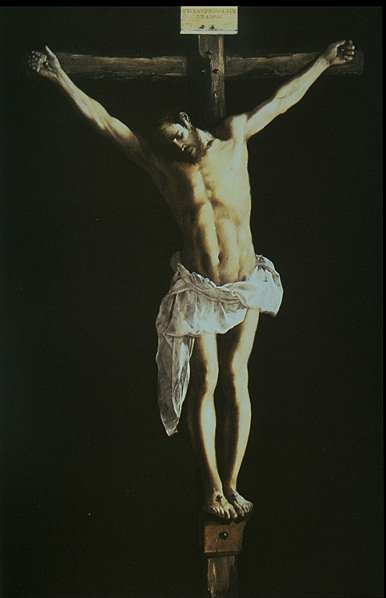
- Christ en croix mourant - Chicago, Art Institute
- Exposition du corps de saint Bonaventure -Paris, Louvre Museum
- L'atelier de Nazareth- Cleveland, Museum of Art
- Saint Casilde - Madrid, Prado Museum/a>
- Hercule et le lion de Némée - Madrid, Prado Museum
- Saint François en prière - London, National Gallery
- Le bienheureux Sérapion - Hartford, Conn., Wadsworth Museum
- Apparition de saint Pierre crucifié à saint Pierre Nolasque
- Nature Morte
- Hercule et le lion de Némée - Madrid, Prado Museum
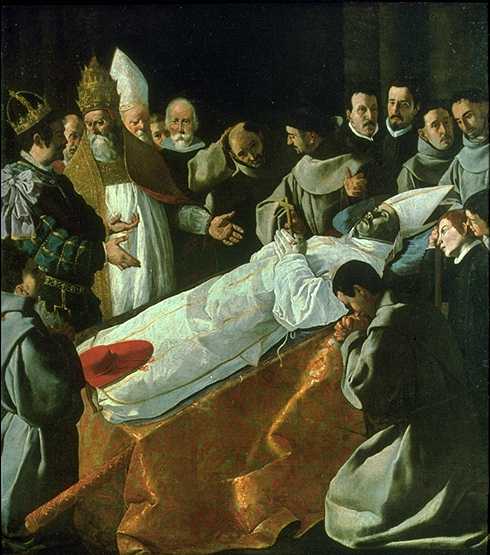
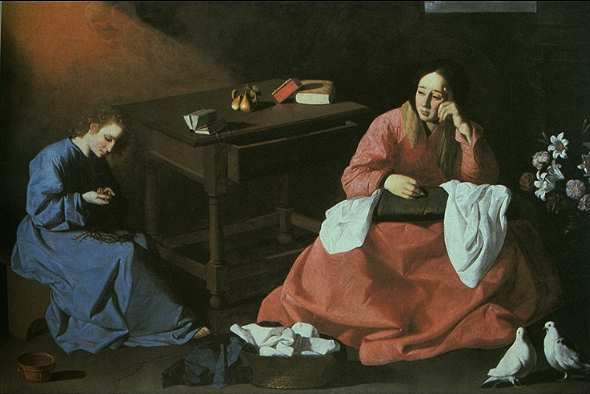
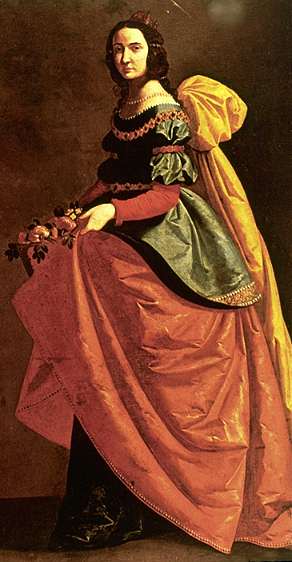
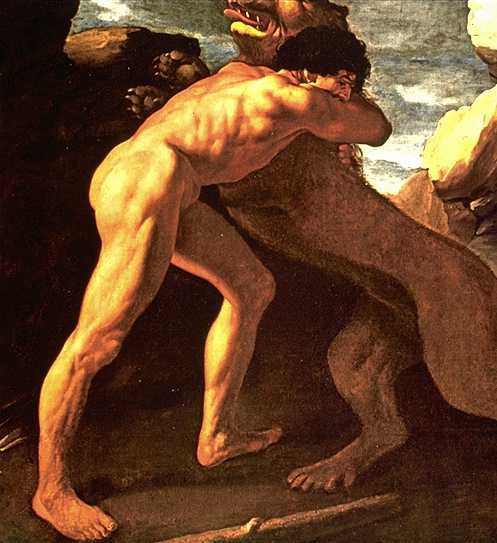
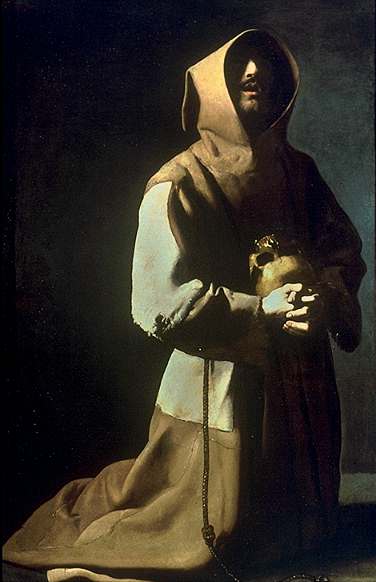
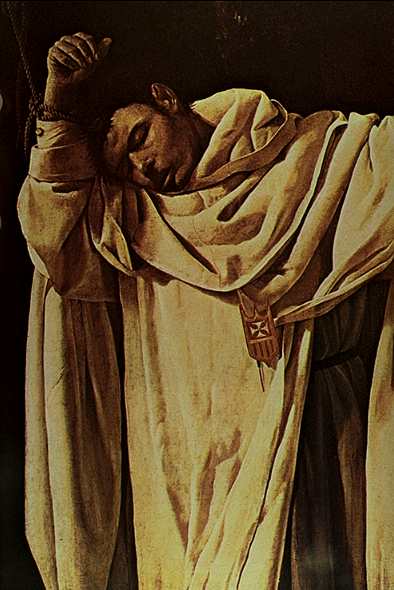
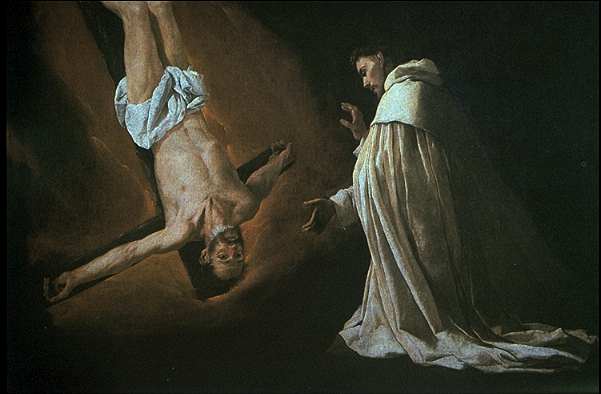
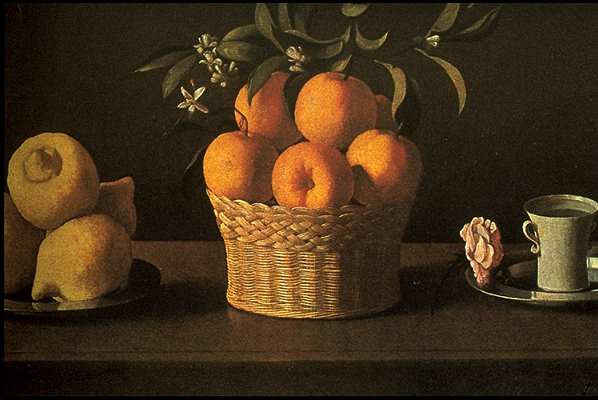
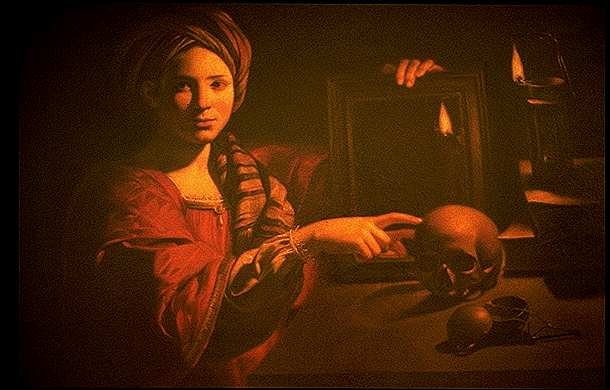
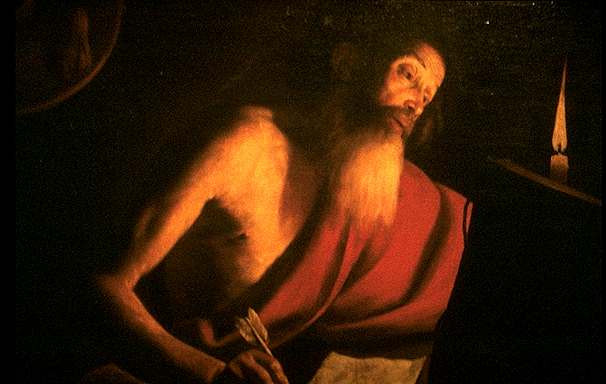
Au centre: La Tour 1593 - 1652 [1], Trophime Bigot - 1579 -1650
Trophime Bigot
- 1579 : naît à Arles- formation locale
- 1621 - 1634 : cité dans les archives romaines, plus exactement dans les actes de l'Académie de Saint-Luc.
- commande de 3 oeuvres pour Santa Maria in Aquiro.
- 2 oeuvres attestées dans la collection Giustinani.
- meurt à Arles
- pour l'heure, son catalogue regroupe une quarantaine d'oeuvres
Au nord: Ter Brugghen 1598 - 1629
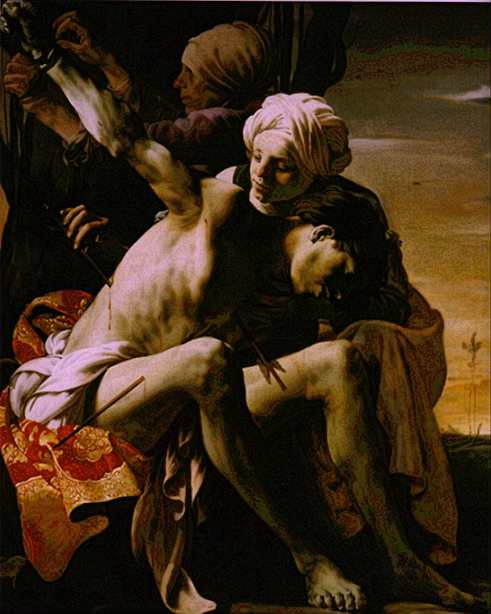
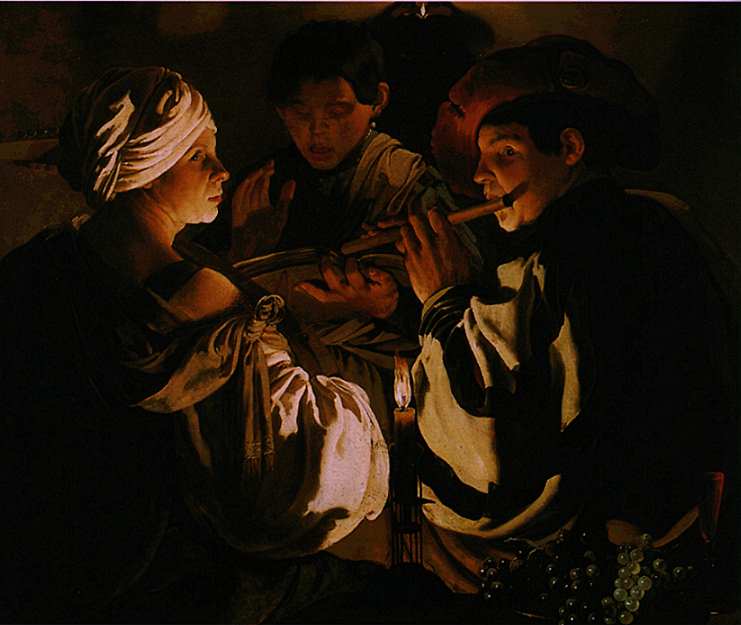
Hendrick Ter Brugghen et la Hollande
- 1588 : naissance à Deventer de Hendrick Ter Brugghen.Formation chez le peintre Abraham Blaemaert
- 1604 : voyage en Italie. Il restera 10 ans à Rome et rentrera par Milan.
- il est le premier peintre du Nord à découvrir le Caravage.
- 1616 : il est inscrit à la Guilde de St-Luc à Utrecht.
- 1629 : il meurt à Utrecht.
Dans cette peinture
Le Concert - Londres National Gallery
[1] Les clés du regard
Le catalogue des oeuvres de «Tout l'œuvre peint de Caravage» Les Classiques de l'Art - Flammarion recense 73 oeuvres.
Mina Gregori dans «Caravage» au éditions Gallimard / Electra présente 87 oeuvres du peintre.
Ce programme vous propose 37 de ses oeuvres:
- Les œuvres profanes: Caravage, peintre de genre.
Bouclier à tête de Méduse
- Florence, Galleria degli Uffizi (ca. 1597-9)
Jeune garçon à la corbeille de fruits
- Rome, Galleria Borghese (1593-94)
Jeune garçon mordu par un lézard
- London, National Gallery 1595-96 (cf. also 1596-97, Florence, Fondazione Roberto Longhi)
Bacchus
- Florence, Galleria degli Uffizi (ca. 1596-97)
Petit Bacchus malade
- Rome, Galleria Borghese (ca. 1593)
La Diseuse de bonne Aventure
- Paris, Musée du Louvre (1596-97) (cf. also 1593-94, Pinacoteca Capitolina)
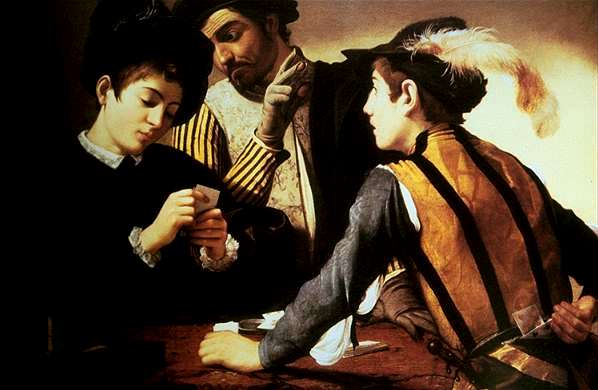
Les Tricheurs
- Fort Worth (Texas), Kimbell Art Museum (ca. 1594)
Narcisse
- Rome, Galleria Nazionale d'Arte Antica, Palazzo Corsini (ca. 1598-99)
Corbeille de fruits
- Milan, Pinacoteca Ambrosiana (ca. 1597-98)

- Les premières oeuvres religieuses, spirituelles - «grandes figures» :
Repos pendant la fuite en Egypte">
- Rome, Galleria Doria-Pamphili (ca.1595-1596)
Judith et Holopherne
- Rome, Galleria Nazionale d'Arte Antica, Palazzo Barberini(1597-98)
- La poursuite des thèmes :
- Saint Jean-Baptiste:
1602, Rome, Musei Capitolini
1603-04, Kansas City, W. Rockhill Nelson Gallery of Art
ca. 1603-04, Rome
, Galleria Nazionale d'Arte Antica Palazzo Corsini
1609-1610, Rome, Galleria Borghese
Bâle, Kunstmuseum
- David avec la tête de Goliath:
(cf. also, Madrid, Prado, 1597-98)
Vienna, Kunsthistorisches Museum (1607)
Roma, Galleria Borghese (1610)
- Cène à Emmaüs:
London, National Gallery (1601)
Milan, Pinacoteca di Brera (1606)
- La période des figures solitaires:
Madeleine repentante
- Rome, galerie Doria-Pamphili (1594-95)
Sainte Catherine d'Alexandrie
- Madrid, collection Thyssen (1597)
Saint Jérôme
- Rome, galerie Borghèse (1606) (cf. also 1608, La Vallette(Malta) Cathedral St. John)



- Le cycle de Saint-Louis-des-Français: vie de saint Matthieu
Vocation de saint Matthieu
(1599-1600)
Martyre de saint Matthieu
(1599-1600)
Saint Matthieu et l'Ange
(1602)
- La grande maturité:
- Rome:
Madone des Pèlerins
- Eglise Sant' Agostino
Crucifiement de saint Pierre
- Eglise Santa Maria del Popolo
Conversion de saint Paul
- Eglise Santa Maria del Popolo
Mise au Tombeau
- Pinacothèque Vaticane (1602-04)
Mort de la Vierge
- Paris Musée du Louvre (1601-1605)
- Naples:
Madone du Rosaire
- Vienne, Kunsthistorisches Museum (1606-1607)
Les sept Oeuvres de Miséricordes
- Naples, église du Pio Monte della Misericordia
- La Vallette (Malta):
Décollation de saint Jean-Baptiste
- La Valette, Malte, Cathédrale Saint-Jean (1608)
- Sicile:
Résurrection de Lazare
- Messine, Musée Régional (1608-09)
Adoration des bergers
- Messine, Musée Régional (1609)


;)