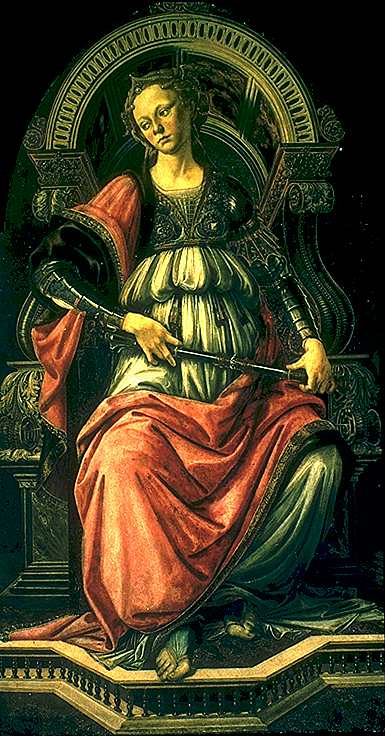

C'est ce tableau qui a donné ses chances à Botticelli et lui a valu une aura presque surnaturelle qu'il est peut-être le premier de la Renaissance à avoir eue : celle de "fils chéri des dieux", de "prodige divin". Cette forme d'auréole, de mandorle qui a entouré Botticelli lui a apporté une notoriété qui n'a jamais failli jusqu'à aujourd'hui. C'est le premier tableau d'un très jeune peintre que tout Florence est allé voir et qui a profité de conditions publicitaires assez extraordinaires. Ce tableau allégorique mesure 1.75 m. de haut et a été peint pour servir de dossier à une chaise. L'un des grands tribunaux de commerce de cette Florence commerçante de la Renaissance, le Tribunal de la Mercanzia, a rafraîchi ses locaux, commandé de nouvelles stalles et il a eu l'idée, très Renaissance d'ailleurs, d'en orner les hauts dossiers de compositions peintes représentant les grandes vertus. Et c'est à Botticelli tout jeune que l'on a commandé la vertu présidentielle : la Force. Lorsque le tribunal a été dissout en 1771, l'œuvre a passé à l'Accademia où elle a traîné dans les greniers, de là aux Offices où elle est restée dans les dépôts et, en 1863 seulement, on l'a retrouvée et exposée où elle est aujourd'hui : au milieu des chefs-d'œuvre de la première Renaissance.
Curieusement, elle ne se trouve pas encore parmi les autres œuvres de Botticelli que possède la Galerie des Offices, trois salles avant, mais dans l'ensemble des sept dossiers où nous la remettrons en place tout à l'heure. Nous sommes en 1470 à Florence. Il s'est passé moins de cinquante ans depuis la conférence de la semaine dernière et pourtant le monde a tourné presque complètement et nous allons reprendre, comme d'habitude, les chapitres de l'histoire occidentale et orientale pour situer ce qui se faisait exactement pendant que Sandro Botticelli peignait la Force. Gazette du monde en 1470 : en France , en Angleterre, en Espagne, dans l'Empire ottoman, en Chine, au Japon.
Gazette du monde en 1470 - En France
La première des choses consistera à assainir le domaine royal, à assainir ces propriétés, ces fiefs qui ne savent plus s'ils sont anglais ou français. Deuxièmement : reprendre l'une après l'autre toutes les places où il y a encore des Anglais, souvent avec la complicité des barons français. Ces places seront toutes reprises sauf une : celle de Calais qui deviendra célèbre quelque temps plus tard par ses bourgeois. La troisième chose importante que l'on doit à Charles VII est d'avoir reconstitué son armée qui n'existait plus. La grande croisade de Jeanne d'Arc et toutes les croisades parallèles qui ont bouté les Anglais hors de France ont coûté très cher et il n'y a quasiment plus d'armée. On nous a dit dans nos leçons d'histoire que pour la première fois dans l'histoire militaire de l'Occident, Charles VII a obligé des nobles à être fantassins, c'est-à-dire à ne plus avoir ce statut de chevaliers qui était le leur, et cela va dresser contre lui une grande partie de la baronnie française. Mais il reconstitue une armée solide avec un certain nombre de barons qui lui sont fidèles et qui sont enthousiastes à l'idée d'une France qui reprend pied. La quatrième chose dans laquelle le roi se lance courageusement est d'assainir les finances, de rétablir la taille et la gabelle et de trouver quelqu'un qui l'aide. Charles VII aura une chance fabuleuse car il trouvera l'homme d'argent par excellence : le fameux Jacques Coeur qui sera son argentier et l'un des personnages les plus palpitants de toute l'histoire de ce qu'on appelle encore le Moyen Age. Homme de génie, il va assainir la situation financière française profitant - et c'est tellement normal - d'assainir la sienne propre. Rappelons son slogan, celui de son blason : "A vaillant coeur, rien d'impossible". Et il faut dire que ses comptes ont été aussi vaillamment défendus que ceux de la France, ce qui lui coûtera fort cher beaucoup plus tard.
Tout cela est très beau, l'armée, les impôts, le peuple, le territoire, mais il y a eu aussi quelques problèmes. La noblesse était totalement opposée à cet étrange démocratisme du roi et elle s'est soulevée contre lui. Cette rébellion larvée de la noblesse a gardé un nom dans l'histoire : la Praguerie. Charles VII la décapitera sans pitié, même en apprenant que son propre fils, le Dauphin, est quasiment à la tête de cette révolte, derrière les plus bruyants des insurgés. Ce Dauphin est le futur Louis XI que l'on va voir apparaître bientôt. Il y a ensuite l'Eglise : le Pape a profité de ce que les Anglais étaient là, et la situation catastrophique, pour s'ingérer dans les affaires de sa fille bien-aimée, la France, et y prendre une place de plus en plus envahissante.
Charles VII réagira avec une extraordinaire violence, le 7 juillet 1438, dans la cathédrale de Bourges où il signe la Pragmatique Sanction qui est un édit à son nom : "Moi, roi de France, j'interdis au successeur de Pierre, c'est-à-dire au pape, de s'ingérer dans la nomination des évêques et, de façon plus large, dans les affaires de l'Eglise française". C'est la première fois qu'un tel texte était promulgué, ce qui a failli coûter à Charles VII son excommunication, mais il était sur une telle lancée de gloire et son aura était si grande en Europe que le pape a préféré reculer. Et la Pragmatique Sanction est restée effective depuis 1438. C'est beaucoup pour un seul homme et, en plus, il a eu encore le temps de faire un grand nombre d'enfants à sa femme, onze pour être précis, et quatre à sa favorite. Il faut citer cette favorite car c'est la première favorite de l'histoire de France, la fameuse Agnès Sorel, celle qu'on appelle la Dame de Beauté en oubliant qu'il ne s'agit pas de sa beauté mais du Château de Beauté-sur-Marne qui lui avait été offert par le roi. C'est une des femmes par lesquelles le raffinement italien est entré le plus effectivement à la cour de France.
Charles VII est mort et Louis XI lui a succédé. C'est important d'avoir tant parlé de Charles VII parce que Louis XI va véritablement profiter du climat d'assainissement total que son père a non seulement entrepris mais achevé : Louis XI hérite d'une France saine, ce qui est énorme. Louis XI aura aussi à mater des révoltes, dont celles de ses propres complices de la Praguerie. Quand on devient un peu révolutionnaire, conjuré, ataviquement on continue, même si son cousin s'est fait supprimer son château, a été défait de ses biens et a été exilé, ce qui était arrivé à nombre de nobles sous Charles VII. On se dit que soi-même on réussira peut-être.
Les nobles continuent à ourdir leurs noirs dessins sous le règne de Louis XI et ce sont les mêmes noms que ceux de ses complices de la Praguerie, ce sont leurs neveux qui ont pris la place. Mais Louis XI sait comment sont organisées ces révoltes larvées, il sait comment les mater et il tapera très fort. Se sentant bien chez lui, bien en France, il se tourne vers cet ennemi de la France, allié et ennemi ataviquement en alternance, qu'est la Bourgogne. Philippe le Bon est mort et son fils a pris sa place. Il a 37 ans, dix ans de moins que Louis XI. Louis XI est laid, le Duc de Bourgogne est beau comme un dieu : c'est Charles le Téméraire. Louis XI déteste le Duc de Bourgogne, la Bourgogne, la richesse et l'influence de la Bourgogne, et il lutte tant qu'il peut pour essayer de saper l'autorité bourguignonne. Il a une idée absolument géniale : il pousse à la révolte les villes propriétés de la Bourgogne sur Liège et Gand et cela marche. Charles le Téméraire un peu affolé le convoque pour parler du sort de la France et de la Bourgogne. Louis XI se rue à Péronne, sûr de trouver un Charles le Téméraire abattu, mais ce sera l'emprisonnement de Péronne où le roi Louis XI sera prisonnier du Duc de Bourgogne jusqu'au moment où il signera tout ce qui est nécessaire à Charles pour continuer à être la figure primautaire de l'Occident.
Lorsque Botticelli peint la Force, Louis XI est presque un grand roi mais il vient de perdre une quantité formidable de ses atouts par l'imprudence de l'entrevue de Péronne. En 1470, il est tout juste sorti de Péronne et il continue à frôler les murs avec un teint plus gris que jamais parce qu'il s'en remet mal et, pour se venger, tous ceux qui pourraient avoir, d'une façon ou d'une autre, approché le Téméraire pendant son incarcération involontaire sont mis en prison, dont le cardinal de la Balue qui inaugurera les prisons inventées par Louis XI, prisons raffinées que l'on appelle les "fillettes".
Voilà pour la France dont on peut dire qu'elle est peut-être plus saine qu'elle ne l'était 45 ans auparavant, mais qu'elle devrait l'être bien plus. Louis XI doit apprendre à "se faire les dents" : il les a eues trop longues et trop rapides, et Charles le Téméraire l'a pris de vitesse avec ce fameux coup de l'entrevue de Péronne.
Gazette du monde en 1470 - En France
Gazette du monde en 1470 - En Angleterre
Gazette du monde en 1470 - En Angleterre
Gazette du monde en 1470 - En Espagne
Nous voyons donc un pays un peu sur le statu quo : la France, un pays toujours en dérive : l'Angleterre, et une puissance en train de naître, cette Espagne dont on ne parle pas encore mais qui est en train de se faire vraiment.
Gazette du monde en 1470 - En Espagne
Gazette du monde en 1470 - L'Empire ottoman
Gazette du monde en 1470 - L'Empire ottoman
Gazette du monde en 1470 - Chine
Gazette du monde en 1470 - Chine
Gazette du monde en 1470 - Japon
Gazette du monde en 1470 - Japon
Il reste la page de Florence et des Médicis que nous allons ouvrir maintenant, avant de nous consacrer à sa biographie, à deux commandes : fresques de la Villa Lemni et celles de la Chapelle Sixtine. Nous reviendrons ensuite à l'Allégorie de la Force puis aborderons son œuvre: les œuvres religieuses, dont la Nativité mystique, et les œuvres profanes, notamment la Naissance de Vénus et le Printemps, sans oublier l'Histoire de Nastagio degli Onesti. Nous admirerons enfin les dessins qui nous amèneront à la conclusion de notre conférence d'aujourd'hui sur Sandro Botticelli.
Florence et les Médicis
Elle était une république sous Masaccio, elle ne l'est plus tout à fait sous Botticelli : les Médicis ont réussi à prendre le gouvernement de Florence, sinon le pouvoir. Nous sommes sous le plus grand des trois, Laurent le Magnifique.
La dynastie a été fondée par Cosme l'Ancien et son épouse Contesina de Bardi. Ils ont eu entre autres un fils : Pietro appelé, à cause d'une forme d'arthrite précoce, Pierre le Goutteux. Devenu maître de Florence, Pietro avait épousé l'admirable Lucrezia Tornabuoni, l'une des plus belles figures que l'histoire de la sculpture et de la peinture nous ait léguée. Ils ont eu des enfants, parmi lesquels celui qui règne maintenant : Lorenzo, celui que l'on appelle Laurent le Magnifique. Laurent a épousé Clarisse Orsini, magnifique liaison dynastique Orsini-Médicis, de nouveau deux pouvoirs qui se conjuguent admirablement. Ils auront trois enfants principaux, le premier Pierre II, appellé Pierre l'Infortuné et qui mettra fin aux grands Médicis en étant bêtement chassé de Florence. Le deuxième est Julien, plus connu sous le nom de Duc de Nemours qui a laissé de grandes traces dans l'histoire notamment de la littérature et de la littérature française. Le troisième s'appelait Jean, le plus glorieux des trois car il deviendra l'un des grands papes de la Renaissance sous le nom de Léon X.
Nous sommes à l'époque des fameux trois premiers Médicis qui tissent, avec une sûreté de jugement absolument formidable, la toile de leurs alliances et de leurs intérêts pour asseoir de mieux en mieux Florence qui est vraiment en train de devenir ce que Laurent voulait : la nouvelle Alexandrie, c'est-à-dire véritablement le phare du monde.
En fait, lorsque Pierre le Goutteux s'est retiré du pouvoir, il l'a légué non pas à Laurent mais à ses deux fils, Laurent et Julien, tous deux portant le titre de "principi estate", de prince d'Etat. Laurent ne régnera seul que plus tard, après avril 1478, date de la conjuration terrifiante où l'on tentera d'assassiner les Médicis au Dôme. Laurent pourra s'enfuir grâce à une porte de sacristie non fermée mais Julien y laissera sa vie et, à partir de cette date, Laurent le Magnifique sera le seul maître de Florence et présidera aux destinées de Florence jusqu'à sa mort le 8 avril 1492. Portraits des Médicis: petite galerie de ces personnages dont les visages sont parfois inattendus :
Dans cette époque de grande célébration, les artistes, les sculpteurs comme les peintres se mettent au service de la dynastie et de ses alliés. Nous allons voir quelques portraits de grands Florentins de cette époque. Naturellement, Botticelli a été peintre auprès des Médicis et ils ont souvent fait appel à lui pour des portraits qu'on envoyait à travers tout l'Occident.
La dynastie a été fondée par Cosme l'Ancien et son épouse Contesina de Bardi. Ils ont eu entre autres un fils : Pietro appelé, à cause d'une forme d'arthrite précoce, Pierre le Goutteux. Devenu maître de Florence, Pietro avait épousé l'admirable Lucrezia Tornabuoni, l'une des plus belles figures que l'histoire de la sculpture et de la peinture nous ait léguée. Ils ont eu des enfants, parmi lesquels celui qui règne maintenant : Lorenzo, celui que l'on appelle Laurent le Magnifique. Laurent a épousé Clarisse Orsini, magnifique liaison dynastique Orsini-Médicis, de nouveau deux pouvoirs qui se conjuguent admirablement. Ils auront trois enfants principaux, le premier Pierre II, appellé Pierre l'Infortuné et qui mettra fin aux grands Médicis en étant bêtement chassé de Florence. Le deuxième est Julien, plus connu sous le nom de Duc de Nemours qui a laissé de grandes traces dans l'histoire notamment de la littérature et de la littérature française. Le troisième s'appelait Jean, le plus glorieux des trois car il deviendra l'un des grands papes de la Renaissance sous le nom de Léon X.
Nous sommes à l'époque des fameux trois premiers Médicis qui tissent, avec une sûreté de jugement absolument formidable, la toile de leurs alliances et de leurs intérêts pour asseoir de mieux en mieux Florence qui est vraiment en train de devenir ce que Laurent voulait : la nouvelle Alexandrie, c'est-à-dire véritablement le phare du monde.
En fait, lorsque Pierre le Goutteux s'est retiré du pouvoir, il l'a légué non pas à Laurent mais à ses deux fils, Laurent et Julien, tous deux portant le titre de "principi estate", de prince d'Etat. Laurent ne régnera seul que plus tard, après avril 1478, date de la conjuration terrifiante où l'on tentera d'assassiner les Médicis au Dôme. Laurent pourra s'enfuir grâce à une porte de sacristie non fermée mais Julien y laissera sa vie et, à partir de cette date, Laurent le Magnifique sera le seul maître de Florence et présidera aux destinées de Florence jusqu'à sa mort le 8 avril 1492.
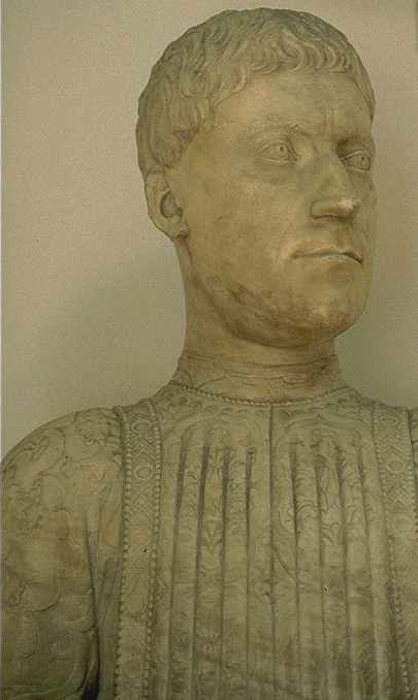
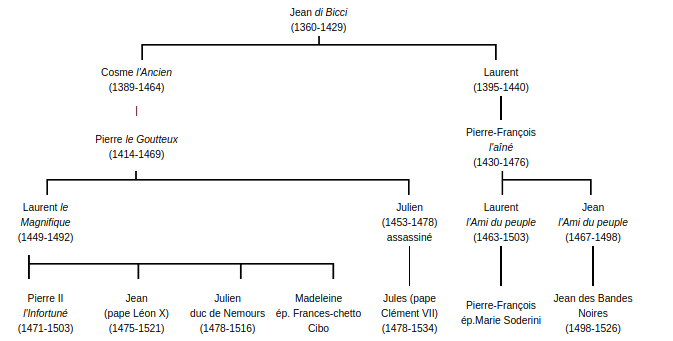 Portraits des Médicis: petite galerie de ces personnages dont les visages sont parfois inattendus :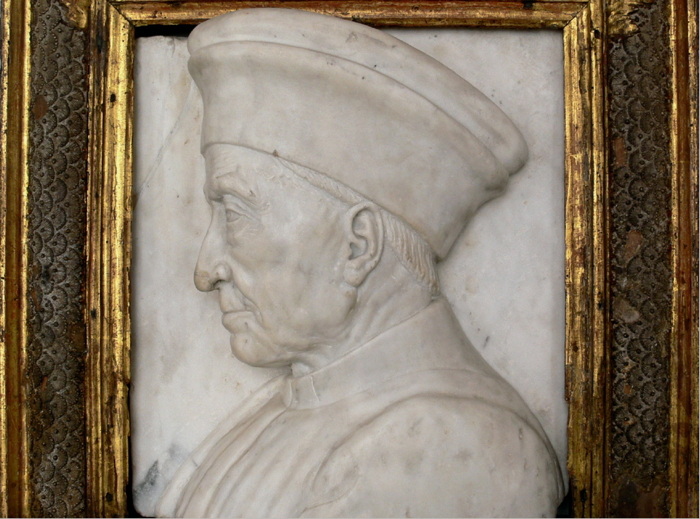
Cosme l'Ancien
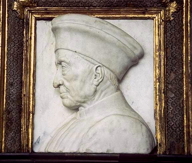
Pierre le Goutteux
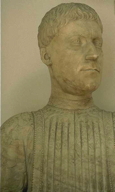
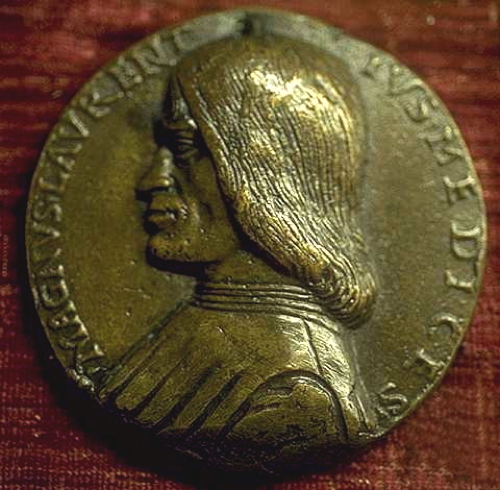
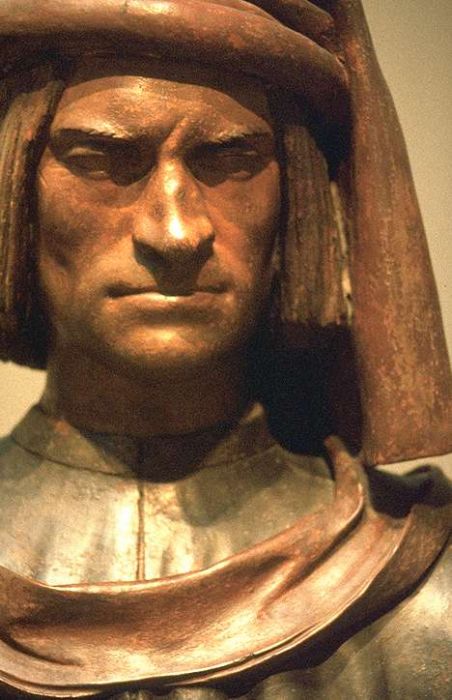
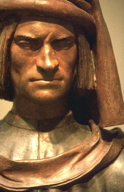
Laurent le Magnifique
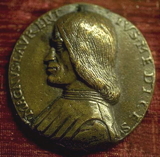
Laurent le Magnifique
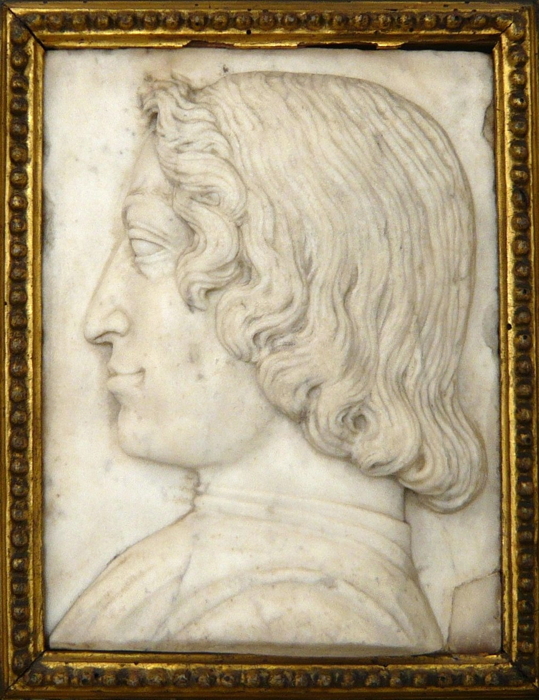
Julien de Médicis
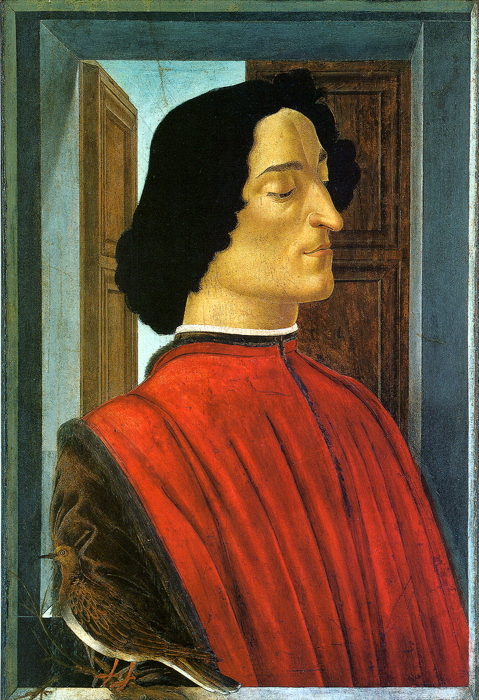
Dans cette époque de grande célébration, les artistes, les sculpteurs comme les peintres se mettent au service de la dynastie et de ses alliés. Nous allons voir quelques portraits de grands Florentins de cette époque. Naturellement, Botticelli a été peintre auprès des Médicis et ils ont souvent fait appel à lui pour des portraits qu'on envoyait à travers tout l'Occident.
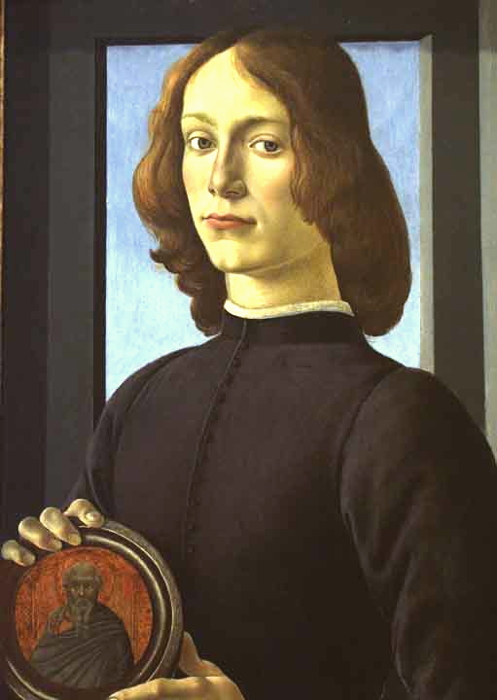
Portrait d'un jeune homme un Médicis ?
Julien de Médicis
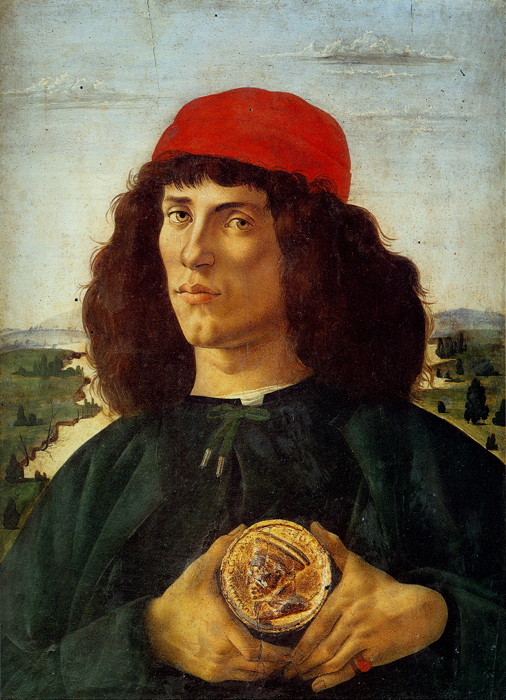
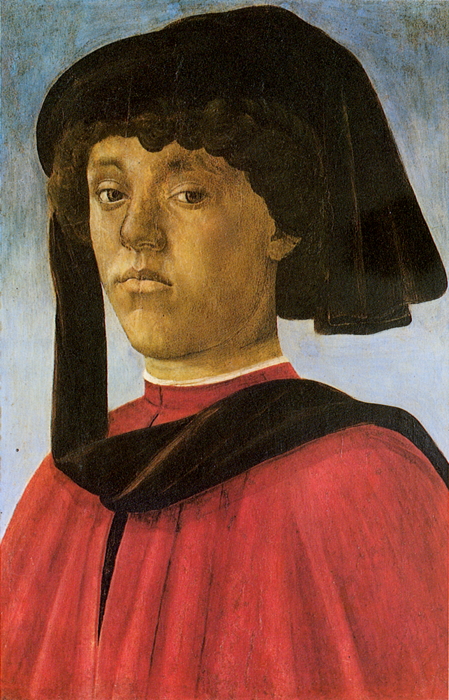
Portrait anonyme
Lorenzo di Pierfrancesco de Médicis
Florence et les Médicis
Elle sera très restreinte, nous n'utiliserons que ce qui est nécessaire pour la compréhension de ce qui va suivre. Il est né en 1445 à Florence dans la paroisse d'Ognissanti où il sera déclaré comme Alessandro, fils de di Mariano Filipepi. Chose assez curieuse, son père a 50 ans et sa mère 40 ans, c'est très vieux et cela lui collera à la peau parce que Sandro Botticelli sera toujours un homme de santé extrêmement fragile auquel tous les médecins diront qu'il est né trop tard de parents trop âgés. Nous savons que son père a profité de sa naissance pour réinscrire dans les livres de la paroisse ses autres enfants et nous apprenons ainsi que Sandro est son quatrième enfant et, par chance, le quatrième fils. Tous vont réussir admirablement : l'aîné s'appelle Giovanni et sera courtier de banque à Florence; le deuxième, Antonio, sera orfèvre; le troisième, Simone, fera presque toute sa carrière à Naples au service de la famille florentine des Rucellai dans le commerce du drap avec l'Espagne. Et Sandro est donc le petit dernier. La famille de Botticelli est bien loin de la médiocrité et de la misère. Les historiens d'art du 19e siècle voulaient nous faire croire que Botticelli était sorti de rien pour devenir un dieu de la peinture, ce qui est inexact. Il vient d'une très bonne bourgeoisie. Il est donc déclaré sous le nom d'Alessandro dont on fera Sandro et, durant toute sa vie, on dira toujours "Sandro bello a mal sacro", "Sandro qui est beau mais malsain" parce qu'il aura toujours ce côté étiolé.
Quand à son nom, pourquoi Botticelli? Là aussi, il y a plusieurs hypothèses, il s'appelle Filipepi pourquoi ne le connaissons-nous pas sous ce nom? Deux explications paraissent possibles, une des deux est vraie, nous choisirons selon nos affinités. Son frère aîné Giovanni, le patriarche de la famille, était énorme, d'une obésité fabuleuse et il avait reçu le surnom de "botticella" ce qui veut dire "tonnelet" en toscan. Ceux qui sont près de "botticella" sont des "botticelli" et c'est de là que viendrait le nom de Botticelli, c'est possible. La deuxième explication est certainement plus vraie : le deuxième fils de la famille est orfèvre et une de ses prérogatives est de battre l'or. On sait que dès que Botticelli aura 14 ans, son frère Antonio l'utilisera pour l'aider à battre l'or. Or, batteur d'or se dit "battigello" qui serait devenu, petit à petit, Botticelli, c'est aussi possible.
Sandro di Filipepi dit Botticelli décidera de devenir peintre. Il fera sa formation chez le meilleur peintre de Florence à cette époque, Filippo Lippi, et son perfectionnement chez Andrea Verrocchio, l'auteur du buste de Lucrezia Donati que nous avons vu tout à l'heure. Enfin, en 1470, il s'estime assez peintre pour pouvoir commencer tout seul et c'est à ce moment-là qu'on lui commande, par une chance extraordinaire, la fameuse Allégorie de la Force que nous avons vue et que nous allons revoir. Cette Allégorie de la Force va naturellement le lancer. Tout Florence viendra la voir et on admirera ce peintre. Les grandes familles florentines qui courent toujours derrière de jeunes artistes qui puissent contribuer un peu à dorer leur blason, se pressent chez lui pour faire peindre qui une madone, qui une Sainte Elisabeth, qui un Saint Augustin. C'est une période de travail presque à la chaîne durant laquelle Botticelli fait des peintures de petites dimensions par lesquelles il se pose dans la société florentine.
Il obtiendra son brevet le 28 janvier 1475 à 10 heures du matin : les cloches de Santa Croce sonnent à tout rompre car, comme cela se passe une fois tous les cinq ans, les Médicis offrent à Florence un tournoi, et cela se faisait encore en pleine Renaissance. C'est celui de Julien de Médicis qui en est le héros avec une armure, un bouclier, une épée, des plumes, c'était grandiose et Florence en a gardé un souvenir ému. Mais surtout il tient au bout d'une hampe ce qui est l'emblème d'un héros de tournoi : sa bannière qui est fabuleuse et qui a été peinte par Sandro Botticelli.
Cette œuvre portée par le maître de Florence va faire de Botticelli non seulement le protégé des dieux, mais aussi le protégé des princes. Sitôt après commence la grande carrière de Botticelli. Pour résumer cette grande carrière, nous allons voir deux commandes, une profane : deux fresques à la Villa Lemmi, une sacrée : celles de la Chapelle Sixtine, qui sont des œuvres peu connues de Botticelli.
Cette chapelle est désespérément blanche et Sixte IV décide d'appeler les meilleurs artistes pour l'orner. Les meilleurs artistes de cette époque ne sont pas à Rome, on sait qu'ils sont à Florence. Le pape fait venir Rosselli en tête, grande gloire de la peinture de cette époque, un peu plus jeune : Ghirlandaio, beaucoup plus jeune : Botticelli et, encore plus jeune : le Pérugin. Tous les quatre, trois Florentins plus un habitant de Pérouse, se rendent à Rome pour travailler une année à décorer non pas le plafond de la Sixtine qui reste obstinément bleu avec des étoiles dorées à cette époque, mais les murs latéraux dont le souverain pontife a fixé le programme : des histoires de l'Ancien et du Nouveau Testament, mises en regard les unes des autres de façon à ce que l'Ancien Testament prophétise et révèle le Nouveau Testament et donc que l'évidence christique soit déjà retrouvée dans les grandes scènes de l'Ancien Testament.
Les quatre jeunes artistes se sont quasiment tirés les sujets au sort. En neuf mois, Botticelli a exécuté trois panneaux à fresque dont le plus petit mesure 11 mètres de longueur. C'est dire que, chez Lippi et chez Verrochio, il avait appris son métier. Nous allons voir ces trois fresques qui sont très laborieuses de sujet.
La Tentation du Christ
En une série d'épisodes séquentiels, on voit les moments de la tentation du Christ parmi lesquels le moment culminant : au sommet du temple, Satan montre au Christ le monde en lui disant "Tout cela t'appartient". Au passage, par groupes, sont représentés d'autres moments de cette tentation du Christ qui se termine lorsque, enfin maté, Satan préfère se jeter du haut des rochers plutôt que de continuer à assister à la ferveur du Christ. Selon un récit un peu médiéval encore, celui de juxtaposer plusieurs histoires en une même scène quitte à la rendre relativement touffue, ce qui est le cas, Botticelli raconte les Tentations du Christ. Admirons un détail de l'adoration de l'eucharistie, la grande scène centrale avec une figure admirable : la porteuse d'offrandes où l'on retrouve les Grâces de la Villa Lemmi de tout à l'heure et qui annonce déjà les Grâces du Printemps.
Les Epreuves de Moïse
Cette fresque est tout aussi complexe et laborieuse. On reconnaît le buisson ardent qui représente la rencontre de Moïse et de l'Eternel, les filles de Jéthro, la préparation à la montée au Sinaï avec Moïse qui se déchausse, Moïse frappant un Egyptien car il ne sait pas encore qu'il n'est pas égyptien. Tous ces épisodes de l'histoire de Moïse convergent autour de ce noeud central qui est le puits de Jéthro, avec les deux figures des filles de Jéthro tout en blanc et, de nouveau, cette transparence liliacée par laquelle nous voyons l'orientation qui continue chez Botticelli de cet art infiniment élégant et délicat.
La Punition des Rebelles
C'est certainement la fresque la meilleure. Le prêtre Aaron a été défié par trois rebelles qui ne veulent plus entendre parler de son autorité et lui proposent de faire un sacrifice double : les rebelles feront le leur, Aaron fera le sien et on verra lequel l'Eternel accepte. Bien entendu, c'est la fumée du bûcher de Aaron qui monte tout droit, les flammes du sacrifice des rebelles les enflamment par terre. Histoire superbe, très vive de récit, c'est une des premières fois que Botticelli se lance dans un récit parfaitement dynamique d'attitude et même de mimique des personnages. Le tout est unifié par un superbe paysage, le plus réussi de tous, paysage unifié encore par cette copie quasiment conforme de l'Arc de Constantin que Botticelli a introduit dans cette scène, vision presque entièrement archéologique du monument romain sur un arrière fond de lac et de montagnes qui donne à l'ensemble une vigueur et une puissance exceptionnelles.
Quand à son nom, pourquoi Botticelli? Là aussi, il y a plusieurs hypothèses, il s'appelle Filipepi pourquoi ne le connaissons-nous pas sous ce nom? Deux explications paraissent possibles, une des deux est vraie, nous choisirons selon nos affinités. Son frère aîné Giovanni, le patriarche de la famille, était énorme, d'une obésité fabuleuse et il avait reçu le surnom de "botticella" ce qui veut dire "tonnelet" en toscan. Ceux qui sont près de "botticella" sont des "botticelli" et c'est de là que viendrait le nom de Botticelli, c'est possible. La deuxième explication est certainement plus vraie : le deuxième fils de la famille est orfèvre et une de ses prérogatives est de battre l'or. On sait que dès que Botticelli aura 14 ans, son frère Antonio l'utilisera pour l'aider à battre l'or. Or, batteur d'or se dit "battigello" qui serait devenu, petit à petit, Botticelli, c'est aussi possible.
Sandro di Filipepi dit Botticelli décidera de devenir peintre. Il fera sa formation chez le meilleur peintre de Florence à cette époque, Filippo Lippi, et son perfectionnement chez Andrea Verrocchio, l'auteur du buste de Lucrezia Donati que nous avons vu tout à l'heure. Enfin, en 1470, il s'estime assez peintre pour pouvoir commencer tout seul et c'est à ce moment-là qu'on lui commande, par une chance extraordinaire, la fameuse Allégorie de la Force que nous avons vue et que nous allons revoir. Cette Allégorie de la Force va naturellement le lancer. Tout Florence viendra la voir et on admirera ce peintre. Les grandes familles florentines qui courent toujours derrière de jeunes artistes qui puissent contribuer un peu à dorer leur blason, se pressent chez lui pour faire peindre qui une madone, qui une Sainte Elisabeth, qui un Saint Augustin. C'est une période de travail presque à la chaîne durant laquelle Botticelli fait des peintures de petites dimensions par lesquelles il se pose dans la société florentine.
Il obtiendra son brevet le 28 janvier 1475 à 10 heures du matin : les cloches de Santa Croce sonnent à tout rompre car, comme cela se passe une fois tous les cinq ans, les Médicis offrent à Florence un tournoi, et cela se faisait encore en pleine Renaissance. C'est celui de Julien de Médicis qui en est le héros avec une armure, un bouclier, une épée, des plumes, c'était grandiose et Florence en a gardé un souvenir ému. Mais surtout il tient au bout d'une hampe ce qui est l'emblème d'un héros de tournoi : sa bannière qui est fabuleuse et qui a été peinte par Sandro Botticelli.
Cette œuvre portée par le maître de Florence va faire de Botticelli non seulement le protégé des dieux, mais aussi le protégé des princes. Sitôt après commence la grande carrière de Botticelli. Pour résumer cette grande carrière, nous allons voir deux commandes, une profane : deux fresques à la Villa Lemmi, une sacrée : celles de la Chapelle Sixtine, qui sont des œuvres peu connues de Botticelli.
Villa Lemmi
Deux fresques à la Villa Lemmi
Quelques années après le tournoi, une commande très flatteuse de la famille des Tornabuoni amène Botticelli jusqu'à leur villa hors les murs, la Villa Tornabuoni, aujourd'hui Villa Lemmi. A la loggia, ils lui font peindre deux fresques car leur fils, Lorenzo Tornabuoni, vient de se marier avec Giovanna Albizzi, une fois de plus c'est un de ces mariages très florentins où personne ne perd rien. Comme la grande cérémonie se passera à la loggia de la villa, il faut la décorer et on demande le décor à Botticelli.
Giovanna rendant hommage à Vénus et aux Grâces
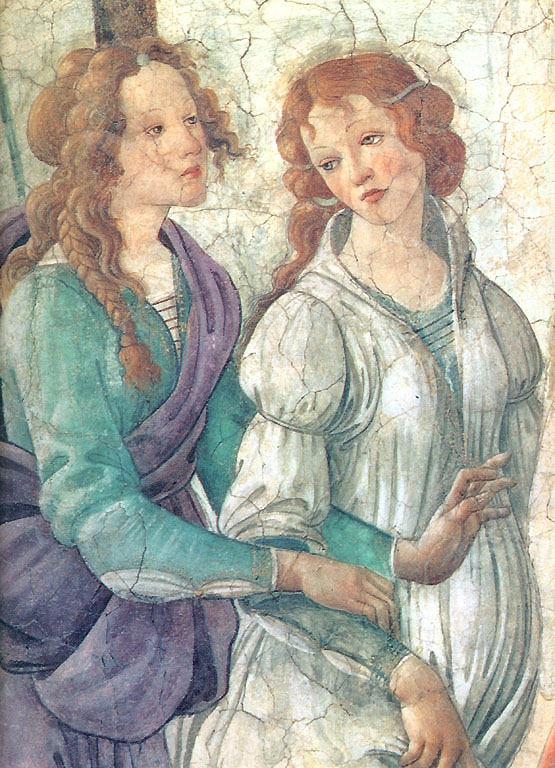
Dans les Grâces notamment, il y a déjà tout ce sens de la rondeur, de la sinuosité de la ligne qui fait vraiment de la peinture de Botticelli une peinture divine.
Lorenzo reçu par le cortège des Arts Libéraux
Sandro Botticelli est l'un des premiers de la Renaissance qui ose nous montrer des personnages de face, de trois-quarts, de dos même et nous donne l'impression de cet aréopage étrange vers lequel semble être poussé cet austère jeune homme. Fresque admirable, ne serait-ce que par la rigueur du profil splendide du jeune homme et aussi par les détails des Arts Libéraux où l'on retrouve ce sens de l'évanescence, de la danse de la ligne qui permettent même à des images aussi sévères que les représentations des Arts Libéraux d'avoir une aura divine tout à fait extraordinaire.
Ces fresques ne sont pas en très bon état car, très peu de temps après le mariage, elles ont été chaulées en blanc, ce type de décor n'était pas fait pour durer. Combien d'œuvres des grands Vinci, Mantegna et autres avons-nous perdues parce qu'elles étaient des œuvres de fête? En toute bonne foi on les a simplement chaulées pour changer le décor. C'est en 1863 seulement que la famille Lemmi qui avait hérité cette villa de la famille Tornabuoni, faisant des travaux, a découvert qu'il y a avait quelque chose sous la chaux. On a fait venir l'antiquaire Birnari qui a vu que cela devait être bien et a proposé de racheter : il avait reconnu que c'était Botticelli. Il a voulu faire vite pour que les héritiers ne se rendent pas compte avant la fin des travaux, il a fait décaper et détacher les fresques tellement mal qu'il en a perdu plus de la moitié. Et il mettra près de onze ans pour réussir à vendre ces fantômes de Botticelli. C'est le Musée du Louvre qui les achètera.
Quelques années après le tournoi, une commande très flatteuse de la famille des Tornabuoni amène Botticelli jusqu'à leur villa hors les murs, la Villa Tornabuoni, aujourd'hui Villa Lemmi. A la loggia, ils lui font peindre deux fresques car leur fils, Lorenzo Tornabuoni, vient de se marier avec Giovanna Albizzi, une fois de plus c'est un de ces mariages très florentins où personne ne perd rien. Comme la grande cérémonie se passera à la loggia de la villa, il faut la décorer et on demande le décor à Botticelli.
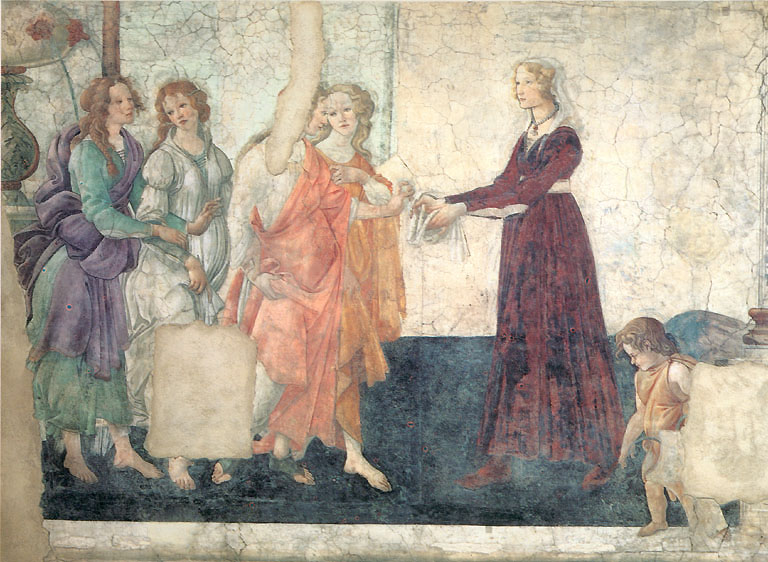
Giovanna rendant hommage à Vénus et aux Grâces
Dans les Grâces notamment, il y a déjà tout ce sens de la rondeur, de la sinuosité de la ligne qui fait vraiment de la peinture de Botticelli une peinture divine.
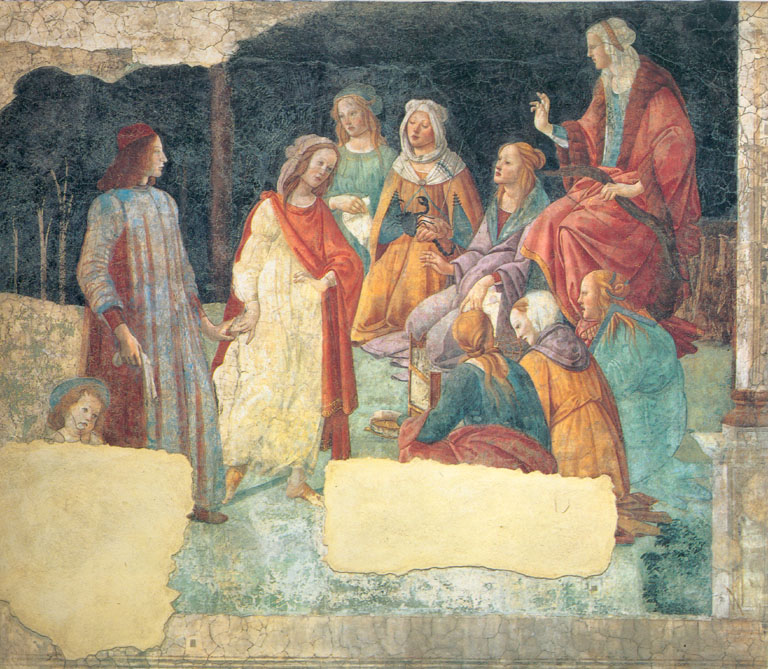
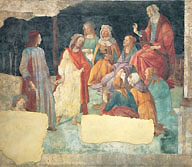
Lorenzo reçu par le cortège des Arts Libéraux
Sandro Botticelli est l'un des premiers de la Renaissance qui ose nous montrer des personnages de face, de trois-quarts, de dos même et nous donne l'impression de cet aréopage étrange vers lequel semble être poussé cet austère jeune homme. Fresque admirable, ne serait-ce que par la rigueur du profil splendide du jeune homme et aussi par les détails des Arts Libéraux où l'on retrouve ce sens de l'évanescence, de la danse de la ligne qui permettent même à des images aussi sévères que les représentations des Arts Libéraux d'avoir une aura divine tout à fait extraordinaire.
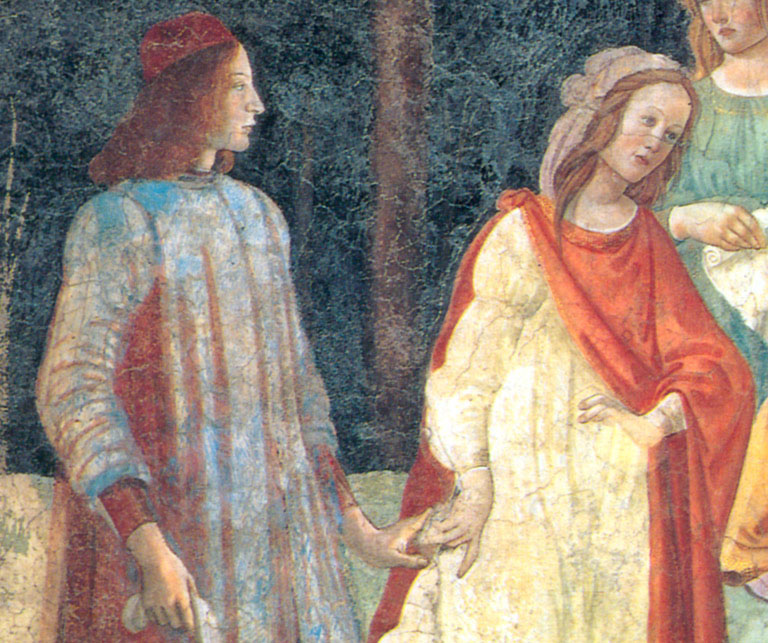
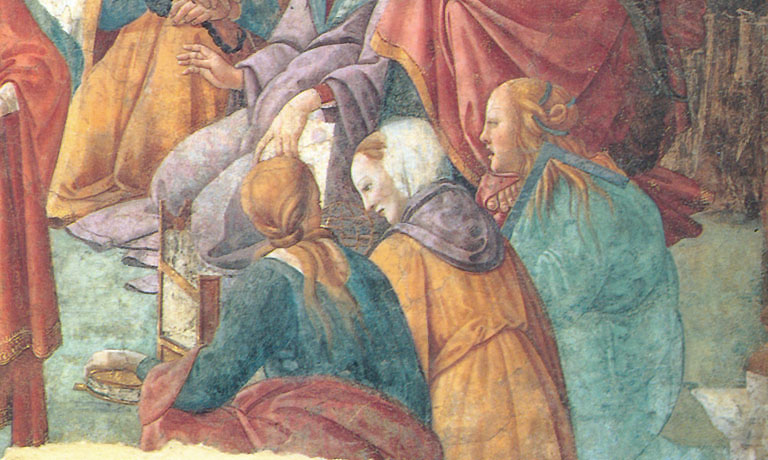
Ces fresques ne sont pas en très bon état car, très peu de temps après le mariage, elles ont été chaulées en blanc, ce type de décor n'était pas fait pour durer. Combien d'œuvres des grands Vinci, Mantegna et autres avons-nous perdues parce qu'elles étaient des œuvres de fête? En toute bonne foi on les a simplement chaulées pour changer le décor. C'est en 1863 seulement que la famille Lemmi qui avait hérité cette villa de la famille Tornabuoni, faisant des travaux, a découvert qu'il y a avait quelque chose sous la chaux. On a fait venir l'antiquaire Birnari qui a vu que cela devait être bien et a proposé de racheter : il avait reconnu que c'était Botticelli. Il a voulu faire vite pour que les héritiers ne se rendent pas compte avant la fin des travaux, il a fait décaper et détacher les fresques tellement mal qu'il en a perdu plus de la moitié. Et il mettra près de onze ans pour réussir à vendre ces fantômes de Botticelli. C'est le Musée du Louvre qui les achètera.
Villa Lemmi
Chapelle Sixtine
Autre commande, sacrée celle-là, qui nous montre l'aura sociale que prend Botticelli. A Rome, le pape Sixte IV vient enfin de finir sa chapelle construite entre deux ailes du Palais du Vatican pour les unifier, chapelle "rabibochée" dont l'architecte lui-même est fort mécontent, mais le souverain pontife est ravi parce qu'il a enfin sa chapelle à laquelle il donne son nom, la Chapelle Sixtine.
Cette chapelle est désespérément blanche et Sixte IV décide d'appeler les meilleurs artistes pour l'orner. Les meilleurs artistes de cette époque ne sont pas à Rome, on sait qu'ils sont à Florence. Le pape fait venir Rosselli en tête, grande gloire de la peinture de cette époque, un peu plus jeune : Ghirlandaio, beaucoup plus jeune : Botticelli et, encore plus jeune : le Pérugin. Tous les quatre, trois Florentins plus un habitant de Pérouse, se rendent à Rome pour travailler une année à décorer non pas le plafond de la Sixtine qui reste obstinément bleu avec des étoiles dorées à cette époque, mais les murs latéraux dont le souverain pontife a fixé le programme : des histoires de l'Ancien et du Nouveau Testament, mises en regard les unes des autres de façon à ce que l'Ancien Testament prophétise et révèle le Nouveau Testament et donc que l'évidence christique soit déjà retrouvée dans les grandes scènes de l'Ancien Testament.
Les quatre jeunes artistes se sont quasiment tirés les sujets au sort. En neuf mois, Botticelli a exécuté trois panneaux à fresque dont le plus petit mesure 11 mètres de longueur. C'est dire que, chez Lippi et chez Verrochio, il avait appris son métier. Nous allons voir ces trois fresques qui sont très laborieuses de sujet.
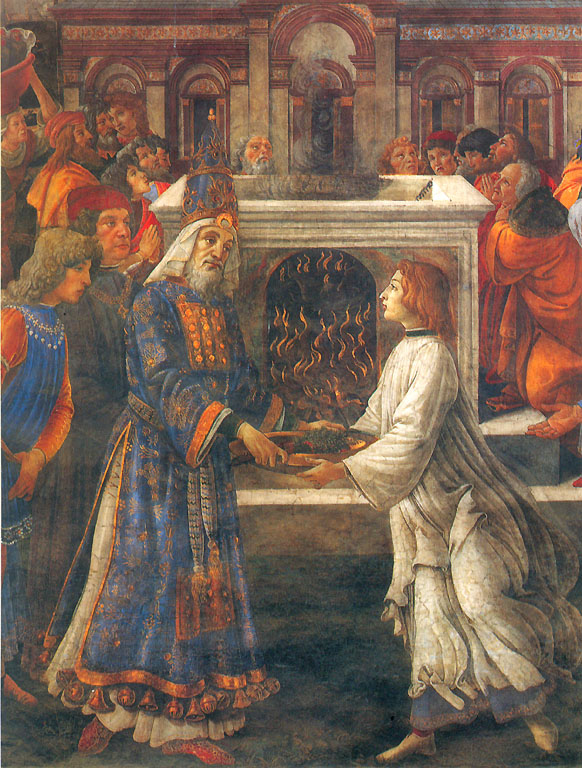
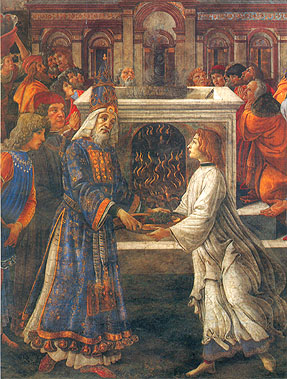
La Tentation du Christ
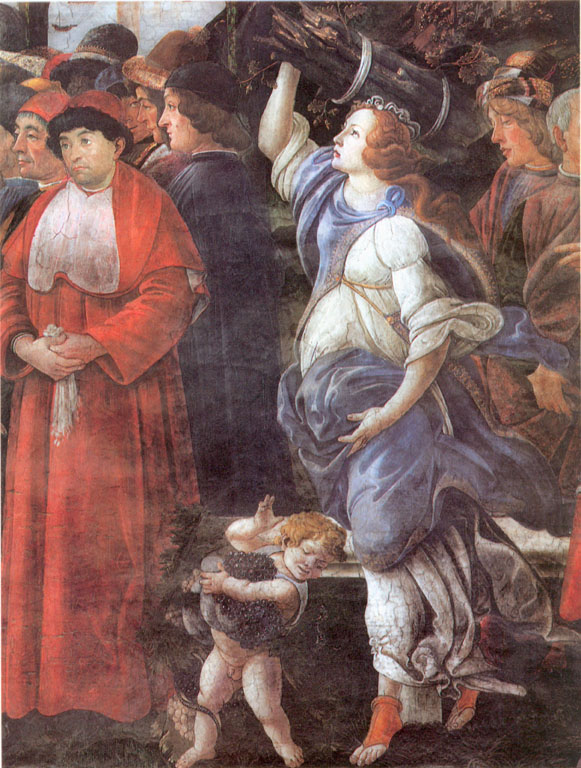
En une série d'épisodes séquentiels, on voit les moments de la tentation du Christ parmi lesquels le moment culminant : au sommet du temple, Satan montre au Christ le monde en lui disant "Tout cela t'appartient". Au passage, par groupes, sont représentés d'autres moments de cette tentation du Christ qui se termine lorsque, enfin maté, Satan préfère se jeter du haut des rochers plutôt que de continuer à assister à la ferveur du Christ. Selon un récit un peu médiéval encore, celui de juxtaposer plusieurs histoires en une même scène quitte à la rendre relativement touffue, ce qui est le cas, Botticelli raconte les Tentations du Christ. Admirons un détail de l'adoration de l'eucharistie, la grande scène centrale avec une figure admirable : la porteuse d'offrandes où l'on retrouve les Grâces de la Villa Lemmi de tout à l'heure et qui annonce déjà les Grâces du Printemps.
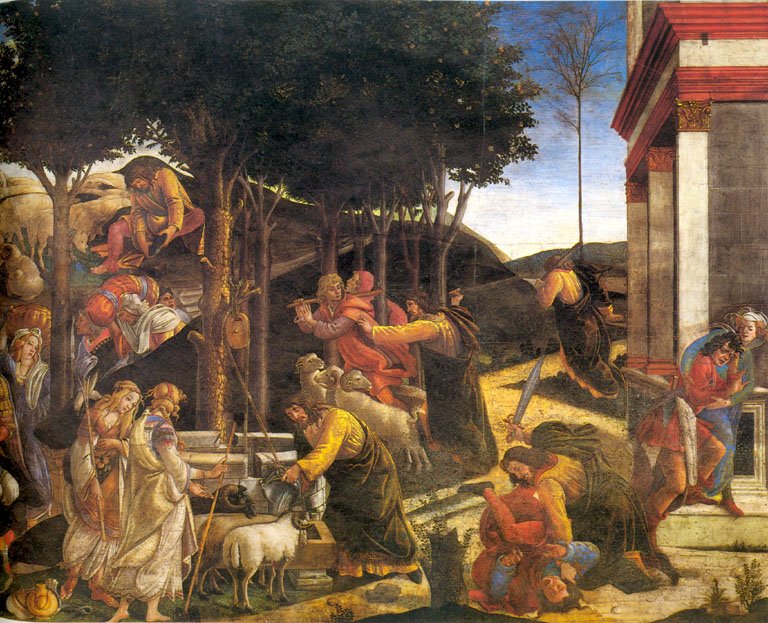

Les Epreuves de Moïse
 Cette fresque est tout aussi complexe et laborieuse. On reconnaît le buisson ardent qui représente la rencontre de Moïse et de l'Eternel, les filles de Jéthro, la préparation à la montée au Sinaï avec Moïse qui se déchausse, Moïse frappant un Egyptien car il ne sait pas encore qu'il n'est pas égyptien. Tous ces épisodes de l'histoire de Moïse convergent autour de ce noeud central qui est le puits de Jéthro, avec les deux figures des filles de Jéthro tout en blanc et, de nouveau, cette transparence liliacée par laquelle nous voyons l'orientation qui continue chez Botticelli de cet art infiniment élégant et délicat.
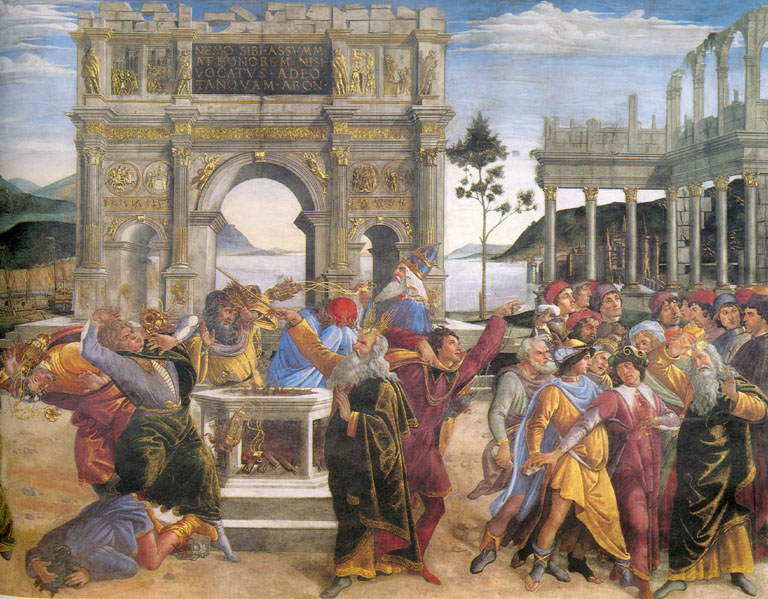
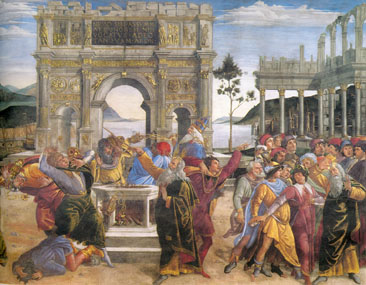
La Punition des Rebelles
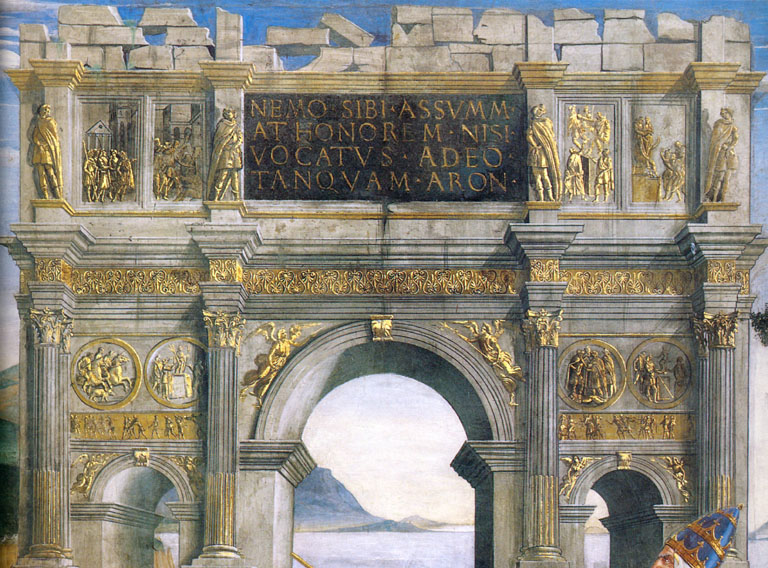
Chapelle Sixtine
En décembre 1469, le Tribunal de la Mercanzia de Florence, situé Place de la Seigneurie, en face du Palais, se rend compte qu'il faut complètement restaurer le tribunal en profitant de "la vacance de la Noël" comme on disait à l'époque. Il faut rafraîchir entièrement la salle et refaire le mobilier. C'est à ce moment-là que les sept juges - la Mercanzia avait six juges et un président volant - arrêtent leur choix sur des grandes chaises avec de hauts dossiers recouverts par les images des vertus. Il s'agit de choisir le peintre et on choisit Pollaiuolo, pas le grand, pas Antonio, on choisit son frère Piero qui passe Noël et Nouvel An à dessiner ces vertus qui nous sont conservées et nous allons les regarder. Ce sont de fort bonnes peintures mais d'un esprit très traditionaliste encore, très première moitié du Quatrocento.
La Foi
La Prudence
Ces plis très cassés donnent un caractère monumental à la robe.
La Justice
La Justice avec sa grande épée brillante et le globe céleste sur lequel, comme toute justice, elle doit régner à jamais. C'est de la bonne peinture, un peu plate, un peu terne, un tout petit gothicisante par le côté aigu des robes. Or, il y a parmi les sept de la Mercanzia un personnage nommé Rudelai qui, lorsque Pollaiuolo apporte une vertu, fait chaque fois une tête plus longue car il les trouve laides. Il prend sur lui de commander la septième et dernière à un artiste dans lequel il a foi et qui s'appelle Sandro Botticelli dont personne n'a jamais entendu parler. Il fallait voir les six autres vertus pour mieux comprendre comment les sept juges d'abord, puis tout Florence vont flamber d'enthousiasme pour cette peinture.
La Force
Chez Botticelli, il est vrai que nous avons des drapés qui drapent vraiment, des modelés qui tournent vraiment, l'attitude est héroïque et, surtout, jusque dans le détail c'est peint avec un bonheur de peindre tout à fait exceptionnel. Cela tranche infiniment sur le reste des peintures de Piero del Pollaiuolo, c'est certain. Et c'est cela la grande chance de Sandro Botticelli.
Rudelai sera tellement content de son choix qu'il va en parler à tout Florence et tout Florence va venir. Mais ce qui est beaucoup mieux - et cela marcherait tout aussi bien au 20e siècle - Pollaiuolo sera tellement furieux qu'il fera une interpellation. On lui donnera un peu raison par contrat, mais beaucoup tort en voyant les œuvres. L'histoire ayant été portée par le malheureux artiste au grand public, cela s'est dit, cela s'est su, tout Florence est venu voir l'œuvre du si jeune, si mince et si pâle Alessandro Filipepi dit Botticelli. C'est comme cela que tout a commencé. Il était important de s'arrêter un peu longuement sur ces circonstances car cela nous explique l'aura particulière dont bénéficiera de son vivant Botticelli : il n'est pas seulement un peintre, un bon peintre, un grand peintre, il est l'enfant chéri des dieux.
Cette suite de succès, et notamment cette septième vertu qui écrase les six autres, est un fait tellement exceptionnel, presque miraculaire, que Botticelli prendra là cette fameuse épithète d'enfant chéri des dieux qui va beaucoup l'aider tout au long de sa carrière.
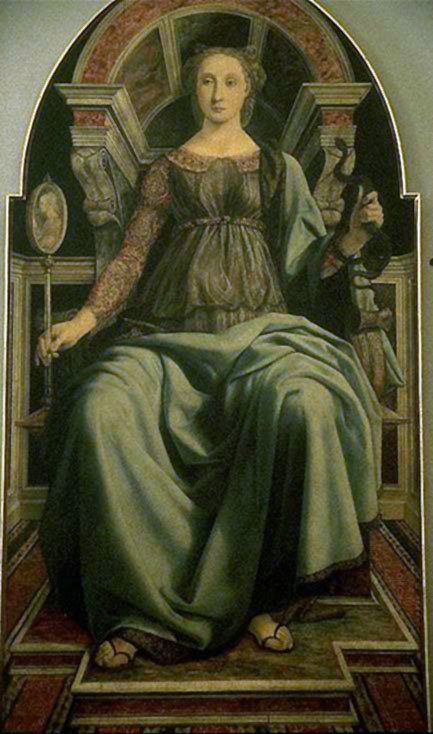
La Foi
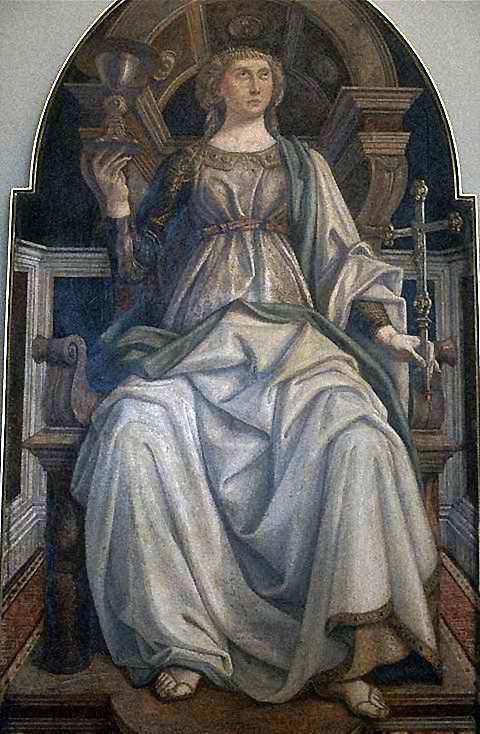
La Prudence
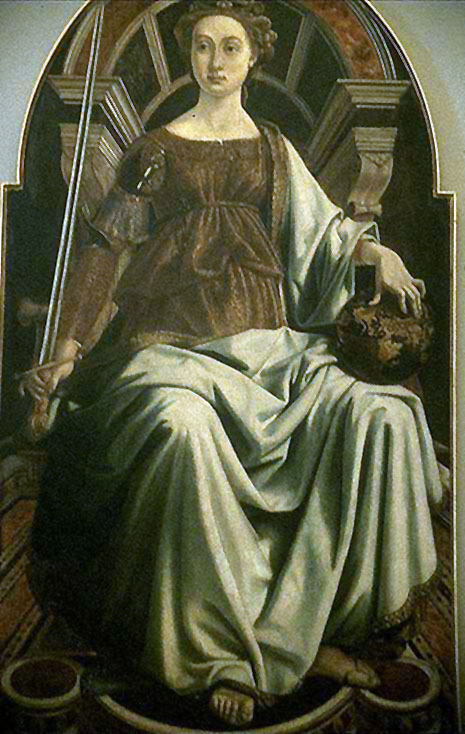
La Justice
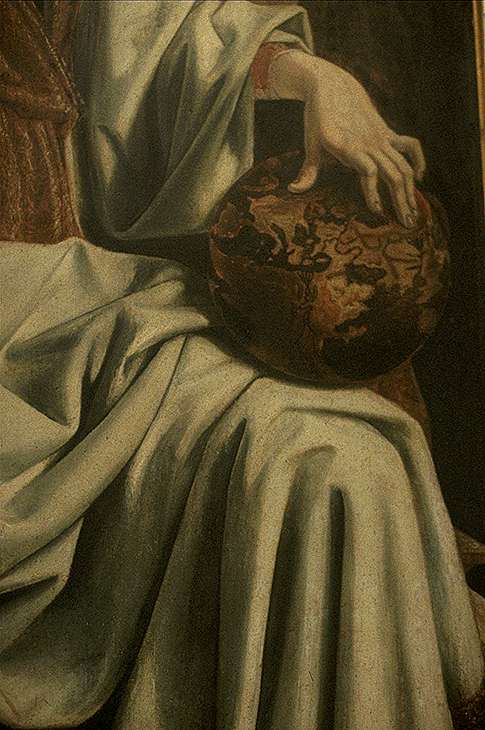 La Justice avec sa grande épée brillante et le globe céleste sur lequel, comme toute justice, elle doit régner à jamais. C'est de la bonne peinture, un peu plate, un peu terne, un tout petit gothicisante par le côté aigu des robes. Or, il y a parmi les sept de la Mercanzia un personnage nommé Rudelai qui, lorsque Pollaiuolo apporte une vertu, fait chaque fois une tête plus longue car il les trouve laides. Il prend sur lui de commander la septième et dernière à un artiste dans lequel il a foi et qui s'appelle Sandro Botticelli dont personne n'a jamais entendu parler. Il fallait voir les six autres vertus pour mieux comprendre comment les sept juges d'abord, puis tout Florence vont flamber d'enthousiasme pour cette peinture.
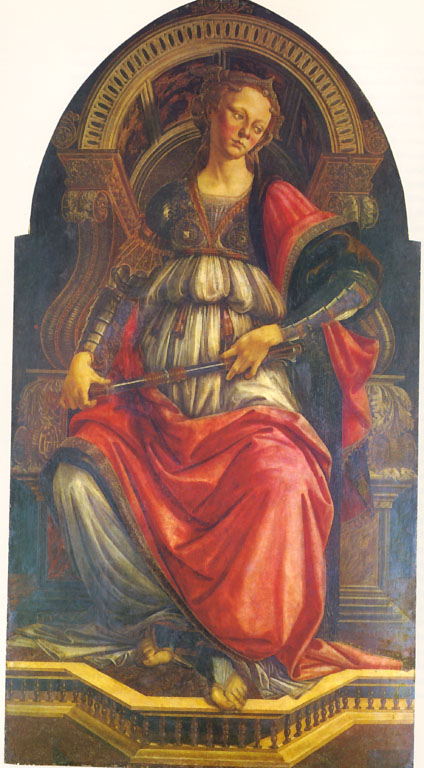

La Force
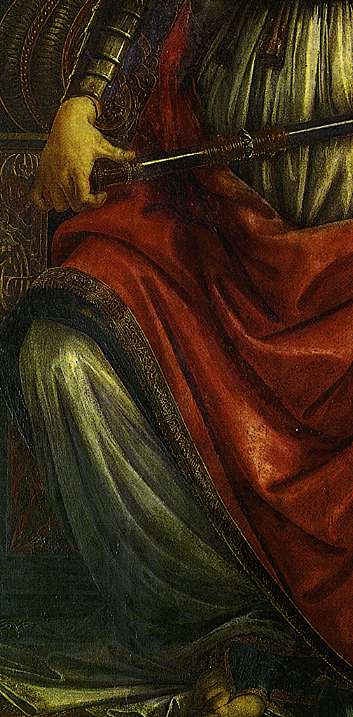 Chez Botticelli, il est vrai que nous avons des drapés qui drapent vraiment, des modelés qui tournent vraiment, l'attitude est héroïque et, surtout, jusque dans le détail c'est peint avec un bonheur de peindre tout à fait exceptionnel. Cela tranche infiniment sur le reste des peintures de Piero del Pollaiuolo, c'est certain. Et c'est cela la grande chance de Sandro Botticelli.
Rudelai sera tellement content de son choix qu'il va en parler à tout Florence et tout Florence va venir. Mais ce qui est beaucoup mieux - et cela marcherait tout aussi bien au 20e siècle - Pollaiuolo sera tellement furieux qu'il fera une interpellation. On lui donnera un peu raison par contrat, mais beaucoup tort en voyant les œuvres. L'histoire ayant été portée par le malheureux artiste au grand public, cela s'est dit, cela s'est su, tout Florence est venu voir l'œuvre du si jeune, si mince et si pâle Alessandro Filipepi dit Botticelli. C'est comme cela que tout a commencé. Il était important de s'arrêter un peu longuement sur ces circonstances car cela nous explique l'aura particulière dont bénéficiera de son vivant Botticelli : il n'est pas seulement un peintre, un bon peintre, un grand peintre, il est l'enfant chéri des dieux.
Chez Botticelli, il est vrai que nous avons des drapés qui drapent vraiment, des modelés qui tournent vraiment, l'attitude est héroïque et, surtout, jusque dans le détail c'est peint avec un bonheur de peindre tout à fait exceptionnel. Cela tranche infiniment sur le reste des peintures de Piero del Pollaiuolo, c'est certain. Et c'est cela la grande chance de Sandro Botticelli.
Rudelai sera tellement content de son choix qu'il va en parler à tout Florence et tout Florence va venir. Mais ce qui est beaucoup mieux - et cela marcherait tout aussi bien au 20e siècle - Pollaiuolo sera tellement furieux qu'il fera une interpellation. On lui donnera un peu raison par contrat, mais beaucoup tort en voyant les œuvres. L'histoire ayant été portée par le malheureux artiste au grand public, cela s'est dit, cela s'est su, tout Florence est venu voir l'œuvre du si jeune, si mince et si pâle Alessandro Filipepi dit Botticelli. C'est comme cela que tout a commencé. Il était important de s'arrêter un peu longuement sur ces circonstances car cela nous explique l'aura particulière dont bénéficiera de son vivant Botticelli : il n'est pas seulement un peintre, un bon peintre, un grand peintre, il est l'enfant chéri des dieux. Cette suite de succès, et notamment cette septième vertu qui écrase les six autres, est un fait tellement exceptionnel, presque miraculaire, que Botticelli prendra là cette fameuse épithète d'enfant chéri des dieux qui va beaucoup l'aider tout au long de sa carrière.
Botticelli est un peintre un peu difficile à aborder parce son œuvre est extrêmement diverse. Il passe d'œuvres profanes à des œuvres sacrées, d'œuvres qui remportent tous les suffrages à des œuvres beaucoup plus laborieuses. Dans un domaine ou dans l'autre, l'œuvre de Botticelli est très en dents de scie. Si on montre chronologiquement ses œuvres, notre admiration va monter et descendre et à la fin nous n'aurons aucune synthèse de son oeuvre. En préparant cette conférence et en mettant toutes les vierges ensemble, cela nous a permis de constater qu'il n'y a pas un Sandro Botticelli, mais vraiment deux.
Quand on regarde ce qui sort de son atelier à la rigueur du temps qui passe, c'est-à-dire dans l'ordre chronologique, on n'a strictement aucune idée du génie de Botticelli. Quand on sait qu'il abordait complètement différemment, non seulement avec un autre pinceau, une autre palette mais avec un autre esprit les scènes religieuses chrétiennes et les scènes religieuses païennes, alors une véritable lumière vient. C'est simplement en ayant eu l'idée de grouper les madones que notre conférence de ce soir est ce qu'elle est. Nous garderons cet ordre-là et nous verrons une série d'œuvres de Botticelli, d'abord les œuvres d'inspiration chrétienne
Quand on regarde ce qui sort de son atelier à la rigueur du temps qui passe, c'est-à-dire dans l'ordre chronologique, on n'a strictement aucune idée du génie de Botticelli. Quand on sait qu'il abordait complètement différemment, non seulement avec un autre pinceau, une autre palette mais avec un autre esprit les scènes religieuses chrétiennes et les scènes religieuses païennes, alors une véritable lumière vient. C'est simplement en ayant eu l'idée de grouper les madones que notre conférence de ce soir est ce qu'elle est. Nous garderons cet ordre-là et nous verrons une série d'œuvres de Botticelli, d'abord les œuvres d'inspiration chrétienne
les œuvres d'inspiration chrétienne
Nous les verrons dans un ordre chronologique. Au début cela a été dur : Botticelli est l'enfant chéri des dieux, les Tornabuoni viennent chez lui, les Rucellai aussi, les Médicis ne tarderont pas à prendre le même chemin, c'est vrai. Mais le grand problème - et c'est le grand problème de tous les jeunes peintres - c'est qu'on demande à Sandro Botticelli, si jeune encore, de faire des choses aussi belles que son feu maître, donc du faux Filippo Lippi. Souvenons-nous qu'il a été formé par le peintre des madones par excellence, que Filippo Lippi a peint les plus belles madones du monde. Mais on n'a plus Filippo Lippi, alors on a Sandro Botticelli qui n'a qu'à continuer...
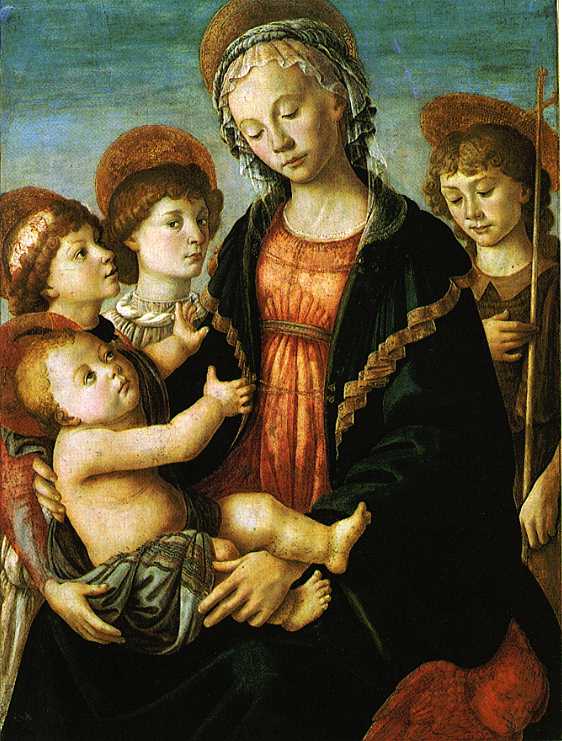
Madone
Au départ il sera obligé de faire de véritables pastiches des œuvres de son maître, ce qui se voit très bien avec un modelé un peu porcelainé du visage de la Vierge, avec le côté un petit peu amidonné de l'Enfant Jésus, la délicatesse de ces roses et de ces bleus mélangés où il y a toute la suavité de maître Lippi.
Petite Madone au donateur
Au fur et à mesure que le temps passe, mais très vite, on voit Botticelli se dégager complètement de qu'on lui demande, l'imitation et la continuation de son maître, pour prendre vraiment un langage propre. Le modelé devient plus sec au bon sens du terme, sans la rondeur séduisante et un peu appauvrissante, beaucoup plus graphique. Les lignes sont plus délimitées et l'espace plastique, c'est-à-dire cette belle tribune avec ce paysage derrière, devient extrêmement intéressant. Le donateur est représenté ici : Giovanni, un des fils de la famille Rucellai.
Vierge à la mer ou au bateau
Plus tard, on arrive à des œuvres encore plus austères et nous verrons au terme de cette conférence que Botticelli est un peintre de l'austérité. Simple Vierge avec un simple enfant sur un simple rideau donnant sur la mer. C'est une des madones les plus vénitiennes de Botticelli. On remarque que c'est un type de mise en page que, presque à la même époque, les Bellini vont beaucoup utiliser. On se demande si, pour se dégager de ce moule Lippi dans lequel on veut l'emprisonner, Botticelli ne regarde pas un peu du côté de la peinture vénitienne comme pour se démarquer d'un passé qui commence à peser lourd. Celle-ci est la plus jolie des trois et se trouve à l'Académie de Florence. En 1993, on a pu établir que cette Vierge à la mer est le volet de droite d'un petit diptyque de voyage dont le portrait du donateur constitue le volet de gauche. Au Musée Capodimonte de Naples, on a un très beau portrait de Niccolo Rucellai par Botticelli, avec en fond un balcon et la mer à l'infini. Le hasard a voulu qu'on rapproche une fois les deux photos : c'est le même balcon, la même colonne, la même mer, les mêmes montagnes. On a pu enfin reconstituer ce diptyque dont une moitié est à Florence et l'autre à Naples et qui date de la grande libération de Botticelli.
Les Florentins qui commanderont ces madones deviendront de plus en plus brillants, ils auront de plus en plus de pouvoir. Ils demanderont donc des choses de plus en plus extraordinaires, toujours plus grandes, toujours plus belles. Ces jeunes artistes étaient pressés, chaque œuvre devait être plus magnifique que la précédente. On verra les programmes augmenter, toujours la Vierge à l'Enfant, les personnages se multiplier et occuper parfaitement ce format très à la mode de la Florence de la deuxième moitié du Quatrocento, la forme ronde, le tondo. Voici l'un des premiers :
Tondo aux huit anges
Tondo aux huit anges
Richement encadré, il a appartenu à la famille Pitti. On voit la Vierge écrivant le Magnificat comme sous la dictée de l'Enfant Jésus et sous la surveillance des anges.
Mais un jour Botticelli dira : "assez de Vierges!", on peut du moins l'imaginer. C'est très curieux car la Vierge du Magnificat est la dernière d'une très longue série qui a marqué toute l'étape préparatoire. On peut penser que Botticelli se sent maintenant les moyens de naître véritablement et les moyens d'être en même temps. Il abandonnera donc cet exercice de style qu'est pour lui la Vierge à l'Enfant et n'y reviendra que beaucoup plus tard et d'une tout autre façon : il se consacrera à un nouveau sujet qui est au fond la Vierge à l'Enfant "enrichie", c'est-à-dire l'Adoration des Mages. Il y vient avec beaucoup de méthode et cette nouvelle série d'œuvres sera monomaniaquement sur le sujet de l'Adoration des Mages. Mardi dernier, nous avions vu que l'Adoration des Mages est un magnifique sujet pour les Florentins qui sont riches, prospères et possèdent ce qu'il y a de plus beau sur la planète : les mages sont comme leur reflet. Peindre luxueusement le cortège des mages, c'est rendre hommage aux familles régnantes. Lorsque Benozzo Gozzoli peindra son fameux Cortège des Rois Mages, il rendra hommage aux Médicis.
Adoration des Mages
Botticelli va peindre toute une série d'Adoration des Mages avec des personnages de plus en plus pressés les uns contre les autres, des costumes de plus en plus extraordinaires, des couleurs toujours très tempétueuses. Cette très longue Adoration des Mages a certainement été un devant de coffre.
Adoration des Mages
Sous forme de tondo, elle est superbe. La Vierge est au centre de la composition avec l'Enfant et tous les personnages s'agencent autour d'elle comme une sorte de ballet de cour, on peut presque le dire, avec des points de fuite de perspective d'une extraordinaire hardiesse dans cet ensemble, dominé par une étude architecturale qui est l'une des plus souveraines que Botticelli ait jamais entreprise. Le tumulte des personnages dans la partie inférieure, cette espèce de chaos de couleurs et de lignes, est exorcisé par la rigueur de cette architecture austère, sévère, désolée ou presque qui marque le haut de cette Adoration. Admirons le détail de la tête d'un cheval effrayé par un petit singe accroché à l'un des figurants. Nous retrouvons maintenant beaucoup de détails exotiques que nous avions déjà vus apparaître dans l'œuvre de Gentile da Fabriano dans les années 1420.
Adoration des Mages
Elle a été peinte pour les Médicis. Pour la première fois, de façon absolue, ce sont les Médicis qui ont "posé" en tant que mages : ils n'ont pas pris place en costume, mais ce sont leurs visages que Botticelli a empruntés pour créer cette représentation. Cosme et ses fils Pierre et Jean représentent les Rois Mages, avec Julien et Laurent en princes. Le tout dans une composition qui ne vise plus au cercle parfait comme la précédente, mais au triangle parfait dont le visage de la Vierge se trouve au faîte. C'est composé exactement comme le fronton d'un temple antique. Cette espèce de solennité mais en même temps cette sorte de cette sérénité en font l'un des très grands chefs-d'œuvre de la première manière de Botticelli. Il faut se rendre compte que Botticelli, à ce point de son métier, n'utilise plus les couleurs franches du début de sa carrière et de la plupart des peintres de son époque, mais il s'amuse à les moirer, à les muter de façon à passer d'un gris à un bleu et de nouveau au gris pour mieux repasser au bleu comme, en particulier, sur les manches du vêtement de Laurent. C'est donc une peinture d'une virtuosité tout à fait étourdissante. Et pour la première fois, Botticelli s'est inclus dans le coin de cette Adoration des Mages : le personnage à l'extrême droite, le jeune homme blond est Sandro Botticelli. Cette fameuse Adoration dite Médicis représente un tournant important dans sa carrière et il regarde ses spectateurs depuis 1478, date donc de cette Adoration des Mages.
Nous sommes presque au bout des œuvres religieuses, mais il faut remarquer deux ou trois choses importantes. Voyons l'œuvre suivante : c'est le fameux
Retable de Saint Barnabé
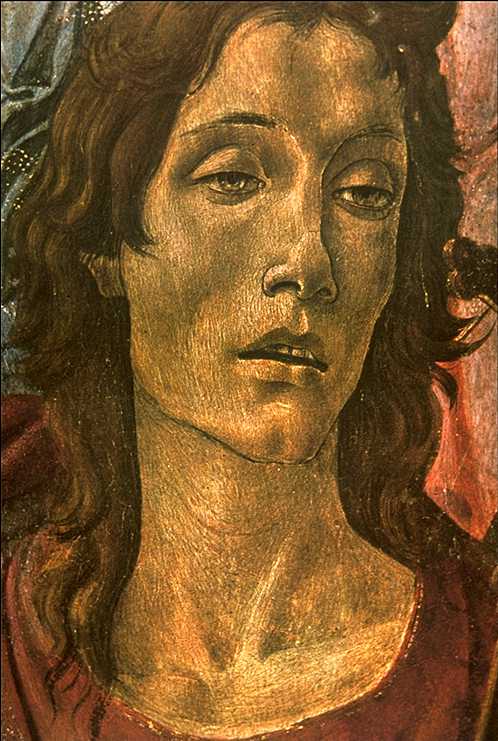
Une commande magnifique de la plus riche des confréries de Florence, celle des médecins et apothicaires, pour leur église consacrée à leur saint, Barnabé, protecteur de la médecine. Dans cette confrérie, il y a tous les parrainages possibles et imaginables, tous les noms de Florence sont là, c'est donc une commande très importante. Botticelli a accepté de peindre cet étrange tableau qui, comme nous l'avons déjà vu, est composé d'un véritable fronton de temple grec nous montrant la Vierge à l'Enfant entourée de saints. La composition est surprenante car elle est d'un immobilisme et d'un hiératisme absolument total : on dirait huit statues posées les unes à côté des autres. Ce qui donne toute sa mobilité à l'ensemble est la présence des anges superbes écartant les rideaux du dais de la Vierge et révélant tous les personnages aux fidèles. Remarquons aussi la beauté de la confrontation des couleurs, le vert très bouteille du vêtement de Sainte Catherine à gauche contre le vert de Saint Augustin beaucoup plus affirmé, et les deux verts servent de contrepoint au bleu royal du manteau de la Vierge. Déjà là Botticelli montre ce sens aventureux de la couleur qu'il va développer. Une des figures va rester célèbre dans ce retable : l'image de Saint Jean-Baptiste dans laquelle on a longtemps voulu voir aussi un autoportrait de Botticelli, mais qui demeure surtout un visage bouleversant par le caractère voyant du regard que Botticelli lui a donné.
La Nativité mystique
C'est la dernière œuvre religieuse que nous verrons ce soir, la plus étrange dans laquelle Botticelli traitera des mystères christiques. C'est toujours le même sujet qu'avant, c'est toujours une nativité. Ce chef-d'œuvre est une des œuvres les plus importantes que nous ayons vues jusqu'à présent. Elle est à la National Gallery de Londres où elle a été admirablement étudiée. Elle se révèle surtout par deux étrangetés. C'est d'une part la seule œuvre de Botticelli qui soit signée et datée, la seule de toute sa production. En haut, dans cinq lignes de texte, il est écrit en langue grecque "Moi, Alessandro Botticelli, en cette fin de l'année 1501, j'ai...", donc signature et date. 1501 est près de sa mort et si elle est signée et datée, c'est pour bien marquer la chose. D'autre part, c'est la plus étrange Nativité que l'on puisse imaginer : il y a bien la crèche, l'âne, le boeuf, la Vierge, Joseph, l'Enfant, mais pour le reste on est complètement perdu. Il n'y a ni bergers, ni mages, une kyrielle d'anges partout, sur le toit, dans le ciel, par terre, et des gens dont on ne sait pas très bien ce qu'ils sont, ni ce qu'ils font ici. L'étude de cette œuvre qui a passé longtemps pour excentrique a apporté une révélation. Botticelli a vécu sa maturité exactement à l'époque du plus grand prédicateur peut-être de tout le siècle : Savonarole. Il faut se souvenir qu'à la fameuse homélie du Carême de l'année 1499, quelques jours avant que Botticelli ne prenne en main ce tableau-ci, Savonarole avait dit aux Florentins : "Repentez-vous de ce que vous avez fait, repentez-vous de vos péchés, éloignez-vous du démon, laissez-vous gagner par les anges seuls capables de vous amener jusqu'au Sauveur".
C'est le canevas car il y avait, comme toujours chez Savonarole, toute une quantité de symboles plus explicites et plus architectoniques encore. Et plus on a regardé cette homélie de Savonarole et l'oeuvre, plus on s'est rendu compte que l'œuvre en est, en quelque sorte, l'illustration. La ronde des douze anges correspondant aux douze heures du jour et aux douze mois de l'année, c'est dans Savonarole qu'il faut la trouver. La présence des anges qui représentent la foi, l'espérance et la charité en robes blanche, rouge et verte, c'est dans Savonarole qu'il y en a le libellé. Les anges, les mêmes, en vert, rouge et blanc qui viennent sauver les humains et les tirer des limbes, c'est dans Savonarole toujours. Les démons chassés, et nous en voyons ici et là, c'est dans Savonarole encore. Tout simplement nous nous rendons compte qu'après une période d'un christianisme très esthétique, celui des premières Vierges, des premiers tondi, et même ce christianisme très social peut-on dire des grandes adorations, il y a eu tout à coup un évènement dans la carrière de Botticelli : la découverte de Savonarole. Et l'œuvre la plus inspirée de Botticelli est cette Nativité mystique, la dernière œuvre de ce premier tronc que nous voulions vous présenter ce soir. Nous aurons d'ailleurs l'occasion, après avoir admiré les œuvres païennes, de voir si le "savonarolisme" a été très important ou épisodiquement important pour Botticelli, s'il explique ou non l'entier de l'oeuvre.
Détails: des anges couronnent de lauriers parce qu'ils ont écouté Savonarole, possés par les trois anges rouge, vert et bleu vers la Nativité, c'est le groupe de droite. Au centre, étonnante accolade de cet ange et de ce gentil qui s'écartent l'un de l'autre pour que l'on voie bien le diable en train d'essayer de s'enfiler sous une dalle. Magnifique double mouvement presque en arc de triomphe qui marque le pas axial de cette composition.
Nous quittons maintenant ce monde chrétien pour passer aux peintures du monde païen, les plus célèbres peut-être.
et puis les œuvres profanes.

Madone
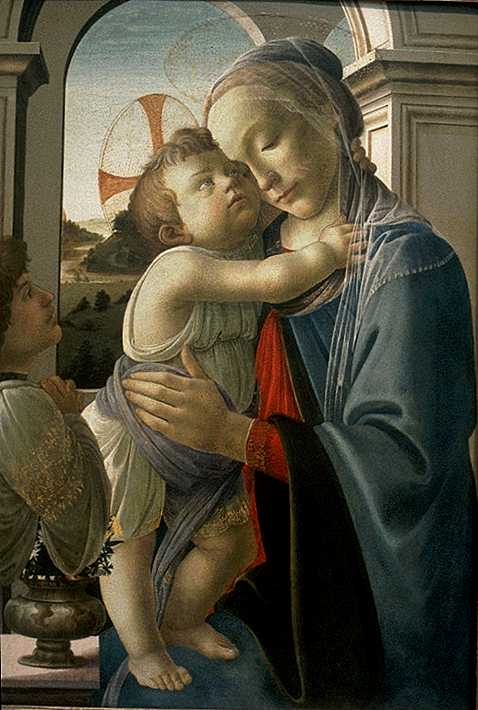

Petite Madone au donateur
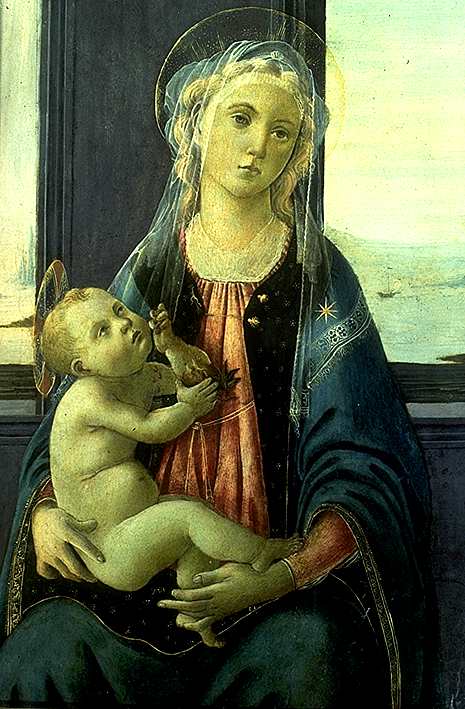

Vierge à la mer ou au bateau
Les Florentins qui commanderont ces madones deviendront de plus en plus brillants, ils auront de plus en plus de pouvoir. Ils demanderont donc des choses de plus en plus extraordinaires, toujours plus grandes, toujours plus belles. Ces jeunes artistes étaient pressés, chaque œuvre devait être plus magnifique que la précédente. On verra les programmes augmenter, toujours la Vierge à l'Enfant, les personnages se multiplier et occuper parfaitement ce format très à la mode de la Florence de la deuxième moitié du Quatrocento, la forme ronde, le tondo. Voici l'un des premiers :
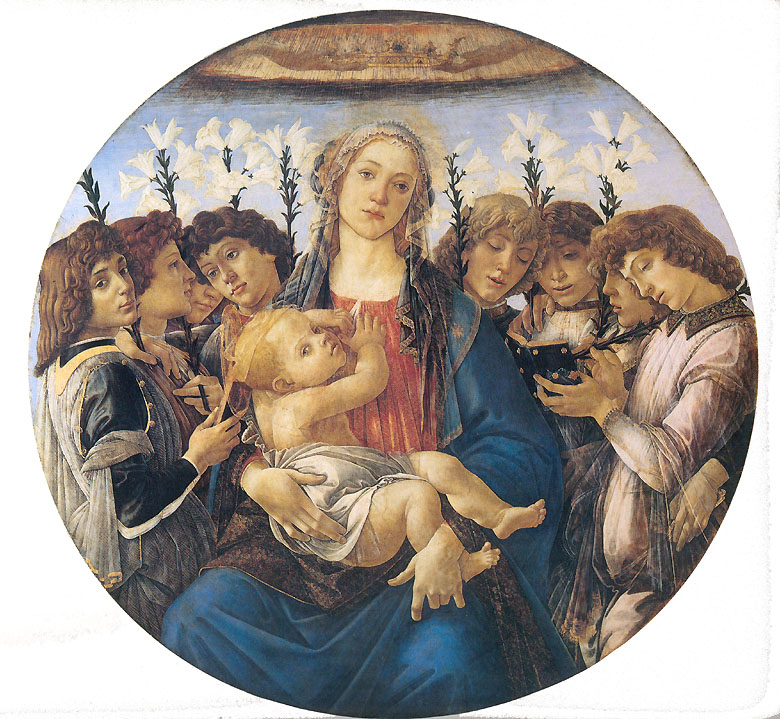

Tondo aux huit anges
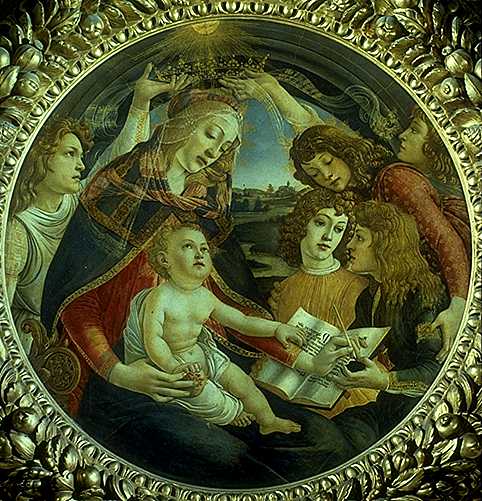

Tondo aux huit anges
Mais un jour Botticelli dira : "assez de Vierges!", on peut du moins l'imaginer. C'est très curieux car la Vierge du Magnificat est la dernière d'une très longue série qui a marqué toute l'étape préparatoire. On peut penser que Botticelli se sent maintenant les moyens de naître véritablement et les moyens d'être en même temps. Il abandonnera donc cet exercice de style qu'est pour lui la Vierge à l'Enfant et n'y reviendra que beaucoup plus tard et d'une tout autre façon : il se consacrera à un nouveau sujet qui est au fond la Vierge à l'Enfant "enrichie", c'est-à-dire l'Adoration des Mages. Il y vient avec beaucoup de méthode et cette nouvelle série d'œuvres sera monomaniaquement sur le sujet de l'Adoration des Mages. Mardi dernier, nous avions vu que l'Adoration des Mages est un magnifique sujet pour les Florentins qui sont riches, prospères et possèdent ce qu'il y a de plus beau sur la planète : les mages sont comme leur reflet. Peindre luxueusement le cortège des mages, c'est rendre hommage aux familles régnantes. Lorsque Benozzo Gozzoli peindra son fameux Cortège des Rois Mages, il rendra hommage aux Médicis.
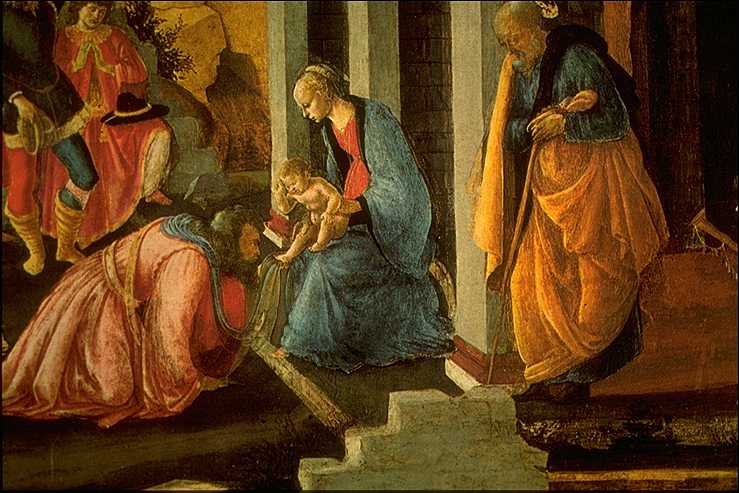
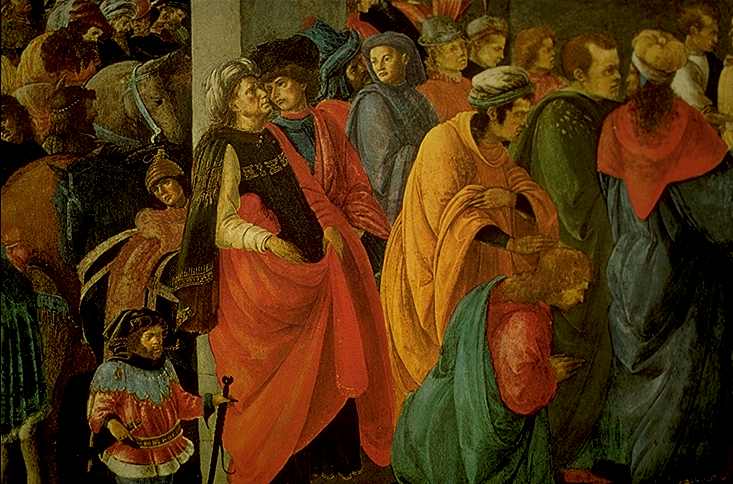

Adoration des Mages
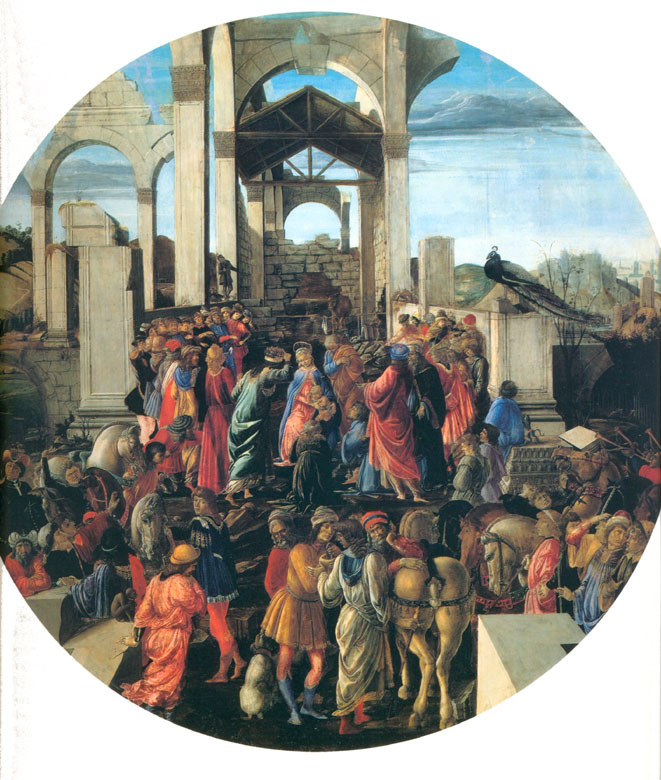

Adoration des Mages
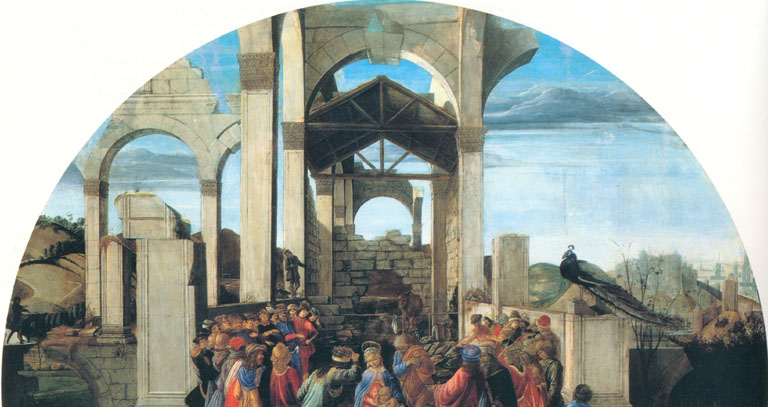
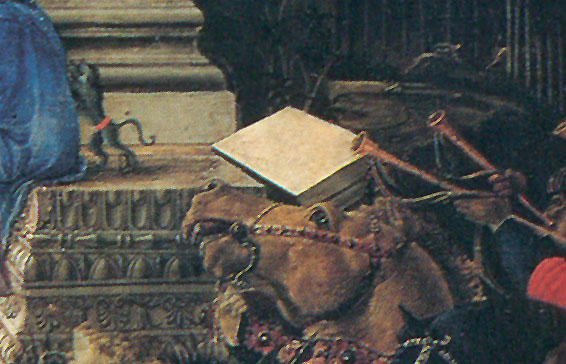
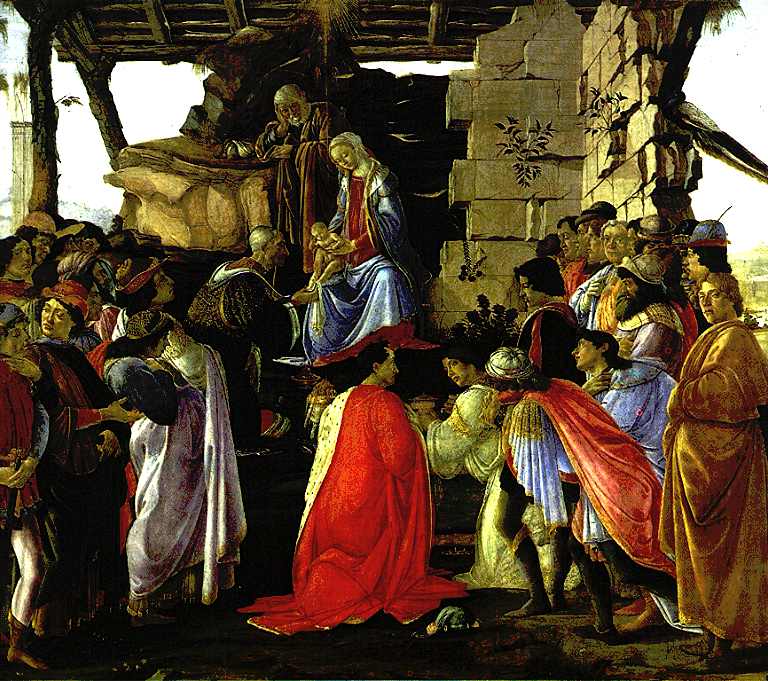

Adoration des Mages
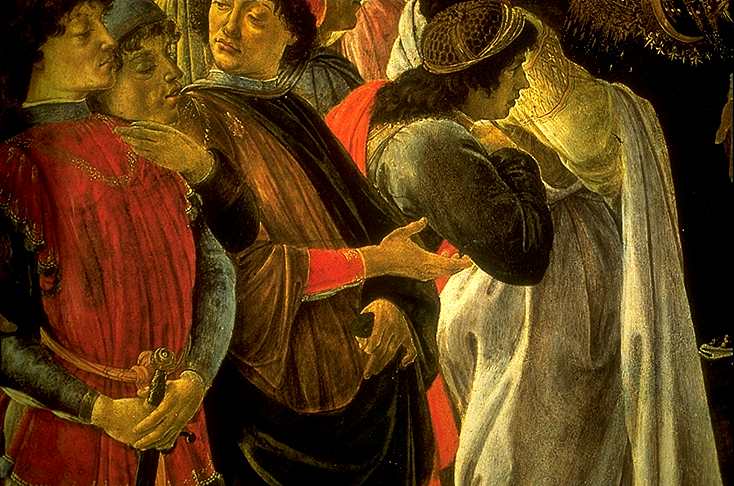
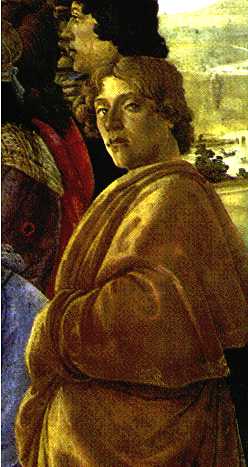 Nous sommes presque au bout des œuvres religieuses, mais il faut remarquer deux ou trois choses importantes. Voyons l'œuvre suivante : c'est le fameux
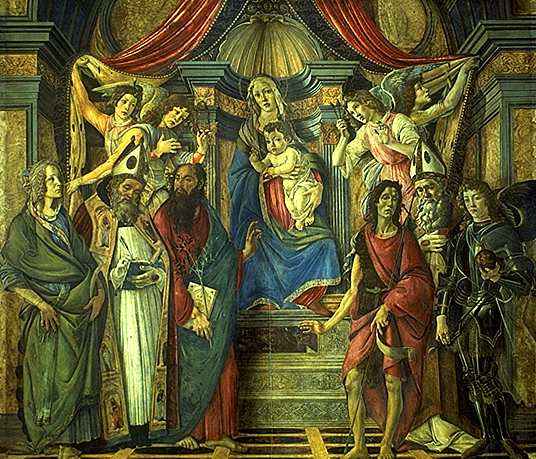

Retable de Saint Barnabé


La Nativité mystique
C'est le canevas car il y avait, comme toujours chez Savonarole, toute une quantité de symboles plus explicites et plus architectoniques encore. Et plus on a regardé cette homélie de Savonarole et l'oeuvre, plus on s'est rendu compte que l'œuvre en est, en quelque sorte, l'illustration. La ronde des douze anges correspondant aux douze heures du jour et aux douze mois de l'année, c'est dans Savonarole qu'il faut la trouver. La présence des anges qui représentent la foi, l'espérance et la charité en robes blanche, rouge et verte, c'est dans Savonarole qu'il y en a le libellé. Les anges, les mêmes, en vert, rouge et blanc qui viennent sauver les humains et les tirer des limbes, c'est dans Savonarole toujours. Les démons chassés, et nous en voyons ici et là, c'est dans Savonarole encore. Tout simplement nous nous rendons compte qu'après une période d'un christianisme très esthétique, celui des premières Vierges, des premiers tondi, et même ce christianisme très social peut-on dire des grandes adorations, il y a eu tout à coup un évènement dans la carrière de Botticelli : la découverte de Savonarole. Et l'œuvre la plus inspirée de Botticelli est cette Nativité mystique, la dernière œuvre de ce premier tronc que nous voulions vous présenter ce soir. Nous aurons d'ailleurs l'occasion, après avoir admiré les œuvres païennes, de voir si le "savonarolisme" a été très important ou épisodiquement important pour Botticelli, s'il explique ou non l'entier de l'oeuvre.
Détails: des anges couronnent de lauriers parce qu'ils ont écouté Savonarole, possés par les trois anges rouge, vert et bleu vers la Nativité, c'est le groupe de droite. Au centre, étonnante accolade de cet ange et de ce gentil qui s'écartent l'un de l'autre pour que l'on voie bien le diable en train d'essayer de s'enfiler sous une dalle. Magnifique double mouvement presque en arc de triomphe qui marque le pas axial de cette composition.
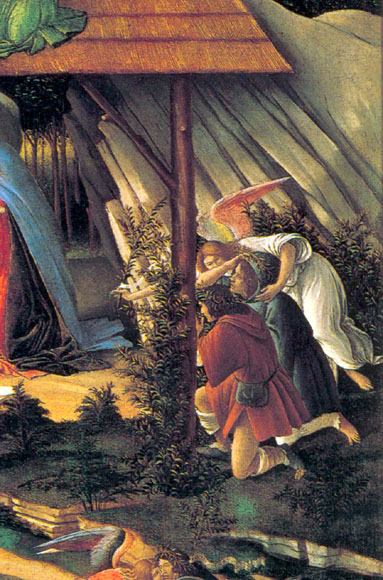
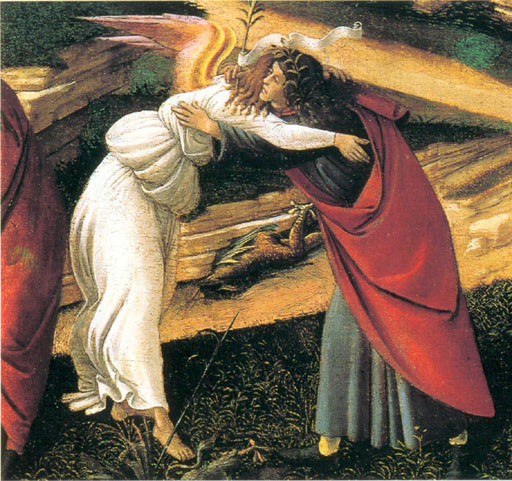 Nous quittons maintenant ce monde chrétien pour passer aux peintures du monde païen, les plus célèbres peut-être.
les œuvres d'inspiration chrétienne
les œuvres profanes
Voici ces œuvres, hormis bien sûr l'étendard de Julien qui est perdu.
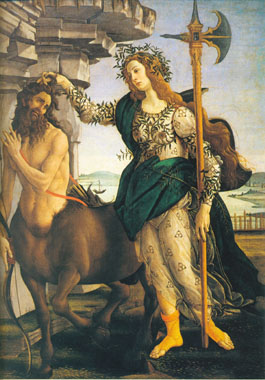
Pallas et le Centaure
Peinture de très grande dimension conservée aux Offices de Florence. Nous connaissons parfaitement les conditions de la commande : c'est Laurent le Magnifique
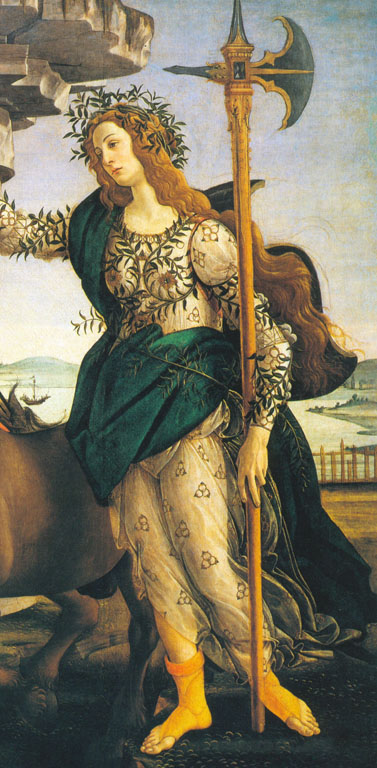
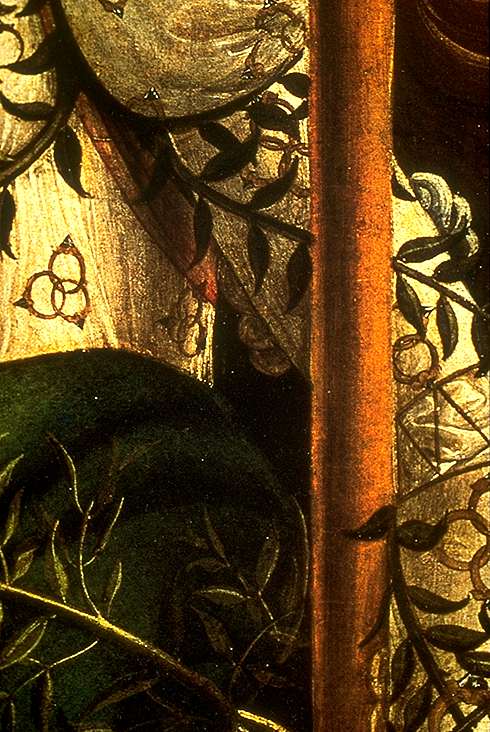
Détails: Pallas qui est la soeur des Grâces de la Villa Lemmi et aussi des filles de Jéthro de la Sixtine avec cette longueur et, en même temps, cette langueur admirablement peintes. D'ailleurs, pour que Pierfrancesco s'y retrouve tout de suite et sache de qui est le cadeau, Sémiramis porte une robe brodée de l'insigne de Laurent le Magnifique : trois ou quatre bagues à diamant, cela dépend de l'endroit. Sur ce détail de la robe, ce sont trois bagues qui signent l'appartenance de cette œuvre au Magnifique qui semble en avoir dicté le motif.
Mars et Vénus
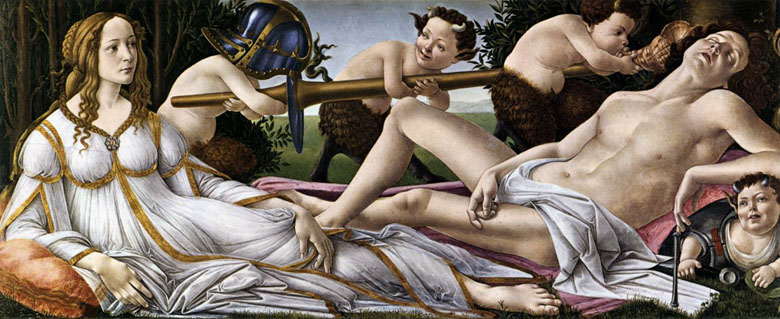
C'est une commande de mariage de la famille Vespucci. Dans ces familles florentines, le grand moment du mariage se passe la veille où l'on exposait la dot de la mariée devant la maison, argenterie, vermeil, bijoux, dans des coffres de plus en plus fous, de plus en plus extravagants, auxquels on donne le nom de "cassone". Plus le 15e siècle passe, plus le 16e siècle passe, plus les coffres deviendront des monuments et les plus grands artistes sont sollicités pour orner ces coffres. Et pour un mariage Vespucci, notre Botticelli sera commis pour peindre celui-ci. L'étrange format de cette oeuvre, très en longueur, un peu le format en prédelle, tient donc au fait que c'est un devant de "cassone". De nouveau, le sujet est philosophique plutôt que mythologique. Il faut remarquer que du premier tableau au deuxième, mais surtout du deuxième au troisième, nous allons voir que les mythes de l'Antiquité ne sont pas utilisés pour leur folklore ou leur anecdotisme, ou la liberté que l'on peut s'accorder dans le détail, mais vraiment de plus en plus dans un but philosophique. Dans ce tableau, on nous montre la jeune épousée, bien sûr, sous les traits de Vénus contemplant le sommeil du jeune époux sous les traits de Mars. Vénus est l'Amour, la Concorde, Mars la Guerre, la Discorde. La nature humaine est faite des deux choses, l'union de Vénus et de Mars ne peut créer que l'équilibre des forces et donc la perfection. Ces leçons de morale très néo-platoniciennes que Botticelli nous assènent ici sont dictées par ses commanditaires. Avec un très joli détail, les petits satyres qui ont volé les armes de Mars et qui jouent à la guerre à l'arrière-plan. On sait que c'est une commande des Vespucci car de la souche on voit sortir des guêpes, "vespe" veut dire guêpe en italien, et les "vespi" sont sur les armes des Vespucci.
La première affirmation aussi insolemment superbe de la beauté païenne chez Botticelli se trouve dans l'image de cette Vénus admirable qui n'a pas de corps : le corps est remplacé par ce jeu d'une extrême subtilité des étoffes les plus fines et, en même temps, ce galon qui les contient et les révèle. De l'autre côté, un des premiers nus héroïques de Botticelli, ce Mars au masque ensommeillé dont tout Florence est venu admirer la lumière sur le visage. Il est frappé d'éclairs de lumière sur le visage ce qui rend son sommeil encore plus lourd. Cette façon de sculpter les visages par coups de soleil, au sens propre du terme, est très nouvelle et remarquée à Florence en ces temps-là. Pour montrer combien Botticelli sait peindre jusqu'au dernier détail, voici le petit satyre qui s'est emparé du casque de Mars. En tout cas, une œuvre qui a fait beaucoup de bruit, tellement de bruit que le plus bruyant des Florentins, le fameux Lorenzo di Pierfrancesco de Médicis, désireux de rendre sa villa plus belle qu'elle ne l'a jamais été, commande à Botticelli deux nouvelles peintures et ce sera l'apogée avec la Naissance de Vénus et le Printemps. Nous verrons ensuite l'Histoire de Nastagio degli Onesti.

Pallas et le Centaure
Laurent le Magnifique
Toutes les familles Médicis descendent d'une même branche, celle de Giovanni de Médicis, premier Gonfalonier de Florence mais qui est hors de l'aventure de la Maison de Médicis. Ce Giovanni aura deux fils, l'un est Cosme, l'autre Laurent.
C'est de Cosme que descend la fameuse branche aînée, celle dont nous avons parlé jusqu'à présent : Cosme l'Ancien, Pierre le Goutteux, Laurent le Magnifique, Pierre l'Infortuné etc.
Pour la branche cadette, Lorenzo l'Ancien aura lui aussi une descendance : Pierfrancesco puis Pierfrancesco aura Lorenzo il Popolano et Giovanni il Popolano, etc. Et descendant de ce Giovanni il Popolano, Cosme deviendra le premier Grand Duc de Toscane.
Toute la grandeur de la famille de Médicis sera faite par la branche aînée qui s'éteindra sous (le petit-fils)Alexandre laMaure, arrière petit-fils de Laurent le Magnifique, sans descendance. Par contre la soeur d'Alexandre n'est autre que Catherine de Médicis au destin glorieux. Le pouvoir passera à la branche cadette au moment où ils abandonneront leur titre de "Premier" de Florence pour prendre le titre plus glorieux de Grand Duc de Florence et ensuite de Grand Duc de Toscane. Lorenzo di Pierfrancesco de Médicis est de la branche cadette qui, historiquement, tiendra le plus longtemps sur le trône. C'est à cette branche qu'appartiendra Cosme Ier, mais aussi Marie de Médicis.
qui a offert cette œuvre à un personnage s'appelant Lorenzo di Pierfrancesco de Médicis. Lorenzo vient de se marier et il a épousé une femme qui a le plus beau nom du monde : Sémiramis d'Appiamo. C'est un nom qui n'est pas encore à la mode, ce sera un nom du 16e siècle. C'est pour ce mariage qu'a été composée cette œuvre brillante, superbement peinte, mais qui est dictée par les circonstances. Laurent veut que cette œuvre soit morale car il connaît Lorenzo di Pierfrancesco. C'est un sensuel, un brutal, un débauché, un violent, un certain nombre de ses domestiques ont déjà été envoyés ad patres... Quant aux épouses de ses domestiques, elles ont au moins chacune six enfants de lui. Il est un peu le seigneur médiéval. Semiramis d'Appiamo est sensée le retenir en ses bras. Voilà ce que veut dire Laurent qui est un peu imprudent : Sémiramis est Pallas, la Raison qui aura raison de la bestialité incarnée ici par le Centaure. C'est un beau cadeau, un joli tableau à mettre sur la cheminée, mais c'est surtout une leçon de morale : "Que ton épouse t'apprenne et t'étaye à la raison". C'est le but de cette première allégorie de Botticelli.
C'est de Cosme que descend la fameuse branche aînée, celle dont nous avons parlé jusqu'à présent : Cosme l'Ancien, Pierre le Goutteux, Laurent le Magnifique, Pierre l'Infortuné etc.
Pour la branche cadette, Lorenzo l'Ancien aura lui aussi une descendance : Pierfrancesco puis Pierfrancesco aura Lorenzo il Popolano et Giovanni il Popolano, etc. Et descendant de ce Giovanni il Popolano, Cosme deviendra le premier Grand Duc de Toscane.
Toute la grandeur de la famille de Médicis sera faite par la branche aînée qui s'éteindra sous (le petit-fils)Alexandre laMaure, arrière petit-fils de Laurent le Magnifique, sans descendance. Par contre la soeur d'Alexandre n'est autre que Catherine de Médicis au destin glorieux. Le pouvoir passera à la branche cadette au moment où ils abandonneront leur titre de "Premier" de Florence pour prendre le titre plus glorieux de Grand Duc de Florence et ensuite de Grand Duc de Toscane. Lorenzo di Pierfrancesco de Médicis est de la branche cadette qui, historiquement, tiendra le plus longtemps sur le trône. C'est à cette branche qu'appartiendra Cosme Ier, mais aussi Marie de Médicis.
Laurent le Magnifique
Détails: Pallas qui est la soeur des Grâces de la Villa Lemmi et aussi des filles de Jéthro de la Sixtine avec cette longueur et, en même temps, cette langueur admirablement peintes. D'ailleurs, pour que Pierfrancesco s'y retrouve tout de suite et sache de qui est le cadeau, Sémiramis porte une robe brodée de l'insigne de Laurent le Magnifique : trois ou quatre bagues à diamant, cela dépend de l'endroit. Sur ce détail de la robe, ce sont trois bagues qui signent l'appartenance de cette œuvre au Magnifique qui semble en avoir dicté le motif.
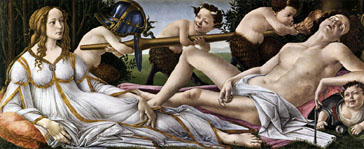
Mars et Vénus
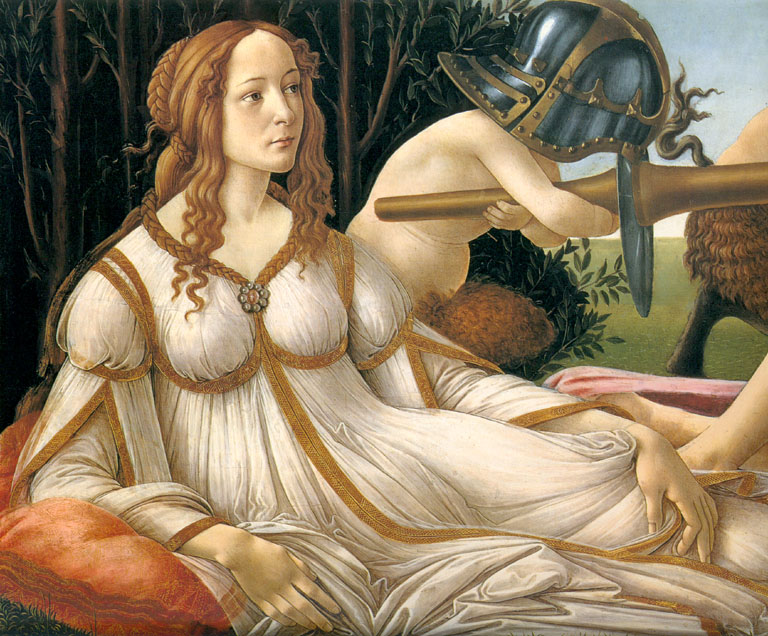
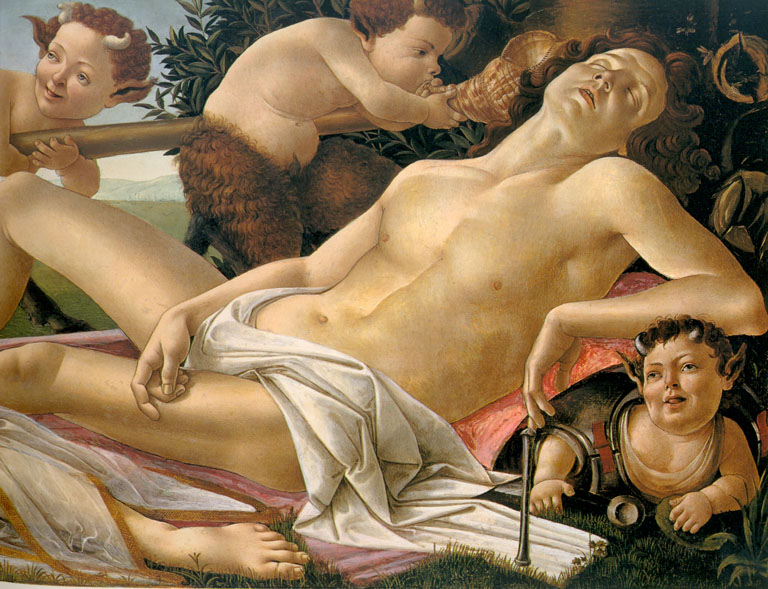
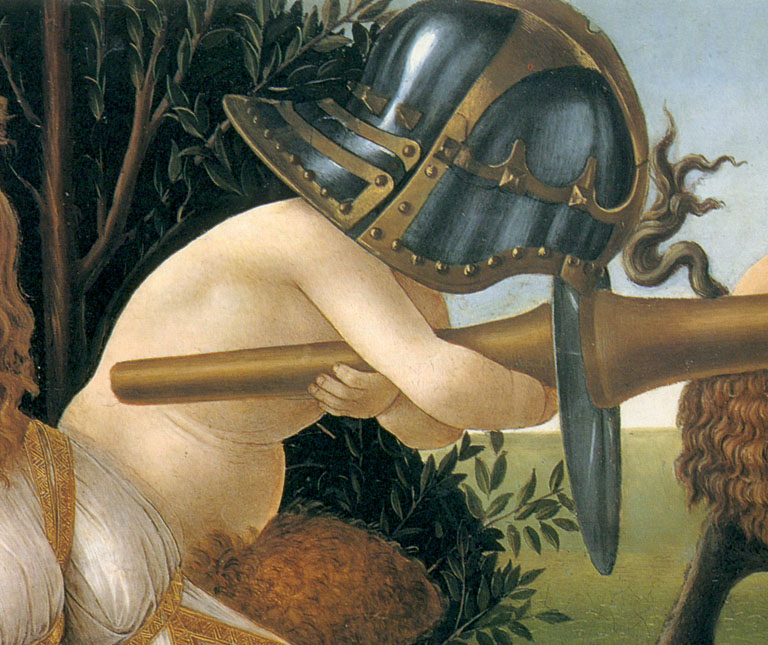 La première affirmation aussi insolemment superbe de la beauté païenne chez Botticelli se trouve dans l'image de cette Vénus admirable qui n'a pas de corps : le corps est remplacé par ce jeu d'une extrême subtilité des étoffes les plus fines et, en même temps, ce galon qui les contient et les révèle. De l'autre côté, un des premiers nus héroïques de Botticelli, ce Mars au masque ensommeillé dont tout Florence est venu admirer la lumière sur le visage. Il est frappé d'éclairs de lumière sur le visage ce qui rend son sommeil encore plus lourd. Cette façon de sculpter les visages par coups de soleil, au sens propre du terme, est très nouvelle et remarquée à Florence en ces temps-là. Pour montrer combien Botticelli sait peindre jusqu'au dernier détail, voici le petit satyre qui s'est emparé du casque de Mars. En tout cas, une œuvre qui a fait beaucoup de bruit, tellement de bruit que le plus bruyant des Florentins, le fameux Lorenzo di Pierfrancesco de Médicis, désireux de rendre sa villa plus belle qu'elle ne l'a jamais été, commande à Botticelli deux nouvelles peintures et ce sera l'apogée avec la Naissance de Vénus et le Printemps. Nous verrons ensuite l'Histoire de Nastagio degli Onesti.
les œuvres profanes
L'étude de cette œuvre qui a passé longtemps pour excentrique a apporté une révélation. Botticelli a vécu sa maturité exactement à l'époque du plus grand prédicateur peut-être de tout le siècle : Savonarole. Il faut se souvenir qu'à la fameuse homélie du Carême de l'année 1499, quelques jours avant que Botticelli ne prenne en main ce tableau-ci, Savonarole avait dit aux Florentins : "Repentez-vous de ce que vous avez fait, repentez-vous de vos péchés, éloignez-vous du démon, laissez-vous gagner par les anges seuls capables de vous amener jusqu'au Sauveur". C'est le canevas car il y avait, comme toujours chez Savonarole, toute une quantité de symboles plus explicites et plus architectoniques encore. Et plus on a regardé cette homélie de Savonarole et l'œuvre, plus on s'est rendu compte que l'œuvre en est, en quelque sorte, l'illustration. La ronde des douze anges correspondant aux douze heures du jour et aux douze mois de l'année, c'est dans Savonarole qu'il faut la trouver. La présence des anges qui représentent la foi, l'espérance et la charité en robes blanche, rouge et verte, c'est dans Savonarole qu'il y en a le libellé. Les anges, les mêmes, en vert, rouge et blanc qui viennent sauver les humains et les tirer des limbes, c'est dans Savonarole toujours. Les démons chassés, et nous en voyons ici et là, c'est dans Savonarole encore. Tout simplement nous nous rendons compte qu'après une période d'un christianisme très esthétique, celui des premières Vierges, des premiers tondi, et même ce christianisme très social peut-on dire des grandes adorations, il y a eu tout à coup un évènement dans la carrière de Botticelli : la découverte de Savonarole. Et l'œuvre la plus inspirée de Botticelli est cette Nativité mystique, la dernière œuvre de ce premier tronc que nous voulions vous présenter ce soir. Nous aurons d'ailleurs l'occasion, après avoir admiré les œuvres païennes, de voir si le "savonarolisme" a été très important ou épisodiquement important pour Botticelli, s'il explique ou non l'entier de l'œuvre.
Détails: des anges couronnent de lauriers parce qu'ils ont écouté Savonarole, poussés par les trois anges rouge, vert et bleu vers la Nativité, c'est le groupe de droite. Au centre, étonnante accolade de cet ange et de ce gentil qui s'écartent l'un de l'autre pour que l'on voie bien le diable en train d'essayer de s'enfiler sous une dalle. Magnifique double mouvement presque en arc de triomphe qui marque le pas axial de cette composition.
Tous les écrivains, tous les auteurs, tous les historiens d'art jusque dans les années 1920 ont vu, dans ces deux œuvres, deux œuvres distinctes parce qu'un des tableaux a 37 cm de moins que l'autre. On avait pensé que le premier tableau avait été commandé et, comme cela faisait joli, on avait ensuite commandé le deuxième. Plus on regarde ces tableaux, plus on se rend compte, à l'évidence absolue, que ces tableaux sont faits pour être l'un avec l'autre, l'un à côté de l'autre, pour ne pas dire l'un dans l'autre. Non seulement leur style pictural mais aussi l'intention de l'artiste vont ensemble : l'un prépare l'autre. Avec les techniques qui sont celles d'aujourd'hui, on a réexaminé les œuvres et on s'est rendu compte que La Naissance de Vénus avait été rabotée de 32,5 cm en haut ce qui crée cette disparité de taille qui veut qu'aujourd'hui, même les conservateurs des Offices n'osent pas les relier l'un à l'autre alors qu'ils sont faits pour être côte à côte. Ce sont des œuvres dans lesquelles il y a un message que nous allons déchiffrer ensemble, un progrès dans l'idée que nous allons voir ensemble, cependant que nous admirerons la beauté de la peinture de Botticelli.
Il faut savoir que nous sommes dans cette Florence des années 1480 où, autour des princes que sont les Médicis en particulier, les Vespucci, les Tornabuoni, etc., il y a les artistes, Botticelli et les autres, mais aussi les humanistes. Il ne faut pas oublier cette race nouvelle des humanistes, des hommes de science qui ont pour mission de faire revivre le passé, de traduire Virgile, Homère, Hésiode, Pindare, de les réactualiser. Autour de ces humanistes, il y a leurs disciples, ceux qui sont de grands penseurs et de grands philosophes et tout ce monde vit ensemble. Laurent le Magnifique, réunissait chaque jour ces humanistes et ces artistes et tous ensemble, comme en un cénacle dirigé par Apollon le Prince, on faisait l'art de Florence et les idées des humanistes étaient traduites ensuite par les artistes, peintres, sculpteurs, orfèvres, musiciens. Quelques générations à peine plus tard naîtra le néo-platonisme musical. Nous savons que cette Naissance de Vénus, et le Printemps qui en est la suite exacte, a été lancé en tant qu'idée par Laurent le Magnifique lui-même, traduite en vers par son humaniste préféré, Ange Politien, commentée par le petit génie Pic de la Mirandole, accréditée par le patriarche Marsile Ficin et le livret a été ficelé pour être confié à Sandro Botticelli. Cela va de Laurent le Magnifique à tout l'humanisme de la Florence de cette seconde moitié du 15e siècle pour enfin être donné à Botticelli qui a donc scrupuleusement suivi un texte : la naissance de la Vénus profane et le couronnement de la Vénus sacrée. C'est écrit par Ange Politien d'après une ode de Hésiode et c'est en fait Lorenzo di Pierfrancesco qui va payer cette œuvre. Nous allons voir maintenant les deux tableaux, mais il faut espérer qu'ils seront une fois côte à côte pour qu'on puisse les réunir sur une seule diapositive.
La Naissance de Vénus Nous voyons la naissance de l'histoire avec les vents Zéphyr et Aura qui, le premier jour de la création, poussent depuis l'inconnu de la mer ce coquillage sur lequel apparaît la triomphante nudité de Vénus. Et en approchant de la terre où elle va prendre son vrai rôle, sa vraie puissance, elle découvre la pudeur et nous remarquons cette attitude que Botticelli a directement empruntée aux beaux exemplaires des Vénus pudica antiques que l'on découvrait à cette époque-là. Il l'a vraiment peinte comme une Vénus pudica. Pour que cette pudicité prenne tout son aspect sacré, une des Grâces au nom des trois est ici et va la revêtir de son manteau. C'est le privilège des Grâces de recouvrir la nudité de Vénus et de faire d'elle en fait la mère et la patronne de toutes les forces de la création. Vénus est en train d'accoster. Il faut remarquer qu'elle accoste à un rivage très découpé et marqué déjà par de grands arbres, lauriers et myrtes réunis, et que les arbres sont serrés les uns contre les autres et les frondaisons obscures les unes par rapport aux autres.
Voici quelques détails pour nous rendre compte de la triomphante splendeur de Vénus. On sait que jusqu'à récemment, cette Naissance de Vénus avait été furieusement passée avec un badigeon-béton, c'est-à-dire que tout simplement ses vernis successifs avaient fini par complètement s'opacifier. Les deux tableaux ont été admirablement lavés et nous avons maintenant découvert un autre Botticelli : des chairs nacrées, presque semi-transparentes, une peau si fine qu'on a l'impression de voir la mer à travers. Toute la qualité formidable de la peinture de Botticelli n'est apparue que depuis le nettoyage.
Voilà le groupe héroïque des vents. Au fond, ils représente dans leur désordre le chaos originel, car une Vénus naît de ce chaos originel qui la pousse ainsi à prendre possession du monde. Admirable Grâce avec le manteau qu'elle a préparé pour revêtir Vénus des fleurs et fruits de la terre car elle deviendra Vénus Flore et Pomone. Elle sera tout cela et, en tant que Vénus sacrée, elle sera la maîtresse des dieux et déesses de l'Olympe. Superbe visage de cette Grâce dont Ingres a dit que c'était le plus beau visage jamais peint (il a toujours aimé les femmes qui n'avaient pas de menton).
L'aspect dansant dans la lumière de la robe blanche animée de bleuets n'est pas dû aux plis mais véritablement au jeu des bleus des bleuets, des parties ensoleillées, des parties en ombres, des parties en avant, des parties en retrait sculptées par les bleuets qui donnent tous les champs qui font dominer la beauté du corps de cette Grâce qui est une des plus belles parties de la Naissance de Vénus.
Le Printemps Il faut d'emblée constater que c'est la même forêt, les mêmes arbres, les mêmes frondaisons, le même espacement entre les arbres, la même terre, le même sol, le même semis de fleurs. Autrement dit, Vénus naît et aborde dans ce deuxième tableau qu'est le Printemps, c'est la suite. Nous la retrouvons toujours en pivot de la composition, mais vêtue comme une souveraine. De la Vénus profane de tout à l'heure, nue, on passe à la Vénus sacrée, vêtue comme une matronne, au sens le plus noble du terme. En tant que telle, elle est vraiment la patronne des forces et des éléments et elle est entourée de tout ce dont elle a besoin pour triompher sur l'ensemble des douze mois de l'année, l'ensemble des quatre saisons, donc sur l'éternité.
Mercure tend son caducée pour arrêter le vent qui soufflait tout à l'heure avec Zéphyr et son frère et, par là même, il arrête le passage de l'hiver au printemps. Le groupe formidable des trois Grâces, peut-être le plus beau jamais peint, c'est l'affirmation de la Primavera, c'est-à-dire du Printemps, vers lequel est encore tournée Vénus. Puis le temps passe et nous voyons l'affirmation de l'été représenté ici par Flore dont la robe est fleurs à proprement parler, et qui répand sur la terre les produits de sa générosité, les fleurs. Et l'automne par Chloris qui se retourne presque frileusement vers un personnage bleu et un peu terrifiant qui tente de la prendre.
Ce personnage est Zéphyr qui, un jour, a oublié de souffler parce qu'il poursuivait dans les bois la nymphe Chloris.
Ce qui est absolument extraordinaire, si l'on se souvient de la Naissance, c'est que nous avions Zéphyr, Vénus, une Grâce dans le premier tableau, et nous retrouvons ici Mercure, les Grâces, Vénus, Flore, Chloris, Zéphyr. Cela commence et cela finit par Zéphyr, donc les deux tableaux forment le cycle complet des saisons, hiver, printemps, été, automne. L'ensemble a été voulu pour nous montrer ce cycle de la nature qui est tellement propre à l'inspiration néo-platonicienne de Hésiode, telle que Marsile Ficin, Pic de la Mirandole et les autres la révéraient à cette époque. Mais cela nous montre aussi la primauté de l'amour sacré, tel qu'il est incarné ici, sur l'amour profane, sur la fragilité de l'eau et du coquillage de l'œuvre précédente. En fait, toutes les allusions pourraient être étudiées beaucoup plus longuement pour nous démontrer la totale suite qu'il y a dans ces deux tableaux. Pour l'instant, nous allons nous promener dans le Printemps.
A gauche, Mercure et les Grâces et, surtout, la très belle image de Mercure élevant son caducée pour arrêter les nuages et les vents et permettre aux Grâces de danser tranquillement, la plus belle chose qui soit. Les robes ont l'air d'être transparentes mais elles ne le sont pas car c'est à peine si on devine les corps. Les corps sont de la danse parce que l'étoffe danse vraiment et les mouvements des bras, en particulier, sont absolument sublimes. Ensuite, nous avons Vénus au centre de la composition, dans cette pose presque solennelle qui est la sienne, matronne présidant à l'année telle qu'elle se développe avec la personne de Flore, l'un des plus beaux détails du Printemps, Chloris et Zéphyr, les trois derniers personnages dont l'aspect dansant, là aussi, est le contrepoint exact du groupe des trois Grâces.
Détails du visage de Flore, le plus célèbre dans la peinture de Botticelli, de la robe de Flore qui est comme une paraphrase de la robe de la Grâce dans la Naissance de Vénus. Tout le mouvement, pour elle aussi, vient de ces fleurs traitées en anamorphose et de ce bouquet de fleurs qu'elle s'apprête à jeter dans le monde. Enfin, Chloris poursuivie par Zéphyr qui a les deux fois les mêmes joues gonflées, une fois il est bleu, c'est le Zéphyr de l'hiver, l'autre fois dans la Naissance de Vénus il était presque jaune, c'était le Zéphyr du printemps.
En quittant ces tableaux qui marquent un des sommets de la peinture profane de Botticelli, nous espérons avoir réussi à démontrer combien elle répond à un programme iconographique, combien ce programme est un mythe et combien ce mythe se veut un enseignement qui nous apprend la primauté de l'amour sacré sur l'amour profane. C'est très important de s'en être rendu compte parce qu'il faut déjà remarquer que dans aucun des tableaux chrétiens, Botticelli n'essaie même d'être enseignant. Par contre, dans tous les tableaux païens, depuis Mars et Vénus et surtout avec la Naissance de Vénus et le Printemps, on voit qu'il y a enseignement. Il est assez extraordinaire de constater que Botticelli est plus à l'aise dans ce rôle didactique du mythe avec les dieux "païens" qu'avec sa pérennité de chrétien.
Il faut savoir que nous sommes dans cette Florence des années 1480 où, autour des princes que sont les Médicis en particulier, les Vespucci, les Tornabuoni, etc., il y a les artistes, Botticelli et les autres, mais aussi les humanistes. Il ne faut pas oublier cette race nouvelle des humanistes, des hommes de science qui ont pour mission de faire revivre le passé, de traduire Virgile, Homère, Hésiode, Pindare, de les réactualiser. Autour de ces humanistes, il y a leurs disciples, ceux qui sont de grands penseurs et de grands philosophes et tout ce monde vit ensemble. Laurent le Magnifique, réunissait chaque jour ces humanistes et ces artistes et tous ensemble, comme en un cénacle dirigé par Apollon le Prince, on faisait l'art de Florence et les idées des humanistes étaient traduites ensuite par les artistes, peintres, sculpteurs, orfèvres, musiciens. Quelques générations à peine plus tard naîtra le néo-platonisme musical. Nous savons que cette Naissance de Vénus, et le Printemps qui en est la suite exacte, a été lancé en tant qu'idée par Laurent le Magnifique lui-même, traduite en vers par son humaniste préféré, Ange Politien, commentée par le petit génie Pic de la Mirandole, accréditée par le patriarche Marsile Ficin et le livret a été ficelé pour être confié à Sandro Botticelli. Cela va de Laurent le Magnifique à tout l'humanisme de la Florence de cette seconde moitié du 15e siècle pour enfin être donné à Botticelli qui a donc scrupuleusement suivi un texte : la naissance de la Vénus profane et le couronnement de la Vénus sacrée. C'est écrit par Ange Politien d'après une ode de Hésiode et c'est en fait Lorenzo di Pierfrancesco qui va payer cette œuvre. Nous allons voir maintenant les deux tableaux, mais il faut espérer qu'ils seront une fois côte à côte pour qu'on puisse les réunir sur une seule diapositive.
La Naissance de Vénus Nous voyons la naissance de l'histoire avec les vents Zéphyr et Aura qui, le premier jour de la création, poussent depuis l'inconnu de la mer ce coquillage sur lequel apparaît la triomphante nudité de Vénus. Et en approchant de la terre où elle va prendre son vrai rôle, sa vraie puissance, elle découvre la pudeur et nous remarquons cette attitude que Botticelli a directement empruntée aux beaux exemplaires des Vénus pudica antiques que l'on découvrait à cette époque-là. Il l'a vraiment peinte comme une Vénus pudica. Pour que cette pudicité prenne tout son aspect sacré, une des Grâces au nom des trois est ici et va la revêtir de son manteau. C'est le privilège des Grâces de recouvrir la nudité de Vénus et de faire d'elle en fait la mère et la patronne de toutes les forces de la création. Vénus est en train d'accoster. Il faut remarquer qu'elle accoste à un rivage très découpé et marqué déjà par de grands arbres, lauriers et myrtes réunis, et que les arbres sont serrés les uns contre les autres et les frondaisons obscures les unes par rapport aux autres.


Voici quelques détails pour nous rendre compte de la triomphante splendeur de Vénus. On sait que jusqu'à récemment, cette Naissance de Vénus avait été furieusement passée avec un badigeon-béton, c'est-à-dire que tout simplement ses vernis successifs avaient fini par complètement s'opacifier. Les deux tableaux ont été admirablement lavés et nous avons maintenant découvert un autre Botticelli : des chairs nacrées, presque semi-transparentes, une peau si fine qu'on a l'impression de voir la mer à travers. Toute la qualité formidable de la peinture de Botticelli n'est apparue que depuis le nettoyage.
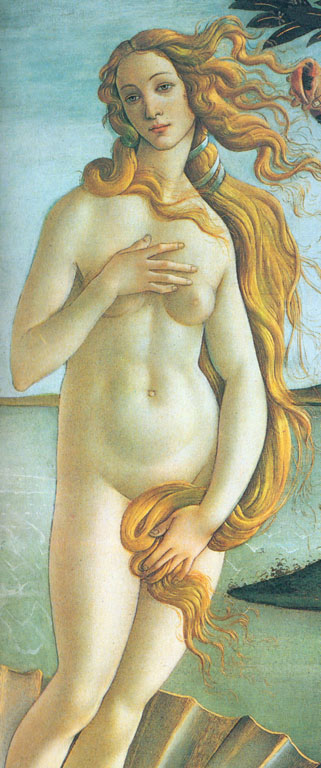
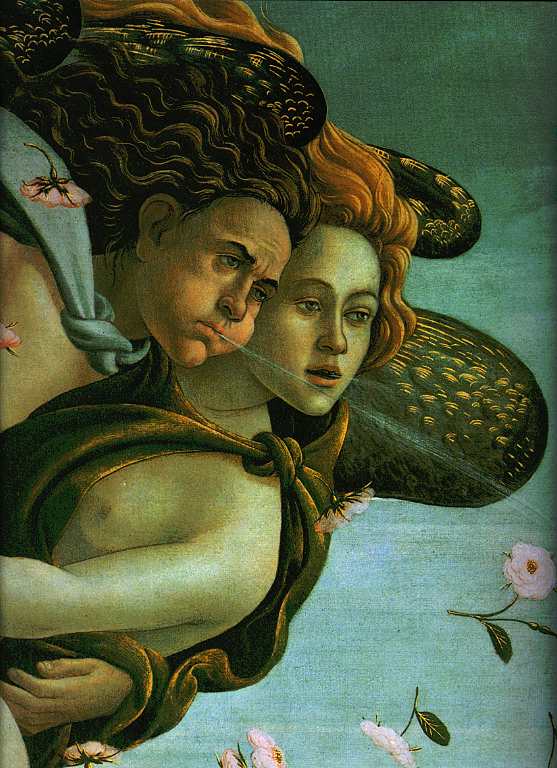
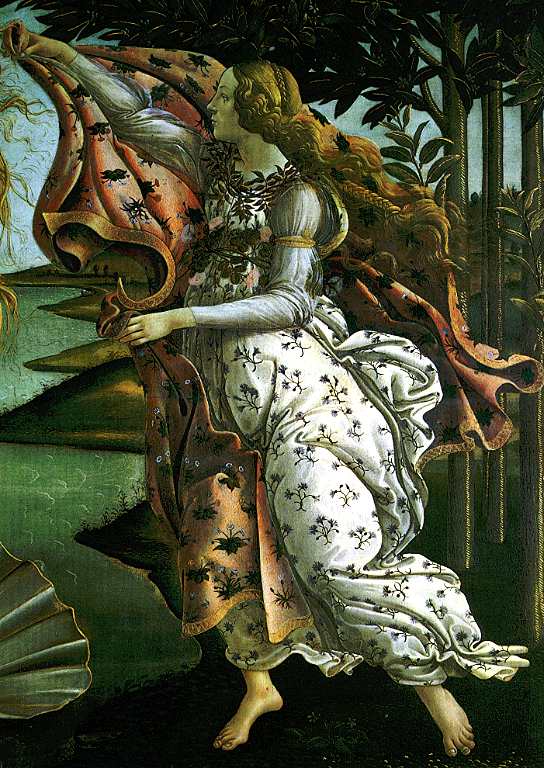 Voilà le groupe héroïque des vents. Au fond, ils représente dans leur désordre le chaos originel, car une Vénus naît de ce chaos originel qui la pousse ainsi à prendre possession du monde. Admirable Grâce avec le manteau qu'elle a préparé pour revêtir Vénus des fleurs et fruits de la terre car elle deviendra Vénus Flore et Pomone. Elle sera tout cela et, en tant que Vénus sacrée, elle sera la maîtresse des dieux et déesses de l'Olympe. Superbe visage de cette Grâce dont Ingres a dit que c'était le plus beau visage jamais peint (il a toujours aimé les femmes qui n'avaient pas de menton).
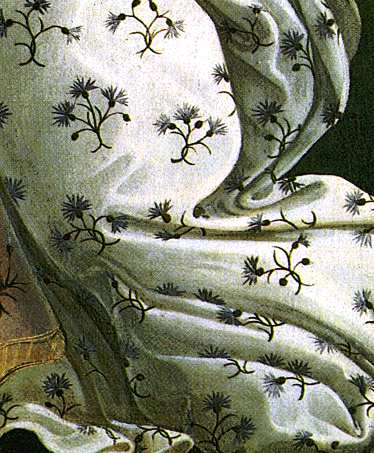 L'aspect dansant dans la lumière de la robe blanche animée de bleuets n'est pas dû aux plis mais véritablement au jeu des bleus des bleuets, des parties ensoleillées, des parties en ombres, des parties en avant, des parties en retrait sculptées par les bleuets qui donnent tous les champs qui font dominer la beauté du corps de cette Grâce qui est une des plus belles parties de la Naissance de Vénus.
Le Printemps Il faut d'emblée constater que c'est la même forêt, les mêmes arbres, les mêmes frondaisons, le même espacement entre les arbres, la même terre, le même sol, le même semis de fleurs. Autrement dit, Vénus naît et aborde dans ce deuxième tableau qu'est le Printemps, c'est la suite. Nous la retrouvons toujours en pivot de la composition, mais vêtue comme une souveraine. De la Vénus profane de tout à l'heure, nue, on passe à la Vénus sacrée, vêtue comme une matronne, au sens le plus noble du terme. En tant que telle, elle est vraiment la patronne des forces et des éléments et elle est entourée de tout ce dont elle a besoin pour triompher sur l'ensemble des douze mois de l'année, l'ensemble des quatre saisons, donc sur l'éternité.
Mercure tend son caducée pour arrêter le vent qui soufflait tout à l'heure avec Zéphyr et son frère et, par là même, il arrête le passage de l'hiver au printemps. Le groupe formidable des trois Grâces, peut-être le plus beau jamais peint, c'est l'affirmation de la Primavera, c'est-à-dire du Printemps, vers lequel est encore tournée Vénus. Puis le temps passe et nous voyons l'affirmation de l'été représenté ici par Flore dont la robe est fleurs à proprement parler, et qui répand sur la terre les produits de sa générosité, les fleurs. Et l'automne par Chloris qui se retourne presque frileusement vers un personnage bleu et un peu terrifiant qui tente de la prendre.
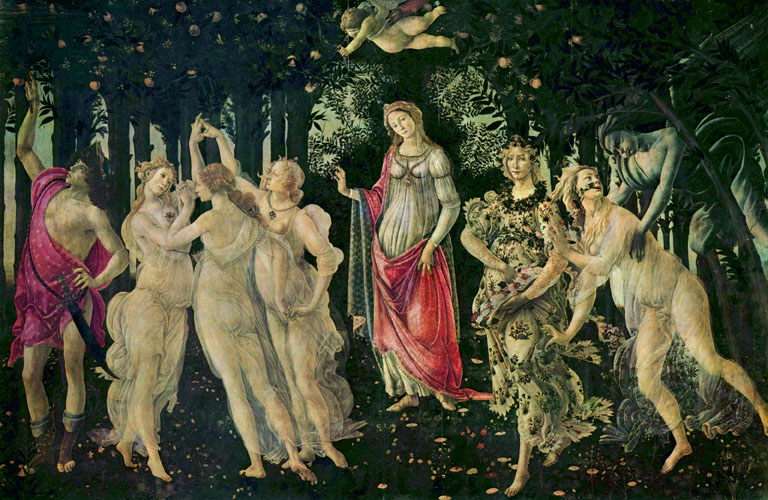
Ce qui est absolument extraordinaire, si l'on se souvient de la Naissance, c'est que nous avions Zéphyr, Vénus, une Grâce dans le premier tableau, et nous retrouvons ici Mercure, les Grâces, Vénus, Flore, Chloris, Zéphyr. Cela commence et cela finit par Zéphyr, donc les deux tableaux forment le cycle complet des saisons, hiver, printemps, été, automne. L'ensemble a été voulu pour nous montrer ce cycle de la nature qui est tellement propre à l'inspiration néo-platonicienne de Hésiode, telle que Marsile Ficin, Pic de la Mirandole et les autres la révéraient à cette époque. Mais cela nous montre aussi la primauté de l'amour sacré, tel qu'il est incarné ici, sur l'amour profane, sur la fragilité de l'eau et du coquillage de l'œuvre précédente. En fait, toutes les allusions pourraient être étudiées beaucoup plus longuement pour nous démontrer la totale suite qu'il y a dans ces deux tableaux. Pour l'instant, nous allons nous promener dans le Printemps.
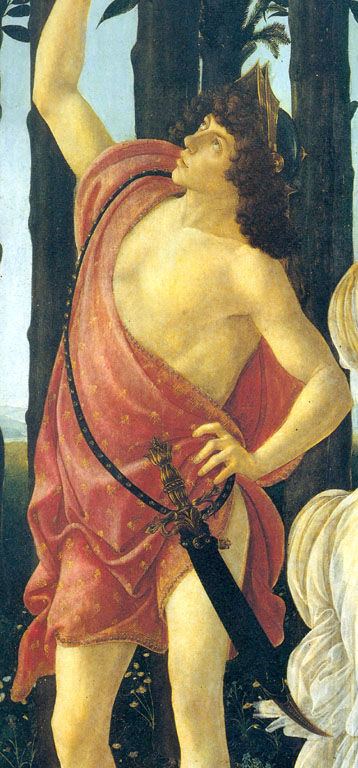
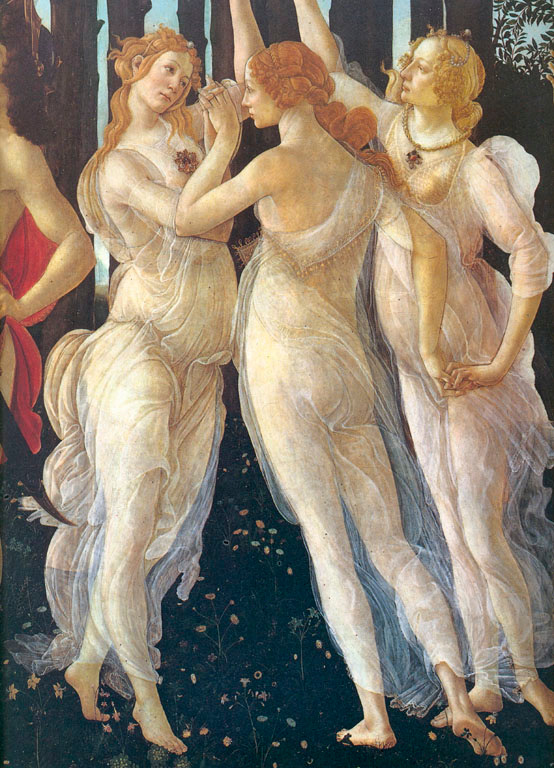
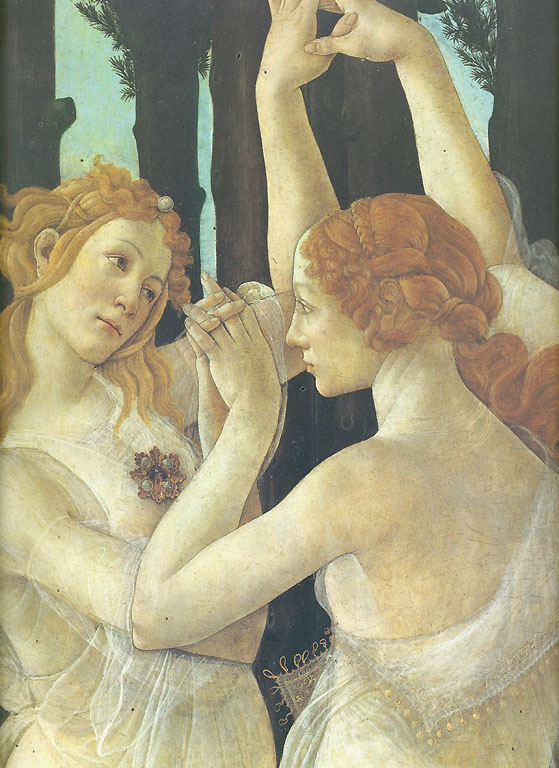 A gauche, Mercure et les Grâces et, surtout, la très belle image de Mercure élevant son caducée pour arrêter les nuages et les vents et permettre aux Grâces de danser tranquillement, la plus belle chose qui soit. Les robes ont l'air d'être transparentes mais elles ne le sont pas car c'est à peine si on devine les corps. Les corps sont de la danse parce que l'étoffe danse vraiment et les mouvements des bras, en particulier, sont absolument sublimes. Ensuite, nous avons Vénus au centre de la composition, dans cette pose presque solennelle qui est la sienne, matronne présidant à l'année telle qu'elle se développe avec la personne de Flore, l'un des plus beaux détails du Printemps, Chloris et Zéphyr, les trois derniers personnages dont l'aspect dansant, là aussi, est le contrepoint exact du groupe des trois Grâces.
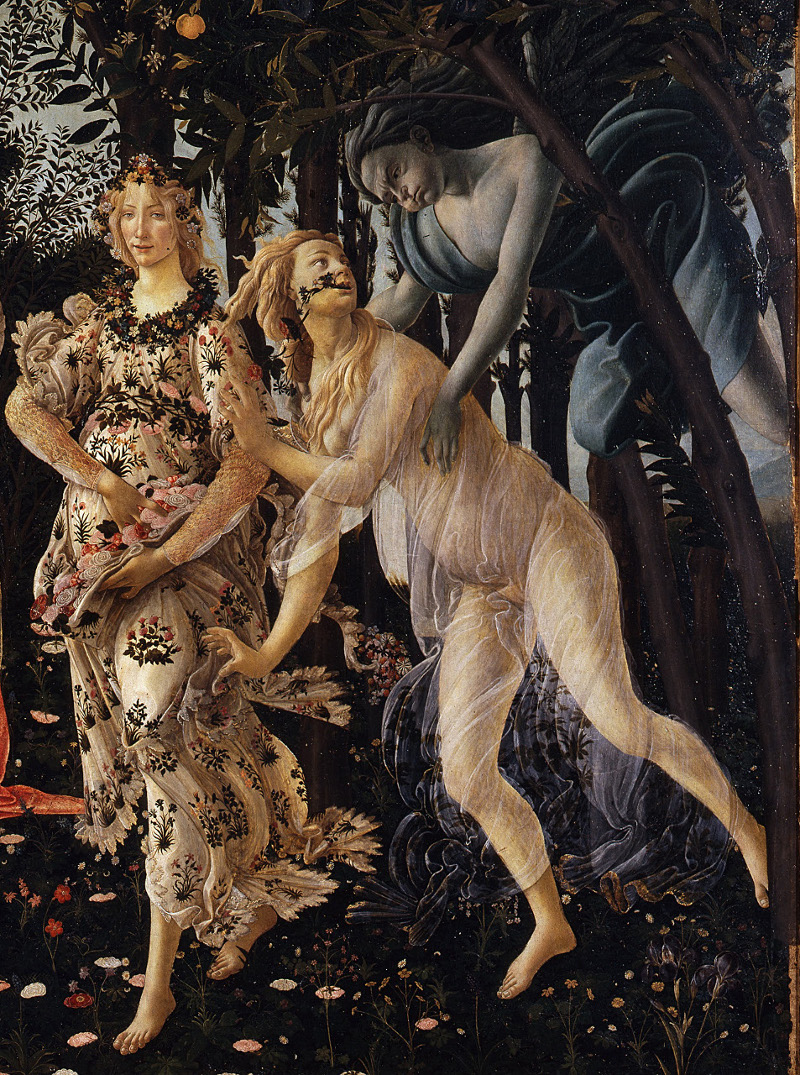
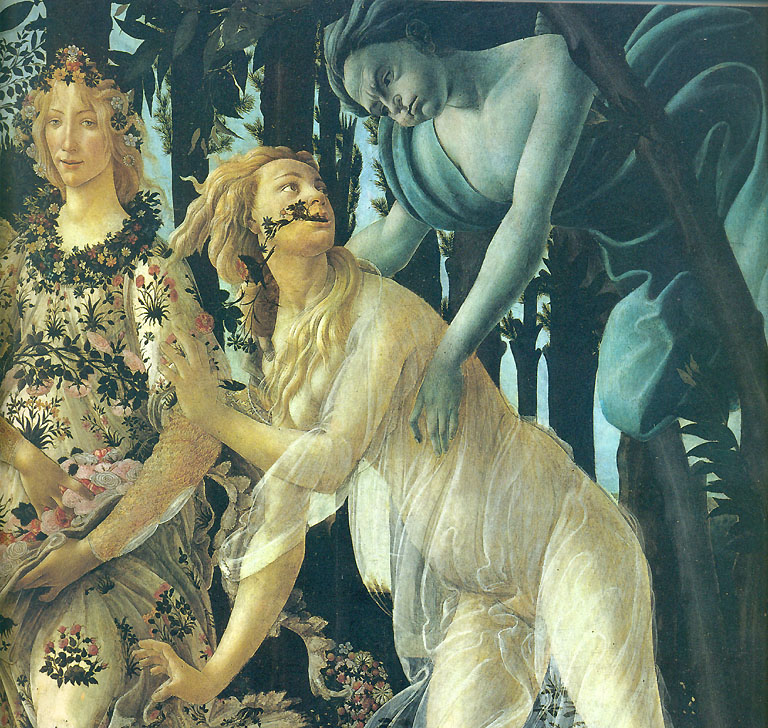
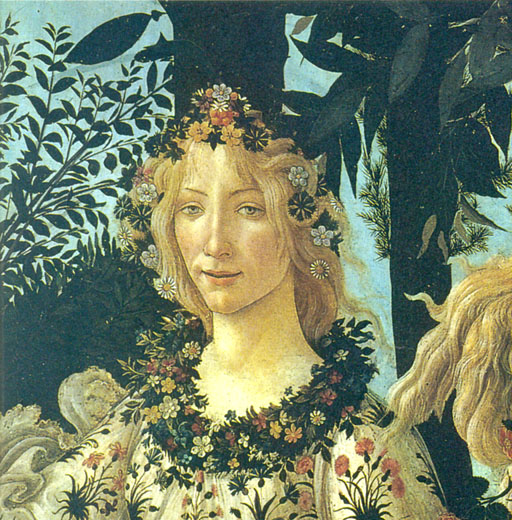
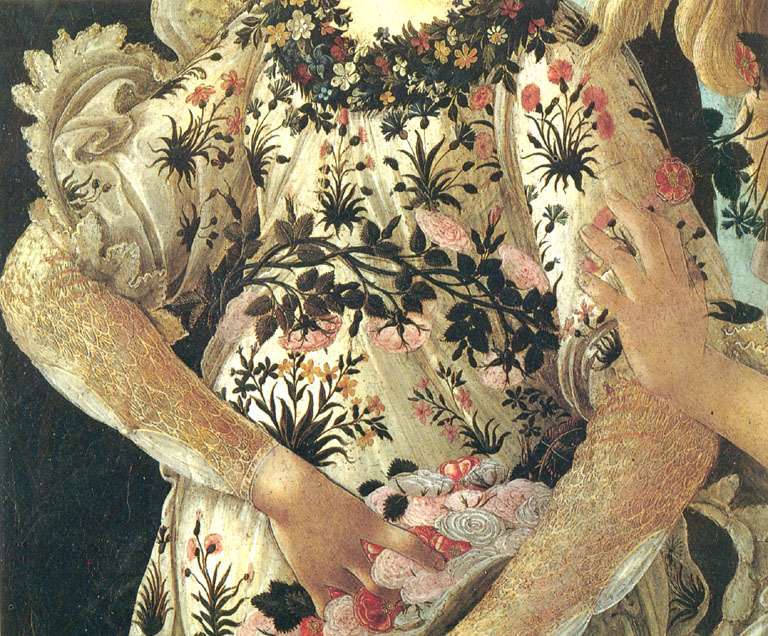
Détails du visage de Flore, le plus célèbre dans la peinture de Botticelli, de la robe de Flore qui est comme une paraphrase de la robe de la Grâce dans la Naissance de Vénus. Tout le mouvement, pour elle aussi, vient de ces fleurs traitées en anamorphose et de ce bouquet de fleurs qu'elle s'apprête à jeter dans le monde. Enfin, Chloris poursuivie par Zéphyr qui a les deux fois les mêmes joues gonflées, une fois il est bleu, c'est le Zéphyr de l'hiver, l'autre fois dans la Naissance de Vénus il était presque jaune, c'était le Zéphyr du printemps.
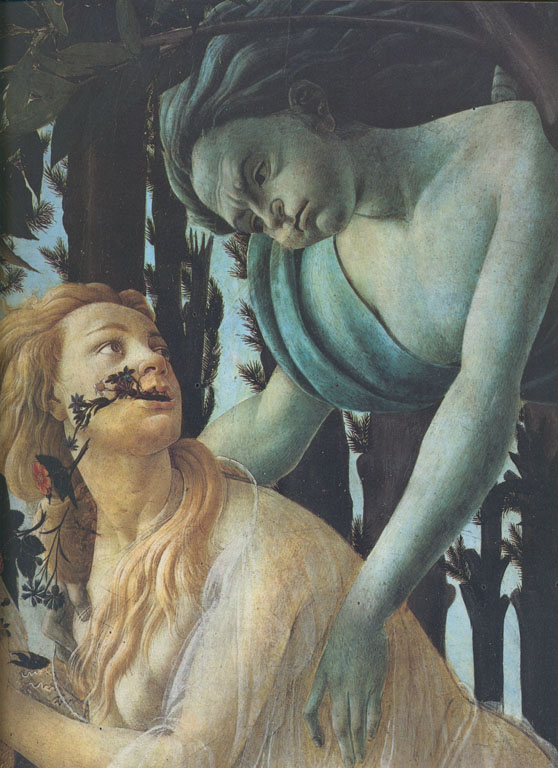
En quittant ces tableaux qui marquent un des sommets de la peinture profane de Botticelli, nous espérons avoir réussi à démontrer combien elle répond à un programme iconographique, combien ce programme est un mythe et combien ce mythe se veut un enseignement qui nous apprend la primauté de l'amour sacré sur l'amour profane. C'est très important de s'en être rendu compte parce qu'il faut déjà remarquer que dans aucun des tableaux chrétiens, Botticelli n'essaie même d'être enseignant. Par contre, dans tous les tableaux païens, depuis Mars et Vénus et surtout avec la Naissance de Vénus et le Printemps, on voit qu'il y a enseignement. Il est assez extraordinaire de constater que Botticelli est plus à l'aise dans ce rôle didactique du mythe avec les dieux "païens" qu'avec sa pérennité de chrétien.
La dernière œuvre païenne que nous verrons ce soir est une série de quatre tableaux superbes racontant une histoire extraordinaire, celle de Nastagio degli Onesti, tirée du Décaméron de Boccace, la neuvième nouvelle de la cinquième journée. Cette histoire est assez intéressante pour être racontée en deux mots. Ce sont quatre épisodes fondamentaux choisis par Botticelli à la demande de Laurent le Magnifique qui en faisait cadeau à son filleul pour son mariage. Et ces quatre tableaux devaient orner le lambris de leur salon d'honneur. Ensuite, ces tableaux se sont dispersés, trois sont à Madrid, le quatrième est dans une collection privée américaine. Trois tableaux sont bien connus et nous allons en voir des images, mais nous n'avons rien pour le quatrième car le collectionneur a toujours refusé de le laisser photographier.
Premier tableau
L'histoire de ce personnage de Onesti est une histoire qui a l'air banale, mais elle est aussi terrifiante qu'une nouvelle de Hoffmann. C'est une nouvelle complètement romantique. Notre de Onesti est un jeune homme bien honnête et il se promène dans la forêt tout marri parce que sa fiancée a refusé de l'épouser. Fou de désespoir, il est allé se perdre dans la forêt où il entend un galop de cheval. Il voit une femme nue paraître devant lui, poursuivie par une meute de chiens, suivie par un chevalier en armure hurlant sauvagement et menaçant de son épée la jeune femme. Détails : de Onesti dans sa méditation au centre, à droite sous le coup de la surprise d'entendre cette chasse incroyable, et surtout la découverte du caractère incroyable de cette chasse. Cette femme complètement tirée vers la gauche parce qu'elle veut échapper à la morsure d'un chien et à l'épée du chevalier. On remarque à quel point c'est beau d'avoir laissé tout le reste du paysage dans une paix totale jusqu'à l'image assez fabuleuse du mouton paissant.
Deuxième tableau
C'est encore pire que ce qu'on pouvait attendre et l'horreur que le jeune homme montre le prouve bien. La femme finit par tomber, mordue par les chiens, touchée par l'épée. Alors le chevalier descend de son cheval, lui fend le dos et lui arrache le coeur qu'il donne à manger à ses chiens. C'est ce à quoi nous assistons : de Onesti est toujours là affolé, la femme dont le dos est fendu, le monsieur avec les mains fouillant son dos et les chiens qui mangent le coeur de la jeune fille. Ce serait simplement un fait divers atroce, mais à peine les chiens ont-ils fini le coeur, la jeune femme se redresse, se remet à courir, les chiens, le cheval se remettent à courir, notre de Onesti se rend compte qu'il assiste à une chasse fantôme qui est une malédiction. Jusqu'à la fin des temps, cette femme devra courir, cet homme devra la tuer, lui fendre le dos, lui arracher le coeur, le donner aux chiens pour repartir et repartir sans cesse. Il apprend tout ceci en rentrant. Pourquoi cette malédiction? Parce que lui l'adorait, elle s'est refusée à lui, ils ont été damnés et pour cette raison-là, il doit la tuer et lui voler le coeur jusqu'à la fin des temps. Botticelli nous montre la chose, on assiste à l'horrible carnage et la chasse est repartie. On voit la femme repartir dans l'autre sens, toujours avec les chiens et le cavalier à ses trousses. Détails: la jeune femme à qui on arrache le coeur, le groupe des chiens mangeant ce coeur et l'admirable figure du cheval à droite, le nouveau départ de la chasse qui part dans l'autre sens. Naturellement cette vision qui hante cette forêt donne à de Onesti une idée géniale : de Onesti invite à un pique-nique la famille de sa fiancée dans cette forêt...
Troisième tableau
Voici le pique-nique, Ugolino est là, ce ne sont que des fantômes mais on assiste de nouveau à l'atroce meurtre de la jeune femme fantôme sous les traits et les coups d'épée de son amant fantôme. On voit l'horreur de tout ce monde affolé. C'est un des plus beaux détails : le dîner qui se renverse et le paysage qui reste d'un calme absolu, chose sublime.
Ces trois tableaux sont parmi les œuvres les moins connues mais les plus belles de Botticelli. Elles sont au Prado à Madrid. Le quatrième tableau manquant représente naturellement la dame disant gentiment : "puisque c'est ainsi je t'épouse" et on assistait au mariage de dona Lucrezia Bini et de notre Ugolino degli Onesti.
Nous avons vu maintenant ces deux mondes de Botticelli, le monde chrétien dans lequel s'affirme un génie de la peinture extraordinaire, mais aussi et surtout ce monde païen dans lequel on ne peut pas dire qu'il y ait un génie du paganisme, mais il y a un génie de philosophe et de "mythagogue" qui est extraordinaire. Nous avons pu voir que c'est dans ce monde même du mythe, de la parabole du mythe qu'est née cette génération de Pic de la Mirandole, de Marsile Ficin et de tous les grands humanistes de son temps, Botticelli a réussi à nous donner la plus grande leçon qui soit.
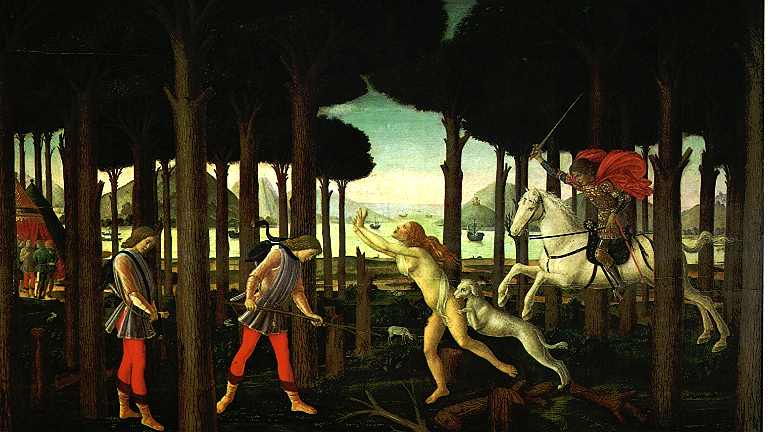
Premier tableau
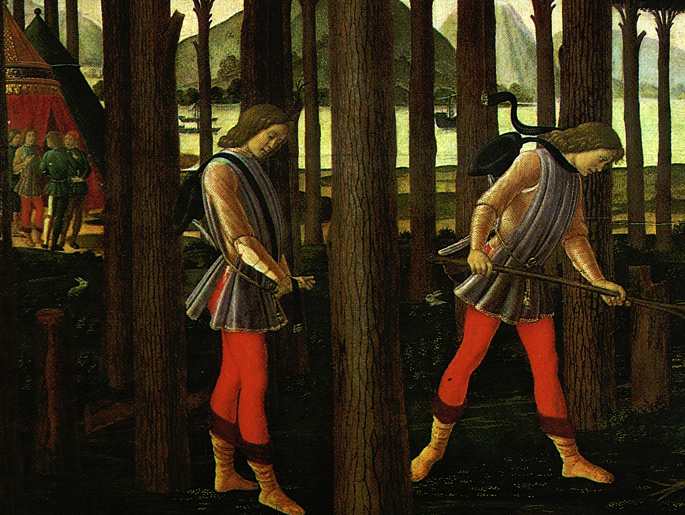
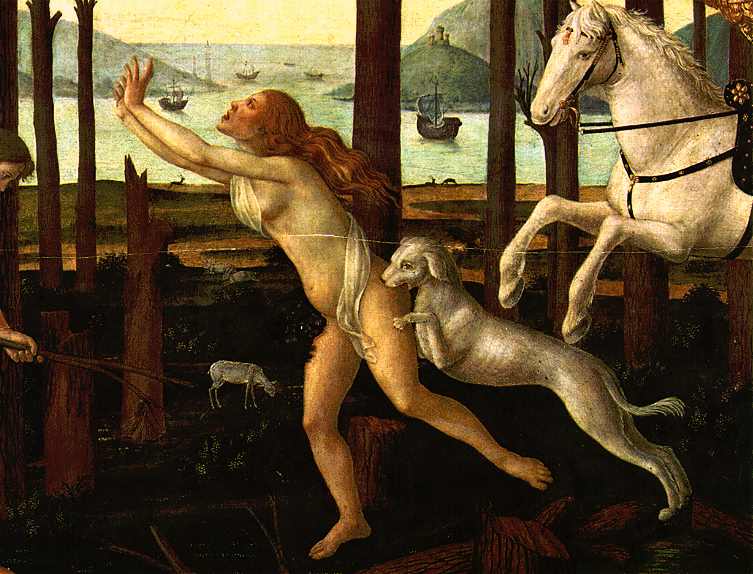
Deuxième tableau
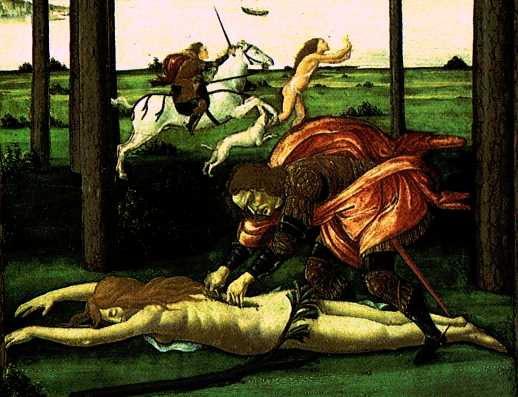
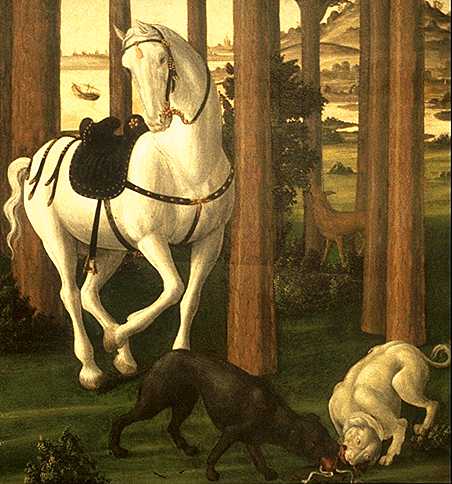
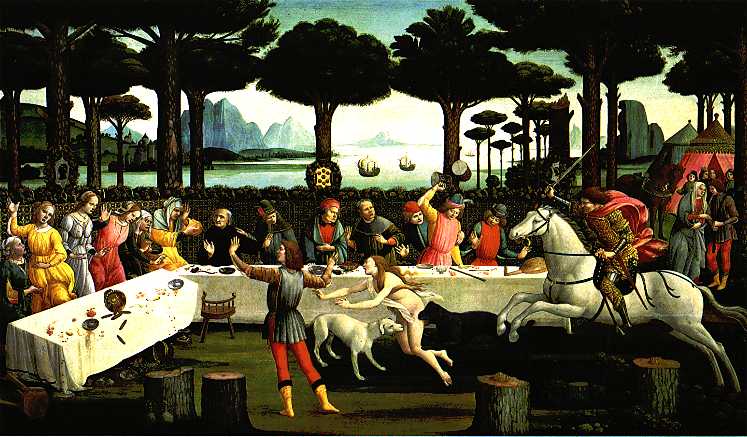
Troisième tableau
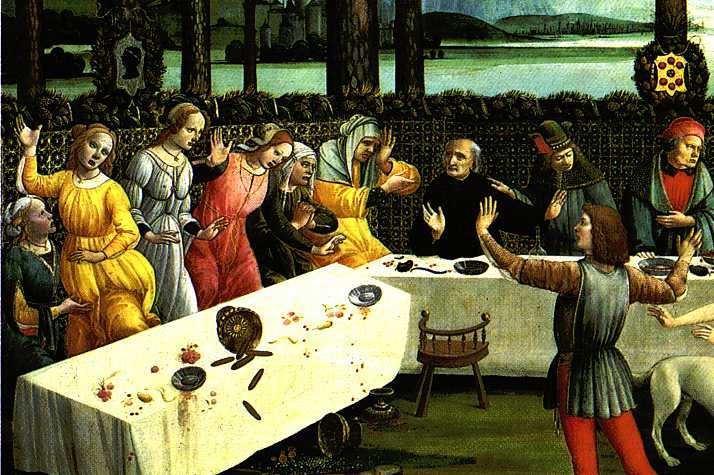 Voici le pique-nique, Ugolino est là, ce ne sont que des fantômes mais on assiste de nouveau à l'atroce meurtre de la jeune femme fantôme sous les traits et les coups d'épée de son amant fantôme. On voit l'horreur de tout ce monde affolé. C'est un des plus beaux détails : le dîner qui se renverse et le paysage qui reste d'un calme absolu, chose sublime.
Ces trois tableaux sont parmi les œuvres les moins connues mais les plus belles de Botticelli. Elles sont au Prado à Madrid. Le quatrième tableau manquant représente naturellement la dame disant gentiment : "puisque c'est ainsi je t'épouse" et on assistait au mariage de dona Lucrezia Bini et de notre Ugolino degli Onesti.
Nous avons vu maintenant ces deux mondes de Botticelli, le monde chrétien dans lequel s'affirme un génie de la peinture extraordinaire, mais aussi et surtout ce monde païen dans lequel on ne peut pas dire qu'il y ait un génie du paganisme, mais il y a un génie de philosophe et de "mythagogue" qui est extraordinaire. Nous avons pu voir que c'est dans ce monde même du mythe, de la parabole du mythe qu'est née cette génération de Pic de la Mirandole, de Marsile Ficin et de tous les grands humanistes de son temps, Botticelli a réussi à nous donner la plus grande leçon qui soit.
De son vivant déjà, Botticelli a été considéré comme l'un des plus grands peintres de tous les temps, et cela parce que les Florentins eux-mêmes l'ont considéré comme l'enfant chéri des dieux. Cela veut donc dire que toute œuvre de Botticelli était attendue et saluée par les Florentins. On parle de ses grandes peintures, le tondo de la Vierge du Magnificat dans la veine sacrée, la Naissance de Vénus ou le Printemps qu'on appelle profanes, on parle de tout cela mais on oublie de parler de ce qui sortait de ses mains pour être immédiatement l'objet d'admiration le plus formidable : les dessins. Il faut savoir, et c'est très important, que Botticelli est le premier artiste dont les dessins ont fait l'admiration des collectionneurs. Au 15e siècle, un dessin était en principe quelque chose qui préparait une peinture, après quoi on le jetait. Botticelli a donné ses lettres de noblesse au dessin parce que, dans le vrai dessin, il y avait quelque chose du miracle qui tombait de ses mains. Nous allons voir quelques dessins pour en admirer la maîtrise.
Etude pour la Nativité mystique
Admirable dessin rehaussé qui n'est ni une étude pour une peinture, ni une étude pour rien du tout, mais une Pomone dessinée à la sanguine avec rehaut de blanc qui a été offerte à Laurent le Magnifique comme une œuvre à part entière.
Pomone
Etude pour l'Adoration des Mages (Médicis)
Etude notamment de ces têtes d'expression, en même temps que l'étude de chevaux extraordinaires de liberté, chevaux qui ont quatre ou six yeux au fur et à mesure qu'en dessinant, Botticelli se corrige lui-même.
Allégorie de l'Abondance
Etude pour le Retable de Saint Barnabé
Un des anges écartant les rideaux. Nous constatons que du premier dessin au deuxième et du deuxième au troisième mais encore mieux du troisième au quatrième, le dessin de Botticelli devient de plus en plus un langage à part entière. On sent très bien que le premier et le deuxième sont peut-être encore des dessins préparatoires, mais qu'à partir du troisième et du quatrième, le dessin devient un art en soi. Une des choses très importantes dans l'apport de Botticelli à son siècle est d'avoir su inventer en quelque sorte la noblesse du dessin en tant qu'expression plastique. Et il fut d'ailleurs l'un des premiers à avoir offert des dessins.
Quelque chose de l'admiration que nous avons aujourd'hui encore au 20e siècle pour le dessin, et quelque chose aussi de la ferveur des collectionneurs de dessins dans l'histoire même de la collection, c'est un peu à Sandro Botticelli qu'on le doit. Il est vrai que quand on est capable d'occuper une feuille avec à la fois autant d'évanescence et autant de sûreté de main, on pouvait être le père du dessin. Et il est très curieux que, sitôt après sa mort, on demandera à des faussaires de continuer à en faire, tellement on veut en avoir.
On peut ajouter à tout ce que nous avons appris sur Botticelli ce petit volet complémentaire qui est celui de l'invention de l'Art du dessin, c'est très important.
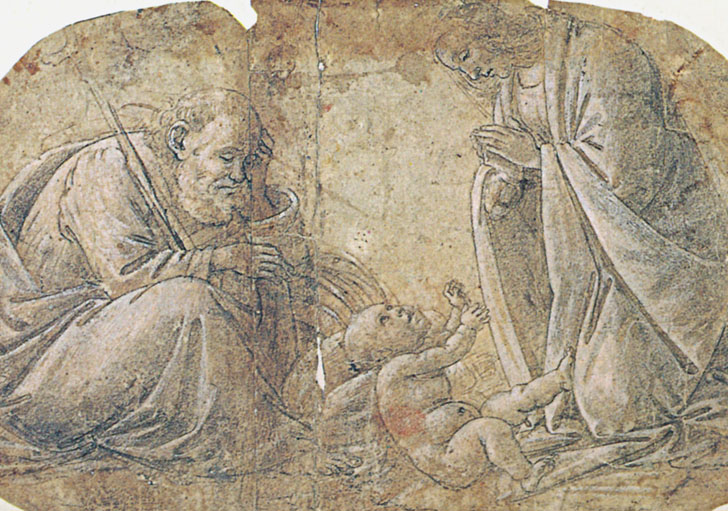
Etude pour la Nativité mystique
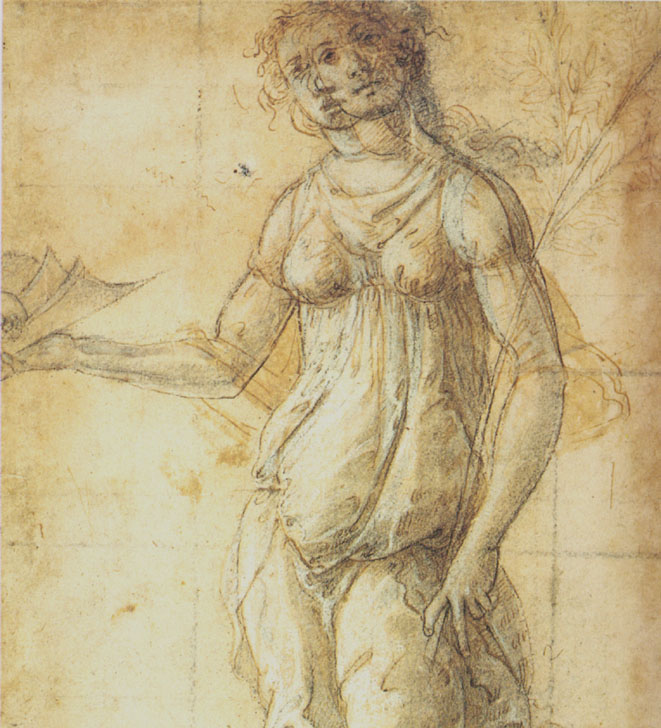
Pomone
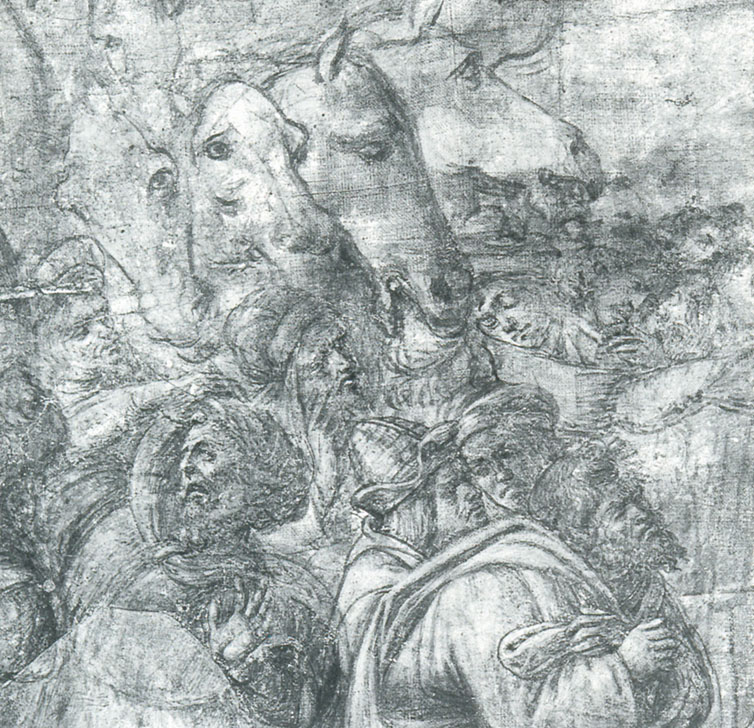
Etude pour l'Adoration des Mages (Médicis)
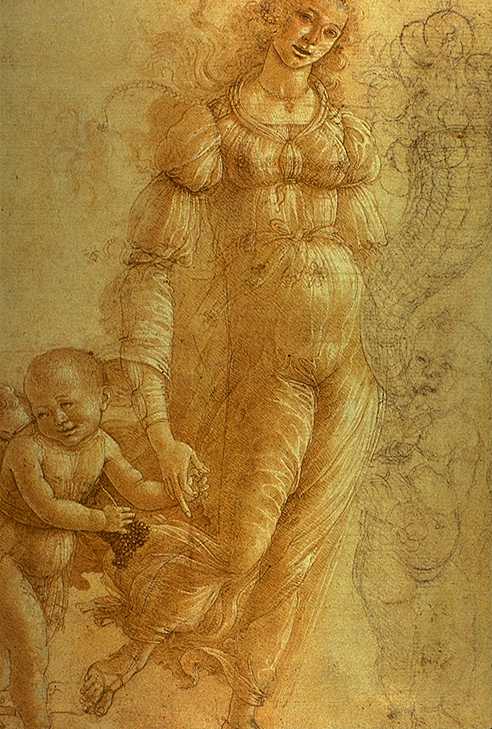
Allégorie de l'Abondance
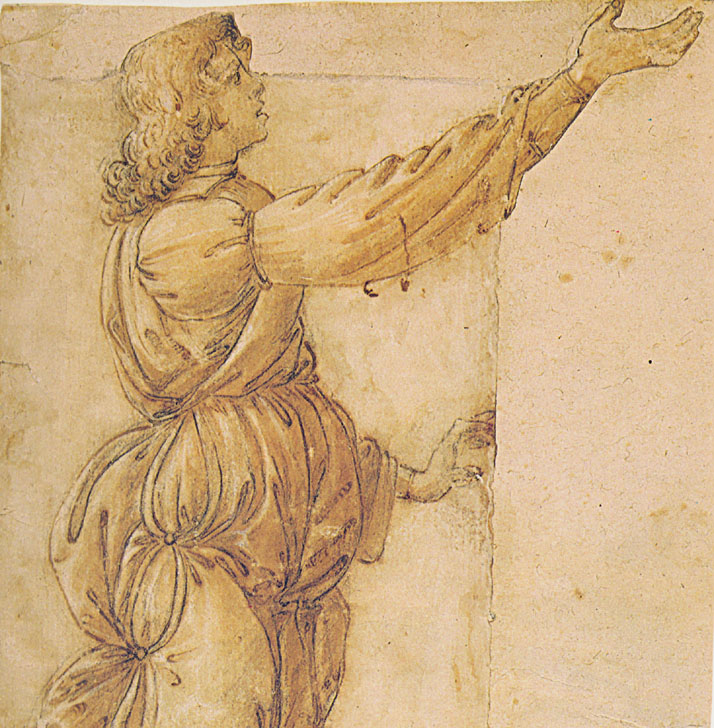
Etude pour le Retable de Saint Barnabé
Quelque chose de l'admiration que nous avons aujourd'hui encore au 20e siècle pour le dessin, et quelque chose aussi de la ferveur des collectionneurs de dessins dans l'histoire même de la collection, c'est un peu à Sandro Botticelli qu'on le doit. Il est vrai que quand on est capable d'occuper une feuille avec à la fois autant d'évanescence et autant de sûreté de main, on pouvait être le père du dessin. Et il est très curieux que, sitôt après sa mort, on demandera à des faussaires de continuer à en faire, tellement on veut en avoir.
On peut ajouter à tout ce que nous avons appris sur Botticelli ce petit volet complémentaire qui est celui de l'invention de l'Art du dessin, c'est très important.
Botticelli a inventé aussi l'idéal : il est un enfant des dieux, il ne peut peindre que ce que les dieux veulent bien lui montrer. Il est un des premiers artistes de la Renaissance italienne qui ne s'est pas contenté de peindre ce qu'il avait sous les yeux, mais de peindre au-delà de ce qu'il avait sous les yeux, ce que Platon et les néo-platoniciens, si importants dans sa formation, appellaient eux-mêmes l'idéal.
Il faut remarquer que les visages, peu à peu, se gomment de ce qu'il y a de trop, des rides, des tares, des cicatrices et petit à petit gagnent ce terrain qu'on appelle l'idéal. Botticelli a adopté immédiatement ce parti pris de peindre l'au-delà de la beauté, le reflet derrière la beauté qui se sent admirablement. Ce privilège qu'a l'artiste de peindre au-delà même de la beauté est un privilège qu'exploiteront surtout les peintres de la grande Renaissance, mais le père de ce besoin de l'artiste d'aller derrière le miroir du quotidien est Botticelli, véritablement.
Le plus incroyable, c'est que lorsqu'on lit les œuvres de celui qui l'a le mieux "connu", c'est-à-dire Vasari dont on sait qu'il a lu les sources directes, nous apprenons ceci : à la fin de sa vie, Botticelli était un homme pauvre, seul, aigri, abandonné et oublié. Naturellement, depuis ce moment-là les historiens d'art se sont jetés sur cette phrase de Vasari pour essayer de la comprendre. On a constaté qu'à la fin de sa vie, Botticelli n'a plus de commande, qu'il ne reçoit plus et ne parle plus, qu'il est très en retrait de toutes choses et on a cherché les raisons.
On a dit que le savonarolisme qui avait été le sien a été une tare pour lui sitôt après la mort de Savonarole. On lui a dit d'abjurer, il a refusé, on l'a donc mis de côté. Première explication qui ne tient pas debout : jamais Botticelli n'a été un savonarolien, il l'a écouté, l'a entendu, il l'a même traduit avec la Nativité mystique, mais il n'a jamais été un savonarolien engagé. Aucun papier de ceux dont on avait à se plaindre en tant que savonarolien ne porte le nom de Botticelli, donc c'est faux.
La deuxième chose retenue, c'est que Sandro Botticelli n'aimait pas beaucoup les dames mais, par contre, assez frénétiquement les jeunes gens. Au début de sa vie, cela allait encore, mais un peu plus tard, les Florentins n'en ont plus voulu à cause de cela. Il faut rappeler qu'il y avait à la même époque un peintre qui était plus frénétique encore, on l'avait surnommé "il sodoma" et cela passait pour un titre de noblesse. Pourquoi Botticelli aurait-il été mis de côté pour cela?. Ce n'est donc pas pour cette raison non plus.
Comme ce sont les deux seules raisons invoquées, nous vous en proposons une troisième, celle de notre conclusion : et si, au fond, Botticelli était arrivé au bout de son cycle? Si ce qu'il avait à dire, ce qu'il avait à montrer, il l'avait dit et montré, ce qu'il avait à peindre, il l'avait peint, ce qu'il avait voulu privilégier comme le dessin, il l'avait privilégié, et si ses dernières années, il se les était données à lui-même pour vivre peut-être plus intensément ce qui, d'après ses contemporains, lui tenait le plus à coeur : le silence. Dans cette Florence désordonnée de la deuxième moitié du 15e siècle à laquelle il était, par métier, associé sans cesse, ce que Botticelli ne supportait pas était le bruit, la passion, ce dont il avait besoin c'était de silence.
C'est pourquoi nous verrons, en conclusion, quelques œuvres dans lesquelles nous avons l'impression que Botticelli s'était comme incarné. Ce sont toujours des images de personnes qui ont trouvé le silence.
Pieta
Quand il est revenu sur le même sujet quelques années plus tard, nous allons retrouver exactement la même chose dans une composition beaucoup plus savante, plus dramatique et c'est sublime. De nouveau, nous avons un étrange Christ qui a fermé les yeux et les oreilles au monde, et cet étrange Christ, une fois de plus, ressemble de façon étourdissante à Botticelli. Il n'a pas voulu faire des autoportraits mais, inconsciemment, il a voulu retrouver dans le Christ le silence auquel lui-même aspirait tellement.
Toujours en mains privées dans une collection de Rome, cette œuvre qui représente on ne sait pas qui tout seul devant une porte. Ce tableau a eu toutes les allusions possibles : on a dit Lucrèce outragée par Tarquin, on a dit Mardochée devant la porte du temple, et on s'en moque. C'est tout simplement l'image de cette quête du silence qui va jusqu'à emplir complètement la rigueur architecturale de cet ensemble.
Saint Augustin
Le tableau dans lequel Botticelli s'est peut-être le plus investi, même si c'est une sorte d'autoportrait idéal, c'est dans l'image de Saint Augustin dont il faut rappeler que, selon les Ecritures, pendant trente ans il n'a pas entendu souffler le vent tellement il était en quête de Dieu. Une des œuvres les plus magistrales de Botticelli est une petite fresque en l'église de Ognissanti, à côté de sa maison natale, où il représente Saint Augustin à l'étude. Son visage est comme l'attente du silence, de cet au-delà du silence. Nous croyons même pouvoir dire qu'au fond, notre Botticelli qui a tout vu naître, les arts et même les sciences, et même la géométrie, et même la pendule, ce Botticelli-là visait à la fin de sa vie à ce silence qu'il s'est simplement offert le luxe de gagner.
Voilà pourquoi devant une œuvre qui, à première vue, pourrait paraître désespérée, Jacques-Edouard Berger ne peut s'empêcher de conclure en nous disant que Botticelli a eu cette chance et ce bonheur d'avoir pu, à un moment de sa vie, s'offrir le luxe du silence que son siècle lui avait ôté et, en tant que tel, il a certainement été un homme heureux.
Il faut remarquer que les visages, peu à peu, se gomment de ce qu'il y a de trop, des rides, des tares, des cicatrices et petit à petit gagnent ce terrain qu'on appelle l'idéal. Botticelli a adopté immédiatement ce parti pris de peindre l'au-delà de la beauté, le reflet derrière la beauté qui se sent admirablement. Ce privilège qu'a l'artiste de peindre au-delà même de la beauté est un privilège qu'exploiteront surtout les peintres de la grande Renaissance, mais le père de ce besoin de l'artiste d'aller derrière le miroir du quotidien est Botticelli, véritablement.
Le plus incroyable, c'est que lorsqu'on lit les œuvres de celui qui l'a le mieux "connu", c'est-à-dire Vasari dont on sait qu'il a lu les sources directes, nous apprenons ceci : à la fin de sa vie, Botticelli était un homme pauvre, seul, aigri, abandonné et oublié. Naturellement, depuis ce moment-là les historiens d'art se sont jetés sur cette phrase de Vasari pour essayer de la comprendre. On a constaté qu'à la fin de sa vie, Botticelli n'a plus de commande, qu'il ne reçoit plus et ne parle plus, qu'il est très en retrait de toutes choses et on a cherché les raisons.
On a dit que le savonarolisme qui avait été le sien a été une tare pour lui sitôt après la mort de Savonarole. On lui a dit d'abjurer, il a refusé, on l'a donc mis de côté. Première explication qui ne tient pas debout : jamais Botticelli n'a été un savonarolien, il l'a écouté, l'a entendu, il l'a même traduit avec la Nativité mystique, mais il n'a jamais été un savonarolien engagé. Aucun papier de ceux dont on avait à se plaindre en tant que savonarolien ne porte le nom de Botticelli, donc c'est faux.
La deuxième chose retenue, c'est que Sandro Botticelli n'aimait pas beaucoup les dames mais, par contre, assez frénétiquement les jeunes gens. Au début de sa vie, cela allait encore, mais un peu plus tard, les Florentins n'en ont plus voulu à cause de cela. Il faut rappeler qu'il y avait à la même époque un peintre qui était plus frénétique encore, on l'avait surnommé "il sodoma" et cela passait pour un titre de noblesse. Pourquoi Botticelli aurait-il été mis de côté pour cela?. Ce n'est donc pas pour cette raison non plus.
Comme ce sont les deux seules raisons invoquées, nous vous en proposons une troisième, celle de notre conclusion : et si, au fond, Botticelli était arrivé au bout de son cycle? Si ce qu'il avait à dire, ce qu'il avait à montrer, il l'avait dit et montré, ce qu'il avait à peindre, il l'avait peint, ce qu'il avait voulu privilégier comme le dessin, il l'avait privilégié, et si ses dernières années, il se les était données à lui-même pour vivre peut-être plus intensément ce qui, d'après ses contemporains, lui tenait le plus à coeur : le silence. Dans cette Florence désordonnée de la deuxième moitié du 15e siècle à laquelle il était, par métier, associé sans cesse, ce que Botticelli ne supportait pas était le bruit, la passion, ce dont il avait besoin c'était de silence.
C'est pourquoi nous verrons, en conclusion, quelques œuvres dans lesquelles nous avons l'impression que Botticelli s'était comme incarné. Ce sont toujours des images de personnes qui ont trouvé le silence.
Pieta
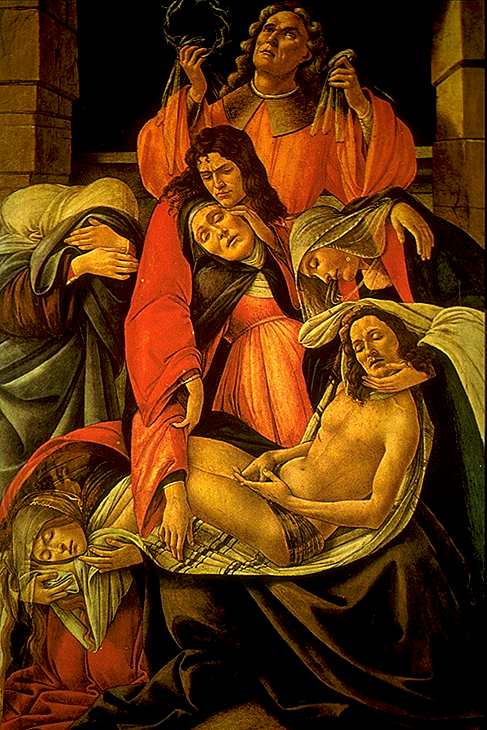
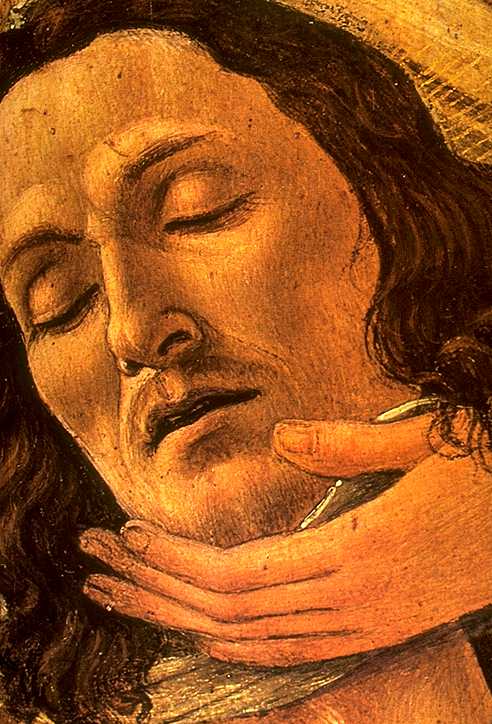
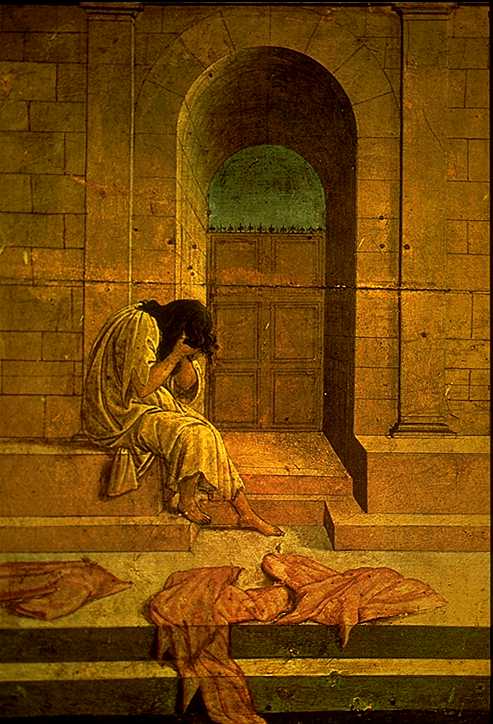

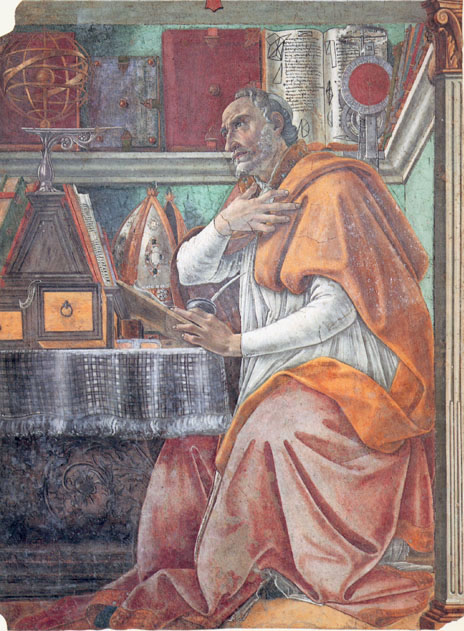

Saint Augustin
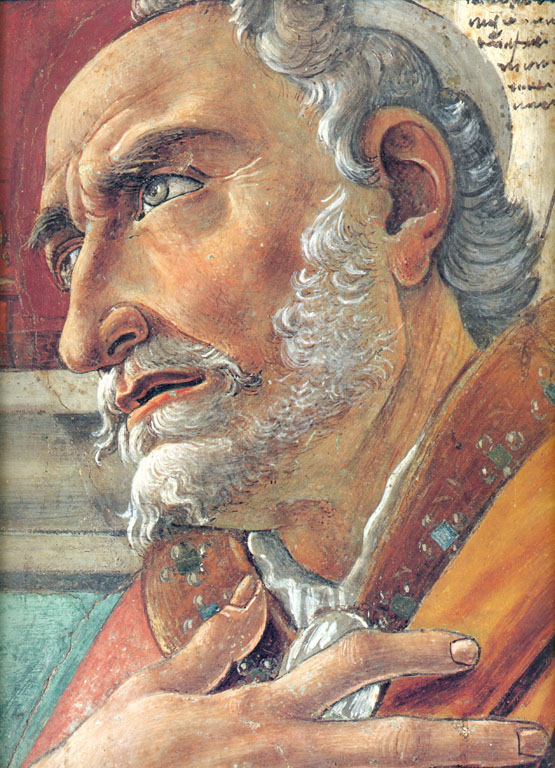
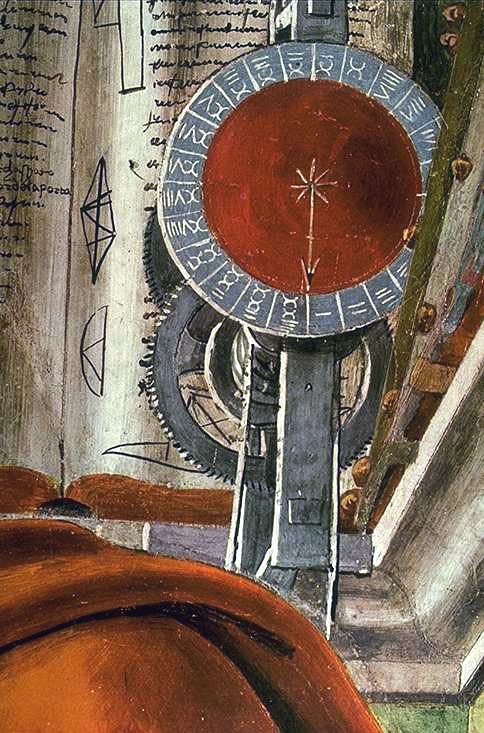
Voilà pourquoi devant une œuvre qui, à première vue, pourrait paraître désespérée, Jacques-Edouard Berger ne peut s'empêcher de conclure en nous disant que Botticelli a eu cette chance et ce bonheur d'avoir pu, à un moment de sa vie, s'offrir le luxe du silence que son siècle lui avait ôté et, en tant que tel, il a certainement été un homme heureux.